

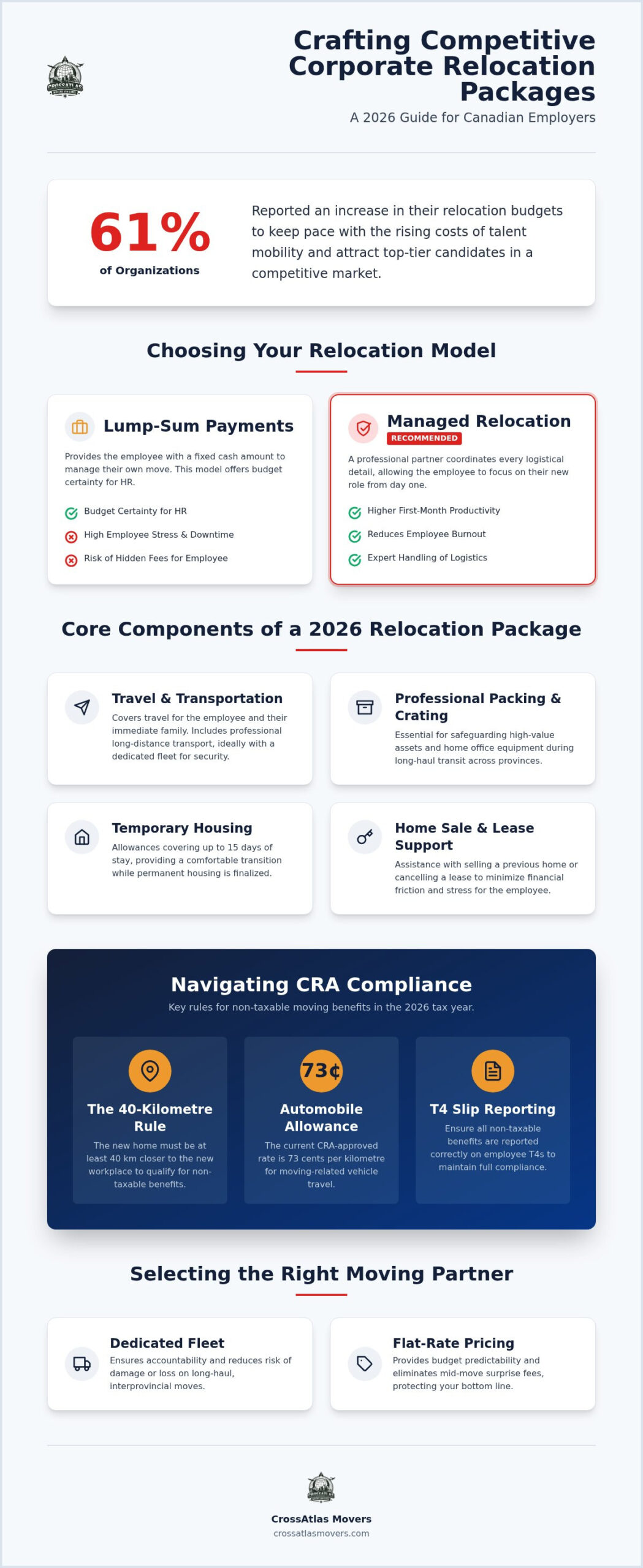
Did you know that 61% of organizations recently reported an increase in their relocation budgets to keep pace with the rising costs of talent mobility? Despite these larger investments, many HR leaders still struggle with the high cost of interprovincial moves and the persistent risk of hidden fees from unreliable providers. You likely understand that a move is more than just a logistical hurdle; it’s a significant life event that can either cement an employee’s loyalty or lead to immediate burnout. Building effective corporate relocation packages Canada requires a delicate balance between providing a warm, supportive experience and maintaining strict adherence to Canada Revenue Agency (CRA) standards.
We’ll help you bridge that gap by showing you how to structure a policy that minimizes employee downtime and maximizes tax efficiency. This guide provides a clear framework for the 2026 tax year, including the essential 40-kilometre rule and the current 73 cents per kilometre automobile allowance. You’ll learn how to move beyond simple lump-sum payments to create a managed transition that protects your talent and your bottom line. We’ll examine the latest CRA meal rates and the strategic benefits of using a dedicated fleet to ensure your next executive move is as seamless as possible.
Key Takeaways
- Learn how to structure competitive corporate relocation packages Canada that align with 2026 market trends to attract and retain top-tier talent.
- Compare the flexibility of lump-sum models against the logistical certainty of managed relocation to determine which approach best supports your organizational goals.
- Identify essential service inclusions, such as professional packing and custom crating, that safeguard high-value assets during long-haul or cross-border transit.
- Ensure full compliance with Canada Revenue Agency standards by mastering the reporting requirements for non-taxable moving benefits on employee T4 slips.
- Gain budget predictability and eliminate mid-move surprises by selecting moving partners that offer flat-rate pricing and dedicated fleets.
Understanding Corporate Relocation Packages in Canada for 2026
A corporate relocation package is a curated suite of benefits designed to support an employee’s move across provincial borders or international lines. You might ask, What is a relocation package? At its core, it is a tool for logistical certainty. In 2026, corporate relocation packages Canada have evolved from simple moving stipends into comprehensive support systems that protect both the hire and the company’s investment. When a move is handled with precision, it removes the heavy burden of life administration from the employee’s shoulders. This allows them to arrive at their new desk ready to contribute on day one.
The Canadian talent market is currently shifting in significant ways. A July 2026 KPMG survey revealed that 42% of manufacturers are considering production moves to the U.S., while 80% aim to keep their headquarters in Canada. This environment creates a high demand for specialized talent who can bridge geographic gaps. When your organization offers robust support, you remove the “geographic barrier” that often prevents a top candidate from accepting a role. It’s about more than just moving boxes; it’s about facilitating a life transition that feels safe and managed.
Organizations typically choose between two primary models. The “lump sum” approach provides the employee with a fixed cash amount to manage their own move. It offers budget certainty for HR but often leads to high employee stress as they navigate unfamiliar logistics alone. Conversely, a “full-service managed” relocation involves a professional partner coordinating every detail. This model typically leads to higher first-month productivity. The employee isn’t spending their first weeks in a new city chasing down moving trucks or worrying about hidden fees because the experts have everything under control.
The Strategic Role of Talent Mobility
Talent mobility is now a key competitive edge. In the Canadian tech and executive sectors, your relocation policy is a direct reflection of your company brand. If a move is chaotic, the employee starts their new role feeling frazzled and undervalued. A methodical, professional approach signals that you value their time and their family’s peace of mind. It builds a foundation of trust that can significantly improve long-term retention rates.
Key Components of a Standard Canadian Package
Most competitive 2026 packages include several core pillars to ensure a seamless transition.
- Travel expenses for the employee and their immediate family to reach the new location safely.
- Professional packing and long-distance transport using a dedicated fleet for added security and accountability.
- Temporary housing allowances, often covering up to 15 days of stay while permanent housing is finalized.
- Home sale assistance or lease cancellation support to minimize the financial friction of leaving the previous residence.
By structuring corporate relocation packages Canada around these pillars, you ensure that the logistical complexities of 2026 don’t interfere with your talent acquisition goals. A well-planned move is the first step in a successful long-term employment relationship.
Standard Inclusions: What Every Package Should Cover
A well-structured corporate relocation package is the difference between a productive new hire and one who is distracted by logistical chaos. While basic travel costs are a given, 2026 standards for corporate relocation packages Canada demand a much higher level of precision. Every package should begin with professional packing and custom crating. This is not a luxury; it’s a necessity for high-value home office equipment and personal assets that must survive a long-haul journey across the provinces. When an employee sees their belongings handled with such care, it reinforces their decision to join your team.
Logistics and Transportation
Relying on brokered moving services can introduce uncertainty into an already stressful transition. We believe a dedicated truck fleet is essential for maintaining accountability throughout the move. When the same team handles the loading in Vancouver and the unloading in Toronto, the risk of damage or lost items drops significantly. This methodical approach is particularly important when navigating interprovincial moves. Each province has its own set of transport regulations, and an expert partner will manage these details silently in the background. For executives with specialized equipment, custom crating ensures that precision instruments or high-value furniture arrive in the same condition they left. This level of protection is a hallmark of premium corporate relocation packages Canada.
Cross-Border and International Specifics
Moving an employee between Canada and the United States introduces a complex layer of customs documentation. You must ensure your policy accounts for the specific requirements of the CBSA and US Customs. Failing to prepare the correct paperwork can lead to lengthy delays at the border, which disrupts the employee’s start date and increases temporary housing costs. This is why partnering with specialized cross border moving companies is vital for maintaining compliance and momentum during a transition.
Beyond the physical move, your package should address the financial protections required by the CRA rules for moving expenses. Comprehensive insurance and valuation protection provide the peace of mind that personal belongings are covered against the unforeseen. Finally, guaranteed delivery dates are a non-negotiable inclusion. Your employee needs to know exactly when their life will be unpacked so they can focus on their new responsibilities. If you are currently reviewing your mobility policy, choosing corporate relocation services that prioritize flat-rate pricing and dedicated support will help you avoid the hidden fees that often plague long-distance moves.
Lump Sum vs. Managed Relocation: Which is Better?
Choosing between a lump sum payment and a managed relocation is a pivotal decision for any HR department. While a lump sum offers immediate budget certainty, it often shifts the entire logistical burden onto the employee. In contrast, managed moves provide a higher success rate by placing the transition in the hands of professionals. For 2026, the “Flat-Rate Managed Move” has emerged as the hybrid winner for corporate relocation packages Canada. It combines the predictable costs of a lump sum with the supportive, hands-on care of a full-service relocation. This approach ensures your talent arrives focused and ready to work rather than exhausted by weeks of DIY planning.
The true cost of employee downtime is often underestimated. When an employee manages their own move, they spend hours researching movers, packing boxes, and navigating delays. This lost productivity can easily outweigh the perceived savings of a cash stipend. By offering competitive relocation packages, you protect your company’s most valuable asset: your employee’s time. A methodical, managed approach allows them to settle into their new role with minimal disruption.
The Hidden Costs of Lump Sum Payments
Lump sum models carry several risks that can quietly erode your corporate relocation packages Canada. Employees, often looking to save a portion of their stipend, might hire low-quality movers who surprise them with hidden fees mid-transit. This creates unnecessary stress and can lead to damage of high-value items. Additionally, the administrative burden of verifying receipts for reimbursement is a drain on HR resources. There are also potential tax pitfalls. If the stipend isn’t structured correctly, the employee may face an unexpected tax bill, turning a supposed benefit into a financial headache.
Efficiency in Managed Moves
Managed moves streamline the entire process through direct billing and centralized communication. Instead of the employee juggling multiple vendors, a professional moving coordinator acts as a single point of contact. This simplifies HR accounting and ensures every detail aligns with company policy. To help your team plan effectively, we recommend reviewing our corporate moving costs Canada guide. It provides a detailed breakdown of how to budget for these transitions without sacrificing quality. When you invest in a managed move, you aren’t just buying a service; you’re buying peace of mind for your team and your new hire.
CRA Compliance and Tax Implications for Moving Expenses
Managing the tax implications of corporate relocation packages Canada requires a methodical approach to ensure both the company and the employee remain in good standing with the Canada Revenue Agency (CRA). While providing a generous move is a sign of a supportive employer, failing to categorize these benefits correctly on a T4 slip can lead to unexpected tax liabilities. In 2026, the CRA continues to distinguish clearly between non-taxable reimbursements and taxable allowances. For a move to be considered eligible for tax purposes, it must meet the distance requirements set out by the federal government.
To qualify for moving expense deductions in 2026, the employee’s new home must be at least 40 kilometres closer to their new place of work or school than their previous residence was by the shortest public route. This “40-kilometre rule” is the primary threshold for eligibility. Once this is met, the employer must maintain rigorous documentation. You should keep all contracts, invoices, and receipts on file for at least six years. This includes the T1-M Moving Expenses Deduction form, which is essential for employees claiming expenses that were not fully reimbursed by the company.
Deductible Moving Expenses for Employees
The CRA allows for several core expenses to be treated as non-taxable when they are directly related to the relocation. These include the transportation and storage of household effects, such as professional packing and custom crating for high-value items. Travel expenses are also deductible. For 2026, the simplified meal rate is $23 per meal, up to a maximum of $69 per day per person. When driving, the reasonable automobile allowance rate is 73 cents per kilometre for the first 5,000 kilometres. Additionally, costs associated with cancelling a lease or the legal fees and real estate commissions from selling a former home are generally deductible, provided they are reasonable and documented.
CRA Administrative Policies for 2026
Understanding the difference between an allowance and a reimbursement is critical for HR professionals. A reimbursement for a specific moving expense, backed by a receipt, is usually not a taxable benefit. However, a round-sum allowance where the employee does not provide receipts is typically taxable and must be reported in Box 40 of the T4 slip. Housing loss reimbursements also have specific rules; the first $15,000 of a reimbursement for a loss on a home sale is generally non-taxable, while only half of the amount exceeding $15,000 is considered a taxable benefit. To ensure your policy stays compliant while remaining competitive, consider partnering with corporate relocation services that prioritize transparent, flat-rate billing to simplify your year-end tax reporting.
Choosing the Right Corporate Moving Partner
Selecting a partner is the final and most critical step in building competitive corporate relocation packages Canada. You need more than just a vendor; you need a methodical expert who takes ownership of the entire logistical process. We believe that a dedicated truck fleet is the best way to ensure this accountability. When a company owns its equipment and employs its own drivers, the risk of miscommunication or delays caused by third-party brokers disappears. This level of precision is essential for executive moves where timing is non-negotiable.
In 2026, budget predictability has become a top priority for HR departments across the country. We recommend demanding flat-rate pricing for all long-distance moves to avoid the mid-move budget escalations that often plague weight-based estimates. By securing a fixed price at the outset, you protect your organization from hidden fees and provide your employees with a sense of security. This transparency allows your team to focus on the transition rather than worrying about fluctuating costs. It’s a professional approach that builds trust from day one.
Specialized experience in long distance moving across Canada is essential for navigating the unique geography and seasonal challenges of our provinces. You should also verify that your partner holds the necessary credentials for international and cross-border transfers. Navigating customs between Canada and the USA requires a deep understanding of evolving regulations to prevent border delays. A partner with global mobility expertise will manage these complexities silently, ensuring a seamless experience for your international hires.
Why a Family-Owned Approach Matters for Business
Accountability is the cornerstone of a family-owned business model. Unlike “faceless corporate” entities, a family-run operation offers direct accountability and a personal level of service for your employees. We understand that we are moving a person’s life, not just their property. The CrossAtlas commitment to transparency and punctuality ensures that your team feels supported during what is often a high-stress event. This personal touch reflects positively on your company brand and helps cement employee loyalty.
Finalizing Your 2026 Relocation Policy
Your relocation strategy should be a living document that evolves with the market. We suggest reviewing your corporate relocation packages Canada annually to ensure they align with current Canadian market trends and the latest CRA allowance rates. Setting clear expectations with your moving partner from the start prevents confusion and ensures a seamless transition for every hire. When you combine a well-structured internal policy with a capable logistical partner, you create a powerful tool for talent retention. Ready to upgrade your mobility strategy? Request a professional corporate relocation quote from CrossAtlas Movers to begin structuring your 2026 employee moves with confidence.
Build a Future-Ready Relocation Strategy
Structuring competitive corporate relocation packages Canada in 2026 is about more than just moving boxes from point A to point B. It’s a strategic investment in your talent. By prioritizing managed moves over simple lump-sum payments, you significantly reduce employee stress and ensure they arrive ready to contribute. Staying compliant with the CRA’s latest mileage rates and the 40-kilometre rule protects your organization from tax liabilities, while flat-rate pricing offers the budget predictability your HR department needs.
Success depends on a partner who values precision as much as you do. We provide a dedicated truck fleet for total control over every shipment and offer guaranteed delivery dates to maintain your business continuity. For high-value corporate assets, our specialized custom crating ensures everything arrives in perfect condition. You don’t have to navigate these complexities alone when you have a methodical expert by your side.
Simplify your employee moves with a flat-rate corporate relocation quote from CrossAtlas Movers.
We look forward to helping your team transition smoothly into their next chapter with the care and integrity your business deserves.
Frequently Asked Questions
What is typically included in a corporate relocation package in Canada?
A standard package usually covers professional packing, the long-distance transport of household goods, and travel expenses for the employee and their family. Many 2026 corporate relocation packages Canada also include temporary housing allowances for up to 15 days and custom crating for high-value home office equipment to ensure a seamless transition.
Are relocation packages taxable benefits for employees in Canada?
Most reimbursements for specific moving expenses backed by receipts are not considered taxable benefits by the CRA. However, round-sum allowances where no receipts are provided are typically taxable and must be reported on the employee’s T4 slip. It’s vital to distinguish between these to ensure tax compliance for both the company and the hire.
How much does it cost to relocate an employee interprovincially?
The total cost of an interprovincial move depends on the volume of household goods, the distance between provinces, and the specific services selected, such as professional packing. Organizations often prefer a flat-rate managed model because it provides budget predictability and eliminates the risk of hidden fees that often arise with weight-based estimates.
Can an employer pay for an employee’s house-hunting trip tax-free?
No, the CRA generally views house-hunting trips as a taxable benefit for the employee. While these trips are a valuable part of a competitive policy, the employer must report the cost as income. This differs from direct moving expenses, like transporting furniture, which are usually non-taxable when properly documented.
What is a lump sum relocation allowance?
A lump sum is a single, fixed payment given to an employee to manage their own relocation logistics. While this simplifies accounting for HR, it often increases employee stress as they must find their own movers and handle the packing. This can lead to significant downtime and potential productivity loss during the first month of employment.
How do I choose between different corporate relocation companies?
You should prioritize partners that operate a dedicated truck fleet rather than those that broker services to third parties. This ensures direct accountability and better protection for your assets. Always demand flat-rate pricing and verify the company’s experience with cross-border and interprovincial regulations to avoid mid-move delays at the border or provincial scales.
What happens if an employee leaves the company shortly after a relocation?
Most corporate relocation packages Canada include a repayment agreement, often called a clawback clause. This legal provision requires the employee to repay a prorated portion of the moving costs if they resign within a specific timeframe, typically 12 to 24 months. This helps protect the organization’s significant financial investment in the move.
Does the CRA allow for the deduction of professional packing services?
Yes, the CRA considers professional packing and the cost of packing materials to be part of the deductible expenses for transporting household effects. When these services are part of a managed move, they are generally non-taxable to the employee, provided the move meets the 40-kilometre eligibility rule and all receipts are kept on file.