
In a year where truckload costs have surged by nearly 17 percent, the lowest moving quote you receive is often your biggest financial risk. When you’re planning a relocation in 2026, the difference between a seamless transition and a logistical nightmare usually comes down to who actually owns the trucks. You likely feel the weight of this decision; the anxiety over hidden delivery fees or the safety of your high-value items during a multi-day haul is completely valid. Understanding how to choose a long distance mover requires looking past the glossy websites to find a partner that offers real accountability and professional care. Furthermore, if your move involves high-value physical assets, you can discover Tax Partners and their expertise regarding the tax implications of holding gold and precious metals.
We’ve designed this comprehensive checklist to give you total confidence in your upcoming move across Canada or the border. You’ll learn how to distinguish asset-based carriers from brokers, navigate the latest CUSMA documentation requirements, and secure a fixed-rate quote that protects your budget. By following this framework, you can replace the confusion of shifting prices with the peace of mind that comes from a guaranteed delivery date. This guide will help you organize every detail of your journey so you can focus on the excitement of your new home. For those relocating to British Columbia, you can check out Steve Kooner & Associates to find the perfect residential or commercial property in the Fraser Valley.
Key Takeaways
- Learn how to verify essential credentials and Canadian Association of Movers (CAM) memberships to ensure your provider is a legitimate, registered entity.
- Discover the critical differences between flat-rate and weight-based quotes to understand how to choose a long distance mover that offers transparent pricing without hidden fees.
- Identify why asset-based companies with dedicated fleets provide superior security and more reliable delivery dates than brokers or third-party logistics providers.
- Gain clarity on navigating cross-border documentation and CUSMA regulations to ensure a smooth transition between Canada and the United States.
- Recognize industry red flags, such as large upfront deposits, and learn to prioritize trust signals like family-owned accountability and professional packing expertise.
The Initial Vetting Checklist: Essential Credentials for Canadian Movers
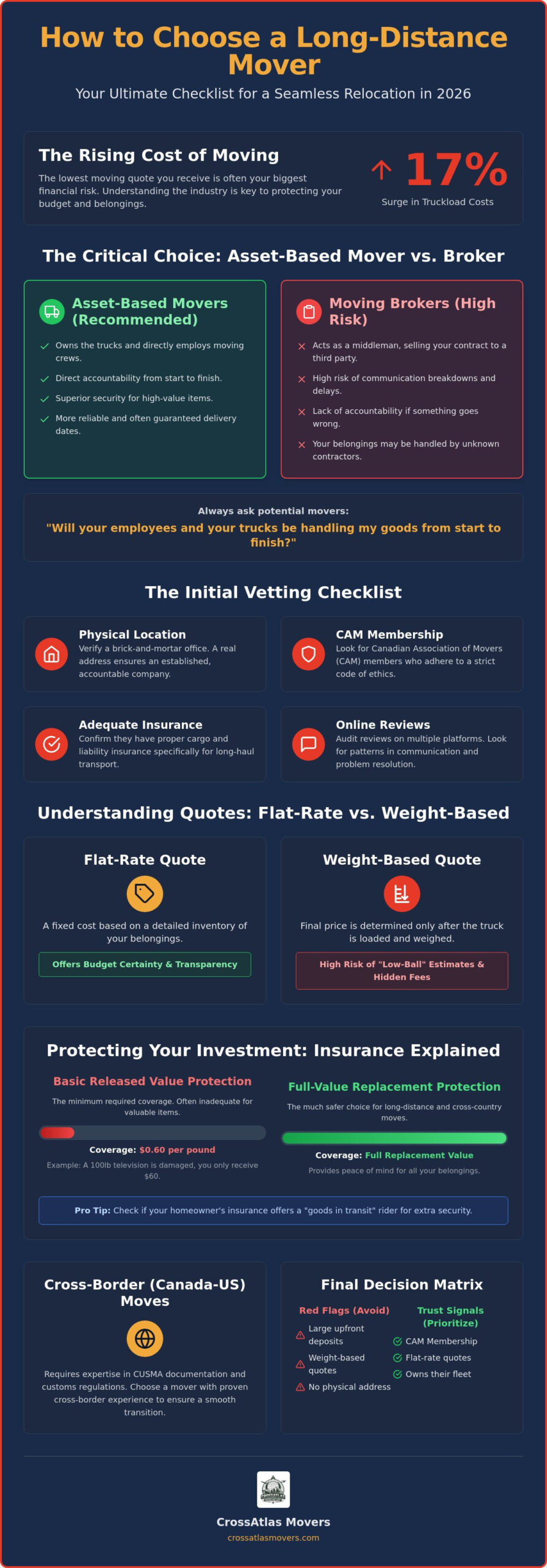
Securing a successful move begins with verifying that your service provider is a legitimate, accountable entity. When you are researching how to choose a long distance mover, your first step should be to confirm their physical office location and federal business registration. A brick-and-mortar presence ensures you are dealing with an established company rather than a digital storefront that might disappear overnight. You should also verify their registration with the Canadian Association of Movers (CAM). This membership is a hallmark of reliability, as CAM members must adhere to a strict code of ethics and maintain professional standards that protect consumers from common industry scams.
Beyond registration, you must confirm that the company possesses adequate cargo and liability insurance specifically for long-haul transport. This is not the same as the insurance required for local deliveries. To get a better sense of professional standards, consulting a moving industry overview can help you understand the baseline requirements for legitimate carriers. Finally, audit online reviews across multiple platforms. Look past the star ratings and focus on patterns. If a company consistently receives praise for their communication during delays, it’s a strong indicator of their commitment to personal accountability.
The Asset-Based Advantage: Movers vs. Brokers
Understanding the difference between a moving broker and an asset-based carrier is vital for your peace of mind. A broker acts as a middleman, selling your contract to another company, which often leads to communication breakdowns and a lack of accountability. An asset-based carrier owns the trucks and employs the crews directly. This direct relationship reduces the risk of lost items and ensures that the team handling your belongings is trained to the company’s specific safety standards. Knowing how to choose a long distance mover involves identifying who actually has their hands on your furniture. Always ask a potential mover directly: “Will your employees and your trucks be handling my goods from start to finish?” If the answer is vague, it’s a signal to look elsewhere.
For readers planning a relocation that involves the Southern United States, Clear Lake Movers, Inc. provides an excellent example of an asset-based carrier that maintains direct control over its fleet and personnel to ensure service quality.
Similarly, if your relocation requires moving a vehicle, AutoPlex Transport Company provides specialized automobile delivery services to ensure your transport needs are handled with the same level of professional care and accountability.
Insurance and Liability: Protecting Your Investment
Long-distance hauls involve more handling and longer transit times, which increases the need for robust coverage. You must distinguish between basic released value protection and full-value replacement protection. In Canada, basic protection often covers only $0.60 per pound. This means if a 100-pound television is damaged, you might only receive $60 in compensation. For a cross-country move, full-value protection is a choice that offers more security. It’s also wise to check your own homeowners insurance policy, or consult with a professional agency like AMCO.NET LLC to understand broader liability protections. Many providers offer “goods in transit” riders that can provide an extra layer of security for your high-value belongings during the relocation process.
Understanding Moving Estimates: Flat-Rate vs. Weight-Based Quotes
The way a company calculates your final bill reveals much about their integrity. When you’re researching how to choose a long distance mover, you’ll likely encounter two primary pricing models: weight-based and flat-rate. Weight-based estimates are common, but they carry an inherent risk. The final price is determined at a scale only after your belongings are loaded and the truck is in transit. This creates a window for “low-ball” estimates, where a mover provides an intentionally low initial figure to win your business, only to present a significantly higher bill on delivery day because the load was “heavier than expected.”
Flat-rate pricing offers a more stable alternative. By providing a fixed cost based on a detailed inventory, this model ensures budget certainty from the start. A professional mover should be willing to stand by their quote, provided the inventory remains the same. This transparency is often the best indicator of a reliable provider. You should also be aware of your consumer rights for interstate moves, particularly if your relocation involves crossing the border, as knowing the regulations helps you avoid fraudulent pricing schemes. If you are moving between provinces, following a thorough moving to another province checklist for Canada can help you anticipate administrative requirements and avoid surprise surcharges before you even begin packing.
Avoiding Hidden Fees and Surcharges
A quote that seems too good to be true often hides a list of additional surcharges that appear only in the fine print. Common hidden costs include fuel surcharges, which can fluctuate wildly, stair fees for homes without elevators, and long-carry charges if the truck cannot park near your door. In some cases, a shuttle fee is applied if a smaller vehicle is needed to reach a restricted area. To protect yourself, ensure your contract explicitly states there will be no hidden fees. If you’re looking for a partner who values transparency, you can request a flat-rate estimate to see the difference for yourself.
The Inventory Audit: How to Get an Accurate Quote
An accurate quote is impossible without a thorough inventory audit. A professional mover will require a virtual or in-person walk-through to document every item, from the heavy wardrobes to the contents of your garage. Rough estimates given over the phone are a major red flag; they lack the precision required for a multi-day haul. For those planning a specific long-haul route, our Vancouver to Toronto Moving Guide provides a deeper look at the logistical requirements of such a journey. Taking the time for a proper audit prevents surprises and ensures the crew arrives with the correct equipment for your specific needs.
Evaluating Logistics: Fleet Quality and Guaranteed Delivery
When you consider how to choose a long distance mover, the quality of the equipment is just as vital as the reputation of the company. A dedicated truck fleet is always superior to a business model that relies on third-party logistics or consolidated loads. When a company owns its trucks, they maintain direct control over maintenance standards and safety records. This ownership, a standard upheld by professional teams like Anspach Removals & Storage, ensures that the vehicle carrying your life’s belongings is mechanically sound and properly equipped for thousands of kilometres. There’s also a significant psychological benefit to knowing exactly who is driving your shipment; it fosters a level of personal accountability that third-party contractors simply can’t match.
Professional labour plays a critical role in long-haul success. Securing items for a cross-country journey requires specialized techniques that differ from short, local trips. For instance, air-ride suspension and high-tensile strapping are essential to prevent shifting during elevation changes or sudden stops. If you’re following a broader guide to hiring movers, you’ll find that verifying these logistical details is a key step in mitigating risk. A methodical expert will be happy to explain their loading procedures and how they protect fragile items during a multi-day transit. Not every relocation involves a full household; if you only need to ship a few items, understanding your options for moving small loads across Canada through consolidated truck space can deliver significant savings without sacrificing professional care.
The Importance of a Guaranteed Delivery Date
Many carriers use the “delivery window” trap, giving you a broad span of several days or even weeks for your arrival. This lack of precision causes immense stress, as it’s impossible to coordinate utility setups or work schedules. A firm, guaranteed delivery date is a hallmark of a professional operation. It allows you to plan your new life with certainty. If a company fails to meet this commitment, you should have a clear path for accountability outlined in your contract. Punctuality is a core value for any dependable partner.
In-Transit Security and Communication
Effective communication is the foundation of a stress-free relocation. You should expect regular updates while your goods are on the road. A single point of contact, such as a dedicated relocation coordinator, is far more efficient than calling a generic customer service line. This coordinator manages the logistics and keeps you informed of the driver’s progress. Professional movers also use strict organizational systems to prevent mix-ups in trailers that contain goods from multiple clients. They use heavy-duty dividers and detailed inventory tags to ensure every box arrives at the correct destination. This level of logistical precision is a hallmark of experienced firms like Carryall Transport, which specializes in managing complex residential and commercial moves with transparency.
Specialized Considerations: Cross-Border and Packing Services
Moving across the border adds layers of complexity that a standard domestic relocation simply doesn’t face. When you’re determining how to choose a long distance mover for an international journey, you must prioritize a partner with a proven track record in cross-border logistics. For those moving beyond North America, firms like Asiatic International Relocation provide the specialized international expertise required for global moves. The 2026 regulatory environment requires precise documentation to avoid costly delays at the border. Professional movers act as your methodical expert, ensuring that every piece of paperwork, from inventory lists to customs forms, is prepared with precision. This level of care transforms a potentially overwhelming process into a manageable transition.
If your relocation involves shipping specific items or smaller shipments globally, Parcel International offers a dedicated platform for delivery to over 220 countries and territories, providing the logistical support needed for a truly international transition.
For those requiring comprehensive freight forwarding and global logistics expertise, active forwarding Uluslararası Taşımacılık Ltd. Şti. provides the specialized infrastructure needed to manage complex international shipments with professional care.
Navigating Canada-US Customs
A successful move to the United States or Canada hinges on proper documentation, such as Form 3299 for personal effects. Professional movers often coordinate directly with customs brokers to streamline the clearance process. For specialized logistics consulting and brokerage support, resources like customsandtradelogistics.com offer the expertise needed to avoid unpredictable border wait times or inspections due to clerical errors. You should also clarify if the service is truly “door-to-door,” meaning the mover handles the entire journey, rather than “door-to-port,” which leaves you responsible for the final leg of the delivery.
If your cross-border relocation takes you to Florida or the surrounding regions, Vision Movers offers the full-service moving expertise needed to navigate the final leg of your journey with ease and accountability.
Professional Packing vs. DIY for Long Distance
While packing your own boxes might seem like a way to save money, it often creates significant risks for long-haul relocations. Long-distance transit exposes your belongings to constant vibrations and significant temperature changes as the truck moves through different climates. Professional packing teams use high-quality materials, such as double-walled boxes and acid-free paper, which offer far more protection than standard retail supplies. If you have high-value items like artwork, pianos, or antiques, custom crating is a necessity to ensure they remain secure throughout the trip. This is particularly true for those moving custom stone pieces; for example, premium slabs from Infinity Stone Inc. represent a significant investment that demands the highest level of professional packing and logistical care.
Choosing professional packing also has a direct impact on your insurance coverage. Most carriers apply a “Packed by Owner” (PBO) limitation, which means they aren’t liable for damage to items inside boxes you packed yourself. By opting for professional labour, you unlock better coverage and gain the peace of mind that your investment is protected. If you’re planning a move across the border, you can explore our cross-border moving services to ensure your transition is handled with the highest level of expertise.
Final Decision Matrix: Red Flags and Trust Signals
Identifying how to choose a long distance mover involves more than just comparing bottom-line figures; it requires an eye for the subtle signals that define a company’s character. As you finalize your decision, you must remain vigilant against common industry red flags. A primary warning sign is a mover who requires a large cash deposit upfront before any work is performed. Legitimate, established carriers, such as Southern Elite Van Lines, have the financial stability to operate without holding your funds hostage. Similarly, be wary of companies that arrive in generic or unmarked trucks. This often suggests a “fly-by-night” operation or that your move has been sub-contracted to an unvetted third party, which breaks the chain of personal accountability.
Accountability is particularly crucial when the move involves vulnerable family members. For those relocating seniors to the East Coast, Earth Angels Home Care provides the personalized in-home support needed to ensure a safe and supportive transition into their new Nova Scotia home.
On the other hand, certain trust signals indicate a partner you can rely on. A family-owned business with a clear history of community presence often provides a level of dedication that larger, impersonal corporations lack. You should look for transparent, detailed contracts that clearly reflect the full service moving experience you were promised. These documents should be exhaustive, leaving no room for ambiguity regarding service levels or final costs. When a company takes pride in its ownership and its fleet, it is a strong indicator that they will take equal pride in protecting your belongings.
The “Gut Feeling” Test: Professionalism in Communication
The way a company handles your initial inquiry is a reliable predictor of their on-road performance. Evaluate the professionalism of the office staff and the quoting agent during your interactions. Prompt, clear, and respectful communication suggests a methodical organization that values your time. If an agent is evasive or pressures you into a “quick sale” without answering your technical questions, they are likely more interested in the contract than the care of your goods. A dependable partner prioritizes transparency and ensures you feel fully informed at every stage of the process.
Making the Move: Your Final Checklist
Before you sign a contract and commit to a cross-country transition, confirm these five non-negotiable items to ensure your peace of mind:
- Price: Is the quote a flat-rate with a written “no hidden fees” guarantee?
- Assets: Has the company confirmed they own the trucks and employ the crew?
- Insurance: Do you have written proof of cargo and liability coverage for the full transit duration?
- Timing: Is your delivery date firm and guaranteed in the contract?
- Reputation: Have you verified their standing with industry bodies and audited their recent performance reviews?
Prioritizing reliability and safety is the only way to ensure a stress-free relocation. If you are ready to secure a partner who values integrity and precision, you can request a flat-rate quote today to lock in your moving date and begin your journey with confidence.
Secure Your Smooth Transition Today
A long-haul relocation is a significant life event that requires more than just a truck; it demands a partner with the expertise to protect your investment. By prioritizing asset-based carriers and insisting on transparent, flat-rate pricing, you eliminate the risks of hidden fees and sub-contracted labour. This methodical approach ensures that your belongings are handled by a dedicated team from start to finish. Learning how to choose a long distance mover is ultimately about finding a provider who offers personal accountability and a steady, organized plan for your journey. For those navigating the administrative complexity of an interprovincial relocation, our detailed moving to another province in Canada checklist walks you through every critical step, from updating your health coverage to securing a flat-rate quote well in advance. If your shipment is smaller in scale, our dedicated guide to moving small loads across Canada outlines how consolidated freight solutions can deliver professional-grade service at a fraction of the cost of a full-truck booking.
Once your journey is complete and you are settling into your new home, ensuring the property is in peak condition becomes a priority. For those relocating to the Vancouver, WA area, Advanced Roofing provides expert guidance on home maintenance; you can read more about their roof replacement services and how to protect your new investment.
CrossAtlas Movers provides the security of a family-owned operation with a dedicated fleet of company-owned trucks. We specialize in fixed-rate contracts and cross-border logistics, ensuring your delivery date is guaranteed and your budget is protected. You deserve a transition that is as predictable as it is efficient. Get your guaranteed flat-rate quote from CrossAtlas Movers today and take the first step toward your new home with total confidence. We are ready to help you move forward with ease.
Frequently Asked Questions
How far in advance should I book my long-distance mover in Canada?
You should aim to book your long-distance mover at least 6 to 8 weeks in advance, especially if you are moving during the peak season between May and August. Top-rated members of the Canadian Association of Movers (CAM) often reach capacity quickly during these busy months. Securing your date early ensures you have access to a dedicated fleet and helps you lock in a guaranteed delivery date for your relocation.
What is the difference between a binding and a non-binding moving estimate?
A binding estimate is a written agreement that guarantees the total cost of the move based on the items listed, while a non-binding estimate is a projection that can increase on delivery day. When researching how to choose a long distance mover, prioritizing companies that offer binding or flat-rate quotes is the best way to avoid unexpected price hikes. This provides the budget certainty necessary for a stress-free transition across provinces.
Do long-distance movers charge by the hour or by the weight?
Long-distance movers typically charge based on the total weight of the shipment or a flat-rate fee, rather than an hourly rate. Hourly billing is the standard for local moves where travel time is minimal. For long-haul relocations, the price is determined by the distance travelled and the volume or weight of your belongings, which is verified at a certified scale after the truck is loaded.
Can I move my plants or pets with a long-distance moving company?
Most professional moving companies do not transport pets or certain houseplants due to safety regulations and the duration of the trip. Transport Canada prohibits the movement of hazardous materials, and many carriers decline perishables or living things that require constant climate control. You will need to arrange for a specialized pet relocation service or transport your plants in your personal vehicle to ensure their well-being.
Is it cheaper to move on a weekday versus a weekend in Canada?
Moving on a weekday is generally more cost-effective and offers greater flexibility than moving on a weekend or at the end of the month. Most demand falls on Fridays and Saturdays, which can lead to higher surcharges or limited crew availability. Planning your relocation for a Tuesday or Wednesday often results in a smoother experience with more personalized attention from the relocation coordinator.
What happens if my belongings are damaged during a long-distance move?
If your belongings are damaged, you must file a formal claim with the mover’s claims department as soon as the inventory is unloaded. Basic “Released Value Protection” in Canada covers only $0.60 per pound, which often fails to meet the replacement cost of high-value items. It’s highly recommended to opt for full-value replacement protection to ensure you’re fairly compensated for any transit related accidents during the thousands of kilometres of travel.
How do I know if a cross-border moving company is authorized to enter the USA?
You can verify a company’s cross-border authority by checking their Department of Transportation (DOT) and Motor Carrier (MC) numbers on the official FMCSA website. These registrations are mandatory for any carrier entering the United States. When you consider how to choose a long distance mover for an international trip, ensure they are familiar with the latest CUSMA regulations and can provide the necessary paperwork for a smooth border crossing.
Should I tip my long-distance movers, and if so, how much?
Tipping is not mandatory, but the standard gratuity for a job well done in Canada is between $20 and $40 per mover. This gesture is a meaningful way to show appreciation for the physical labour and care provided during a multi-day haul. It is best to provide the tip directly to each crew member at the end of the delivery day rather than adding it to the final contract total.