
Could you imagine driving 4,701 kilometres across the second-largest country on earth while every possession you own vibrates in the back of a trailer? Moving from Montreal to Vancouver is more than just a change of scenery; it’s a massive logistical undertaking that often feels like a gamble with your budget and your belongings. You’re likely worried about hidden fuel surcharges, uncertain delivery dates, and whether your glassware can survive the trek across the Rockies.
We understand that you need more than just a truck; you need a strategy that guarantees security. This guide provides expert guidance to help you master the logistics, costs, and timing of your 2026 cross-country relocation. We will explore how to secure a fixed-rate quote with no surprises, navigate the implications of the Free Trade and Labour Mobility in Canada Act, and ensure your delivery window is guaranteed. By the end of this article, you’ll have a clear roadmap for a smooth transition from the Saint Lawrence to the Pacific, backed by the precision of a family-owned expert who treats your move with the care it deserves.
Key Takeaways
- Discover why flat-rate pricing is the most reliable way to avoid weight-based surcharges and hidden fees when moving from Montreal to Vancouver.
- Learn how a dedicated, company-owned fleet provides superior accountability and quality control compared to unpredictable broker-based systems.
- Understand the specialized packing and custom crating techniques required to protect your belongings from the vibrations of a 4,500km transcontinental journey.
- Master your relocation timeline by accounting for Trans-Canada Highway conditions and the unique “Moving Day” traditions in Quebec.
- Identify the essential credentials and insurance requirements that ensure your move is protected under the latest 2026 interprovincial regulations.
The Logistics of a 4,500km Relocation: Moving from Montreal to Vancouver
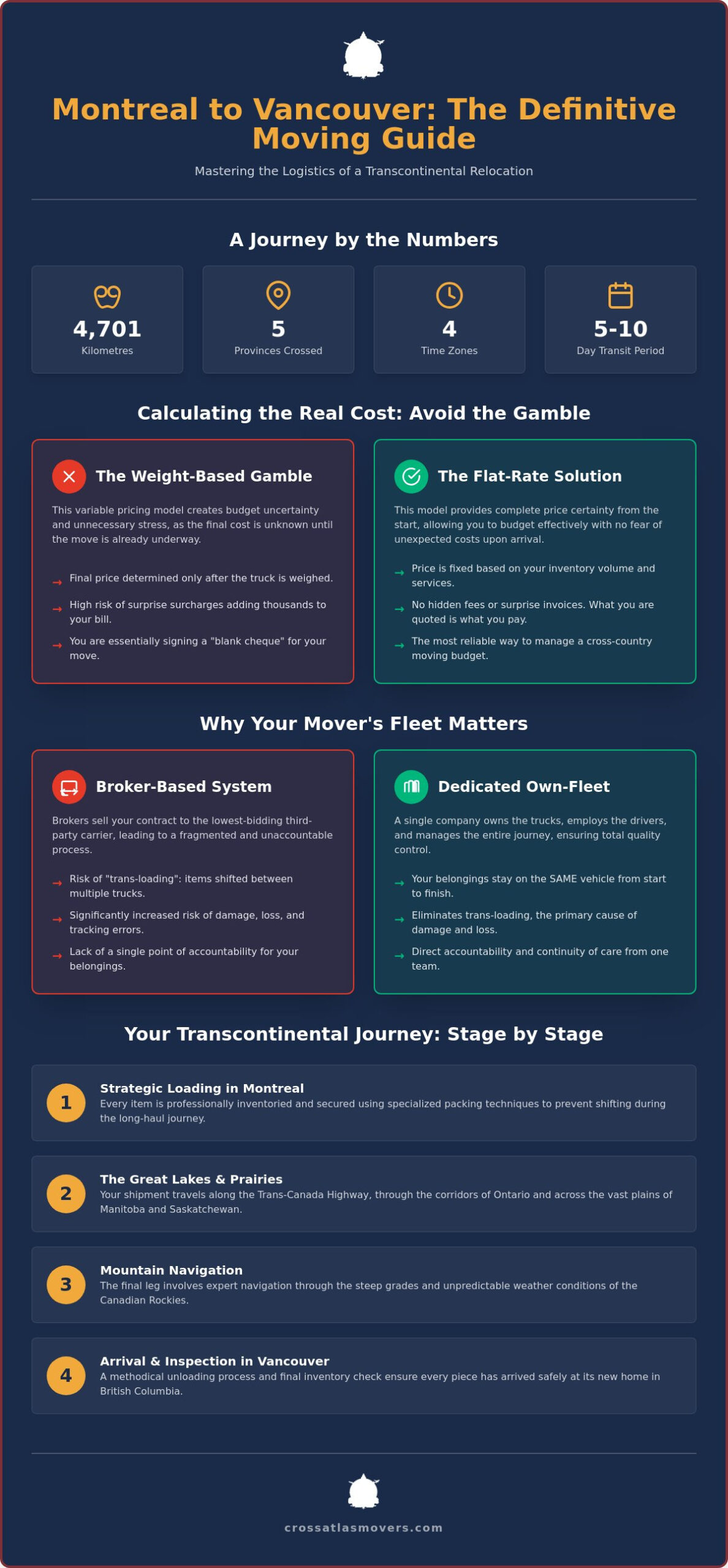
Moving from Montreal to Vancouver involves traversing approximately 4,701 kilometres of diverse Canadian geography. This transcontinental journey crosses five provinces and four distinct time zones, making it one of the most significant domestic relocations a person can undertake. At this scale, the move is no longer a simple transport job; it is a complex logistical operation that requires a methodical plan. Many homeowners unknowingly enter what we call the “Cross-Country Gamble” by hiring brokers who sell the contract and then subcontract the work to third-party carriers. This fragmented approach often leads to “trans-loading,” where your belongings are shifted between multiple trucks, significantly increasing the risk of damage and loss. A successful transition relies on a dedicated fleet and a centralized point of contact to manage the 5-to-10 day transit period with precision.
Transcontinental Transit Stages
The journey from the Saint Lawrence River to the Pacific coast is a multi-stage operation that requires constant monitoring. Our process is designed to ensure stability and safety at every stage:
- Strategic Loading: Every item is inventoried and secured using specialized techniques to prevent shifting during the long-haul trek.
- The Great Lakes and Prairies: Your possessions travel along the Trans-Canada Highway, moving through the dense corridors of Ontario before reaching the vast, open stretches of Manitoba and Saskatchewan.
- Mountain Navigation: The final leg involves navigating the steep grades and unpredictable weather conditions of the Canadian Rockies.
- Arrival and Inspection: Upon reaching British Columbia, a methodical unloading process includes a final inspection to ensure every piece reached its destination safely.
Why Own-Fleet Moving Matters
Utilizing a dedicated fleet is the most effective way to maintain quality control when moving from Montreal to Vancouver. When a single company owns the trucks and employs the drivers, they can strictly enforce safety and climate standards across the entire 4,701-kilometre journey. This approach eliminates the dangers of trans-loading, which is where the majority of tracking errors and physical damage occur in the moving industry. Because your items stay on the same vehicle from start to finish, there is no risk of them being mixed with other shipments or left in an unmonitored warehouse.
As a family-owned operation, we prioritize personal accountability over the impersonal nature of large franchise networks. You gain peace of mind knowing that the same team responsible for packing your home is the same one ensuring its safe arrival. This continuity of care ensures that your move is handled with a consistent work ethic and professional integrity, providing a level of security that broker-based systems simply cannot provide.
Calculating the Real Cost: Flat-Rate vs. Variable Estimates
Estimating the cost of moving from Montreal to Vancouver often leads to more questions than answers. Most online calculators provide broad, unhelpful ranges that fail to account for the specific requirements of a 4,500km trek. Many traditional movers rely on weight-based quotes; these are variable estimates where the final price is determined only after the truck is weighed on a commercial scale. If your inventory is heavier than predicted, you could face surcharges that add thousands to your final bill. This “weight-based gamble” creates unnecessary anxiety during an already stressful transition.
The math is simple. When you choose a variable estimate, you are essentially signing a blank cheque that won’t be filled in until your life’s work is sitting on a scale in the middle of the Prairies. To avoid this, savvy relocators prioritize flat-rate pricing. This model provides price certainty by basing the cost on the volume of your goods and the specific services required. It’s the most effective way to account for 2026 fuel trends and the varying provincial tax implications without fearing a surprise invoice upon arrival.
The Components of a Long-Distance Quote
A professional quote should be granular and transparent. It begins with a detailed inventory of your home to determine the total volume and any specialized handling needs for fragile items. Professional packing labour and the cost of high-grade materials are then factored in to ensure your belongings survive the vibrations of the long haul. Finally, the quote must include comprehensive insurance coverage. While you organize your budget, don’t forget to consult the B.C. government’s newcomer checklist to ensure you’ve accounted for secondary costs like driver’s license transfers and healthcare registration.
Flat-Rate Advantage for Cross-Country Moves
Price certainty is the ultimate goal for any transcontinental relocation. With a flat-rate quote, the price you are promised is the price you pay, provided your inventory doesn’t change. This transparency allows you to identify and eliminate hidden fees before the truck ever arrives at your door. If you are coordinating a move for work, you can find more specific budget planning advice in our guide on Corporate Moving Costs Canada. Choosing a partner who values honesty over low-ball tactics ensures your move remains on track. You can request a transparent quote to begin your journey with total financial clarity.
Professional Packing and Protection for the Long Haul
Moving from Montreal to Vancouver is a test of endurance for your household goods. While standard boxes might suffice for a trip across the city, they often fail during a 4,500km transcontinental journey. The primary culprit is constant road vibration. Over several days of travel, even small movements inside a box can lead to structural failure or surface scratches. To ensure your belongings arrive in the same condition they left, you need a packing strategy designed for the long haul. This isn’t just about putting things in boxes; it’s about engineering a protective environment that survives the transition across five provinces.
The Long-Haul Packing Protocol
A methodical approach to packing is the only way to safeguard your investment. Our protocol involves three critical stages of protection designed to handle the rigours of the road:
- Inventorying and Categorizing: We start by assessing every item for its fragility and value. This allows us to apply the specific level of protection each piece requires and ensures nothing is overlooked.
- Vibration Neutralization: We use multi-layer wrapping with high-grade shock-absorbing materials. This creates a protective buffer that prevents items from rubbing against one another during the week-long trip.
- Strategic Loading: Gravity is a constant factor. We load the truck to prevent shifting during steep mountain ascents in the Rockies, ensuring that heavy items don’t compromise the safety of lighter boxes.
Custom Crating for Fragile Goods
Standard cardboard isn’t always enough for every possession. For high-value items like artwork, antique mirrors, or specialized electronics, custom wood crating is the professional standard when moving from Montreal to Vancouver. These crates provide a rigid external skeleton that absorbs external pressure and prevents crushing. Investing in professional packing labour significantly reduces the likelihood of insurance claims. Our team knows exactly how to properly secure heavy furniture using specialized padding and high-tension straps. This ensures that even the largest pieces remain stationary while the truck navigates the varied terrain of the Canadian landscape.
Organization is equally vital when your life is in transit for up to ten days. We recommend a clear labeling system that identifies the contents and the destination room. Additionally, you should prepare a “First-Night Box.” This container should travel with you rather than on the truck. It should include essentials like basic toiletries, chargers, and a few changes of clothes. Having these items on hand ensures you can rest comfortably the moment you arrive at your new Western home without digging through dozens of sealed boxes. This small step provides immediate peace of mind after a long journey.
Navigating the Journey: Timing, Route, and Delivery
Completing a transcontinental relocation requires a sophisticated understanding of Canadian geography and strict adherence to transit schedules. When moving from Montreal to Vancouver, you should typically expect a transit window of 5 to 10 days. This duration accounts for the 4,701 kilometres of road, mandatory driver rest periods, and the necessary caution required for heavy vehicles. Unlike a personal road trip, a professional long-haul operation must balance efficiency with safety, ensuring that every hour on the road is managed to protect your belongings. Synchronizing your own travel, whether you choose to fly or drive your personal vehicle, is essential to ensure you are present to receive the shipment at your new Western residence.
Route Challenges: From the Shield to the Rockies
The path across Canada presents unique environmental hurdles that vary by season. In Northern Ontario, the route through the Canadian Shield is often remote, requiring drivers to be self-sufficient and highly experienced. As the truck moves into the West, the mountain passes of the Rockies, such as the Rogers Pass or the Coquihalla Highway, introduce steep grades and unpredictable weather. Even in 2026, winter moves require meticulous planning to account for potential closures or required tire chain protocols. Our logistics team utilizes 24/7 truck monitoring to track progress in real time, applying the same rigorous flow principles found in our Vancouver to Toronto Moving Guide to ensure your goods move efficiently regardless of the direction.
The Delivery Window Guarantee
For a long-distance move, a “guaranteed delivery window” is a vital service standard that prevents you from being left in an empty house for weeks. Professional movers realize a precise schedule by using historical transit data and real-time weather monitoring to navigate the 4,701-kilometre journey. We maintain strict communication protocols, providing you with regular updates while your life is in transit across the Prairies. This transparency allows you to prepare your new home for a seamless unloading process, ensuring that parking permits are secured and building access is coordinated before the truck arrives.
A successful delivery is the result of a methodical plan executed by experts who understand the stakes of a cross-country move. By prioritizing accountability and precision, we remove the guesswork from your relocation timeline. If you are ready to secure your spot on our next transcontinental departure, you can book your guaranteed delivery date today and move with total confidence.
Choosing the Right Partner for Your Cross-Country Move
Selecting a mover for a 4,500km journey is a decision that impacts both your financial security and your emotional well-being. It’s vital to distinguish between moving brokers and asset-based moving companies before you commit. A broker acts as a middleman, selling your contract to the lowest bidder, which often results in a lack of accountability. In contrast, a company that owns its fleet maintains total control over the quality of service. When moving from Montreal to Vancouver, you deserve the accountability that only comes from a team that manages the entire process from the first box packed in Quebec to the final item unloaded in British Columbia.
Before signing any agreement, verify that your partner is fully compliant with provincial and federal regulations. This includes active Cargo insurance to protect your investment during the transcontinental trek and WCB coverage to protect the workers on your property. A legitimate mover will also be licensed by the Commission des transports du Québec (CTQ). Additionally, insist on a detailed virtual or on-site inventory. Without a precise list of your belongings, a mover cannot provide an accurate flat-rate quote. This inventory is the only way to ensure the price you’re quoted is the price you’ll actually pay.
Questions to Ask Your Potential Mover
To ensure you’re hiring a professional specialist rather than a generalist, ask these three critical questions during your consultation:
- “Do you own the trucks that will be performing the move?” This ensures you’re dealing with the service provider directly, eliminating the risks associated with third-party brokers.
- “Is this a binding flat-rate quote or an estimate based on weight?” Always seek a fixed price to avoid the uncertainty of commercial scales and hidden weight surcharges.
- “What is your specific protocol for handling claims or delays?” A professional company will have a clear, documented process for resolving issues, providing you with a safety net.
The CrossAtlas Promise
At CrossAtlas Movers, we believe that a cross-country relocation should be defined by predictability rather than stress. Our family-owned approach means we take personal pride in every successful delivery we complete. We provide fixed-rate reliability and the safety of a dedicated fleet, ensuring your move is handled with methodical expertise. When you choose us for moving from Montreal to Vancouver, you’re choosing a partner dedicated to transparency and safety. Experience the peace of mind that comes with a transition managed by professionals who care about your belongings as much as you do. Get your free flat-rate quote today and start your journey on a foundation of trust.
Securing Your Transition to the Pacific Coast
Relocating across the country is a monumental life event that requires more than just a truck. It requires a methodical partner who understands the specific challenges of the 4,701-kilometre journey. By prioritizing flat-rate pricing and professional packing designed to neutralize road vibration, you eliminate the common anxieties of hidden fees and damaged goods. When moving from Montreal to Vancouver, the security of a dedicated fleet and a guaranteed delivery window provides the peace of mind necessary to focus on your new beginning in British Columbia.
As a family-owned and operated company with decades of long-distance experience, we prioritize accountability. We utilize our own dedicated fleet of trucks rather than third-party contractors; this allows us to offer 24/7 shipment tracking and total quality control. You’ve planned for the change; now let us handle the complex logistics. Request your free flat-rate quote for your Montreal to Vancouver move today to begin your relocation with confidence. We look forward to helping you realize a smooth and professional transition to your new Western home.
Frequently Asked Questions
How much does it cost to move from Montreal to Vancouver?
The cost of moving from Montreal to Vancouver is determined by the total volume of your belongings and the specific services you require. While industry averages vary, we prioritize flat-rate quotes to provide you with total price certainty before the journey begins. This approach protects you from the unpredictable surcharges often associated with weight-based estimates. A detailed inventory is the most effective way to receive an accurate, binding price for your specific relocation needs.
How long does it take for a moving truck to drive from Montreal to Vancouver?
A professional moving truck typically requires between 5 and 10 days to complete the 4,701-kilometre transit. This duration accounts for mandatory driver rest periods and the cautious navigation required through the Canadian Rockies and the Shield. We provide guaranteed delivery windows to ensure you can plan your arrival with confidence. Real-time monitoring allows our team to stay on schedule while prioritizing the safety of your possessions during the long haul.
Is it cheaper to move by weight or by a flat rate?
Flat-rate pricing is generally the more cost-effective and secure choice for transcontinental moves. In a weight-based system, your final price remains unknown until the truck is weighed on a commercial scale, which often leads to thousands of dollars in unexpected fees. A flat-rate quote provides total transparency and eliminates the “weight-based gamble.” It allows you to finalize your budget early, knowing the price you are promised is the price you will pay.
Do moving companies provide insurance for long-distance relocations?
Professional moving companies must provide cargo insurance to protect your items during an interprovincial move. We offer various coverage levels to ensure that high-value goods, such as electronics or artwork, are fully protected against potential transit damage. It’s vital to verify that your mover is fully compliant with provincial regulations and carries active WCB coverage. This insurance provides a necessary layer of security while your life’s work travels across five provinces and four time zones.
Can I pack my own boxes for a cross-country move?
You can certainly pack your own boxes; however, professional packing is highly recommended for a 4,500km journey. Standard packing techniques often fail to protect items from the continuous road vibration experienced during a week-long trek across Canada. If you choose to pack yourself, ensure you use high-grade materials and multi-layer wrapping. Keep in mind that professional packing labour often reduces insurance claims and ensures that your fragile items are secured using specialized long-haul protocols.
What is the best time of year to move across Canada?
Late spring and early autumn are often the best times for moving from Montreal to Vancouver to avoid extreme weather conditions. While summer is the most popular season, the July 1st “Moving Day” tradition in Quebec creates significant demand that can impact availability and pricing. Winter moves are possible but require expert planning to navigate snow and ice in the mountain passes. Booking your move well in advance is the best way to secure your preferred date regardless of the season.
Are there hidden fees I should watch out for in moving quotes?
Common hidden fees to watch for include fuel surcharges, stair fees, and long-carry charges that aren’t disclosed upfront. Some companies may also add unexpected costs for “heavy items” if they use variable estimates instead of fixed rates. We eliminate this anxiety by providing transparent, flat-rate quotes with no hidden fees. As a family-owned business, we value honesty and ensure that every logistical cost is identified and agreed upon before our truck arrives at your door.
How do I synchronize my arrival with the moving truck?
You can synchronize your arrival by coordinating your travel plans with our guaranteed delivery window. Whether you choose to fly or drive, we maintain open lines of communication to provide real-time updates on the truck’s progress across the Prairies. We recommend arriving at your new destination at least 24 hours before the scheduled delivery. This buffer allows you to coordinate building access and finalize your provincial registration tasks before the unloading process begins.