
A 4,300-kilometre journey across the Canadian Shield and through the Rocky Mountains isn’t just a move; it’s a complex logistical operation that requires absolute precision. When you’re moving from Toronto to Vancouver, it’s natural to feel the weight of such a massive transition. You might be worrying about how your fragile belongings will handle the high-altitude trek or if your quote will suddenly balloon once the truck hits the Alberta border. We understand that the fear of hidden fees and the logistics of a 45-hour drive can easily overshadow the excitement of your new start in British Columbia.
This guide is designed to eliminate that uncertainty. You’ll discover how to navigate the relocation with total confidence, securing a fixed, reliable price and guaranteed arrival dates for your household goods. We’ll explore expert packing strategies for the long haul, compare the realities of professional transport versus a DIY trek, and provide a clear roadmap for a stress-free transition from the GTA to the West Coast.
Key Takeaways
- Master the logistics of a 4,300-kilometre relocation across four provincial borders and the challenging Rocky Mountain terrain.
- Learn specialized packing techniques designed to withstand the unique vibrations and physical demands of long-haul transit.
- Discover how flat-rate quotes provide a reliable budget for moving from Toronto to Vancouver, protecting you from unexpected price hikes.
- Follow a professional eight-week timeline to organize your decluttering and booking process with total precision.
- Realize the security of using a dedicated fleet where the same methodical team handles your belongings from the GTA to the West Coast.
Planning Your Move from Toronto to Vancouver: The 4,300km Reality
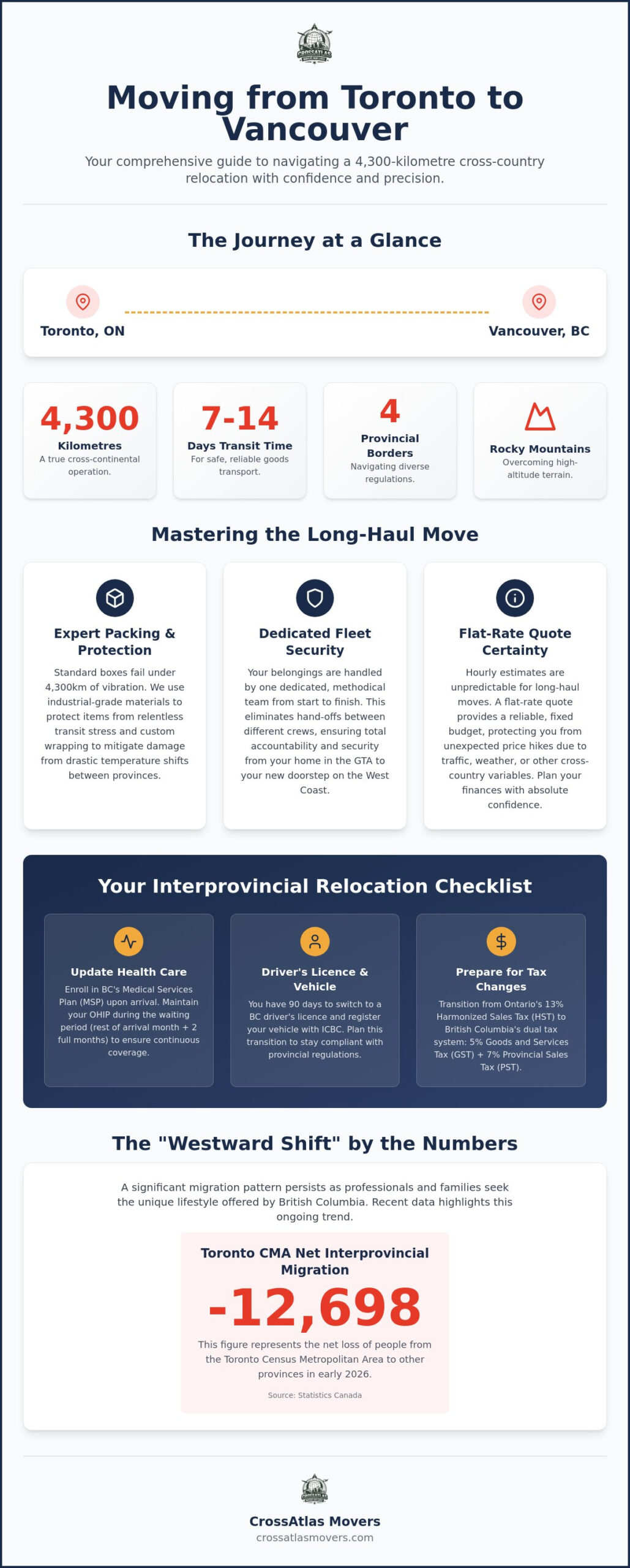
Moving from Toronto to Vancouver represents one of the most ambitious domestic relocations in North America. Spanning approximately 4,300 kilometres, this journey is a true cross-continental operation. It involves far more than simply loading a van; it requires a deep understanding of the geography between the GTA and the Pacific coast. You aren’t just changing cities. You’re navigating four provincial borders and the formidable terrain of the Rocky Mountains. For a move of this scale, a realistic transport timeline is between 7 and 14 days. This window allows for safe passage through varying climates and ensures your belongings aren’t rushed through high-altitude passes.
The primary logistical artery for this move is the Trans-Canada Highway. This network connects the diverse landscapes of our country, but it requires a methodical approach to navigate safely. For those moving from Toronto to Vancouver in 2026, the journey is often motivated by a search for a different quality of life. Statistics Canada data from early 2026 highlights a significant migration pattern; the Toronto CMA saw a net loss of 12,698 people to other provinces. While Vancouver also saw some interprovincial outflow, the “Westward Shift” persists as professionals and families seek the unique balance of urban life and natural access found in BC.
Understanding the timeline is vital for a stress-free transition. A cross-country relocation of this distance typically takes 7 to 14 days for the transport of your goods. This duration isn’t just about driving time. It accounts for the careful navigation of mountain passes, mandatory rest periods for drivers, and the logistical precision required to ensure your items arrive in the same condition they left the GTA. Rushing this process increases risk, so we prioritize a steady, reliable pace that guarantees safety over speed.
The Lifestyle Shift: What to Realize Before Leaving the GTA
The transition involves more than just a new address. You’re moving from Toronto’s high-energy “hustle culture” to a lifestyle that prioritizes outdoor wellness and a slower rhythm. While Toronto’s humid summers and snowy winters are familiar, Vancouver offers a milder, rainier climate that changes your daily routine. To overcome the city’s “clique” reputation, we recommend joining local community groups or hobby-based clubs early. Proactive engagement is the best way to build a supportive social circle in your new West Coast home.
Administrative Logistics for Interprovincial Relocation
Your move requires careful paperwork management. You must enroll in the BC Medical Services Plan (MSP) upon arrival, as there’s a waiting period consisting of the remainder of your arrival month plus two full months. Maintain your OHIP during this gap to avoid out-of-pocket medical costs. For your vehicle, you have 90 days to switch to a BC driver’s licence and register with ICBC. Also, prepare for the tax shift. You’ll move from Ontario’s 13% HST to a combination of 5% GST and 7% PST in British Columbia.
Protecting Your Belongings for the Long Haul Across Canada
Moving from Toronto to Vancouver involves a 4,300-kilometre transit that subjects your furniture to relentless vibrations and significant gravitational shifts. Unlike a local move, where items stay stationary for minutes, a cross-country relocation keeps your goods in motion for up to 14 days. Standard moving boxes often fail under these conditions; they lack the structural integrity to withstand the constant micro-movements and the pressure of a fully loaded trailer. This is why we prioritize industrial-grade materials that can handle the physical demands of a transcontinental trip.
Temperature control is another critical factor that many families overlook. As the truck moves through the humid air of the Great Lakes, the dry heat of the Prairies, and the high-altitude cold of the Rockies, electronics and fine wood furniture are at risk. Wood can expand or contract, while sensitive components in electronics can be damaged by extreme shifts in climate. We mitigate these risks through methodical loading techniques and protective wrapping that acts as a thermal barrier for your most sensitive assets.
Your Bill of Lading serves as the definitive record of your move. It is the most important document you will sign, detailing every item and its condition before transport. This record ensures total transparency and accountability from the moment our team leaves the GTA until we arrive at your new home in British Columbia. Having a precise inventory allows for a seamless unloading process and provides you with peace of mind during the long transit period.
Professional Packing and Custom Crating
Investing in professional packing services is the most effective way to secure high-value items for the long haul. For delicate antiques, mirrors, or original art, custom crating provides a rigid outer shell that absorbs external impacts. We use double-walled boxes and industrial-grade stretch wrap to ensure that even the smallest items remain stationary. If you have concerns about specific heirlooms, you can request a detailed inventory consultation to discuss specialized protection options.
Navigating the Rockies: Transport Safety Standards
Crossing the Rocky Mountains is the most demanding phase of the journey. Professional drivers must manage steep descents and high-altitude routes like the Kicking Horse Pass with absolute precision. We use advanced tie-down techniques and interior decking systems to prevent the load from shifting during these steep inclines. A dedicated fleet offers a significant safety advantage over consolidated van lines. When your goods stay on one truck with one team, the risk of damage from repeated unloading and reloading is eliminated. This methodical approach ensures your belongings arrive in Vancouver exactly as they left Toronto.
Comparing Moving Costs: Why Flat-Rate Quotes Beat Hourly Estimates
Choosing the right pricing model is the most consequential decision you’ll make when moving from toronto to vancouver. While hourly rates might seem manageable for a cross-town transition, they are dangerously unpredictable for a transcontinental relocation. A single road closure on the Trans-Canada Highway or a sudden winter storm in the mountain passes can add hours or even days to your transit time. With an hourly contract, those logistical delays translate directly into higher costs for you. Flat-rate pricing eliminates this financial risk by providing a fixed cost that remains unchanged regardless of traffic, weather, or unexpected road conditions.
A professional moving quote for a 4,300-kilometre journey must be comprehensive to be valid. It should clearly outline fuel surcharges, labour costs, and transit insurance. You should be wary of “rogue movers” who offer low-ball estimates over the phone without a physical inspection or a verifiable office address. These operators often use bait-and-switch tactics, holding your goods hostage until you pay additional, undisclosed fees. Financial certainty is the foundation of a stress-free move, and a transparent, binding quote is your primary protection against moving-day price shock.
The Pitfalls of Van Lines and Brokers
Many national moving companies operate as brokers or van lines, meaning they sell your contract to third-party drivers or local agents. This often leads to “trans-loading,” where your belongings are moved from one truck to another at various hubs across the country. Every time your furniture is handled, the risk of damage increases significantly. Additionally, it is vital to understand the difference between Basic Released Value and Full-Value Protection. Basic coverage typically offers only 60 cents per pound per item, which is insufficient for high-value electronics or designer furniture. We always recommend Full-Value Protection to ensure your assets are covered at their actual replacement cost.
The Value of a Dedicated Fleet
A dedicated fleet ensures that the same truck and team that load your items in the GTA are the ones who unload them at your new BC residence. This direct transport model provides a level of accountability and safety that brokers simply cannot match. You have a single point of contact for the entire 4,300km journey, allowing for precise tracking and clear communication. Flat-Rate Moving is a binding agreement that protects the consumer from mid-transit price hikes by locking in a single, all-inclusive price before the truck ever leaves your driveway. This methodical approach ensures your 2026 relocation budget remains intact and your transition stays on schedule.
Your Essential Moving Checklist: Organizing the Relocation to BC
Organizing a 4,300-kilometre relocation requires more than just energy; it requires a methodical timeline. When you are moving from toronto to vancouver, the sheer distance means that small oversights in the GTA can become significant burdens once you reach the West Coast. Success depends on a structured approach that addresses both physical belongings and administrative requirements well in advance of your departure date.
- 8 Weeks Out: Finalize your Vancouver to Toronto moving guide research and book your professional mover to secure your preferred 2026 dates. Early booking is essential to guarantee your arrival window during the busy summer months.
- 6 Weeks Out: Declutter every room and organize a garage sale. Long-distance moving costs are often tied to volume, so you shouldn’t pay to transport items you no longer need or use.
- 4 Weeks Out: Secure your flight or plan your cross-Canada road trip route. If you are driving, ensure your vehicle is serviced for the demanding trek through the Prairies and the Rockies.
- 2 Weeks Out: Initiate address changes for banking, the CRA, and provincial services. This is the time to ensure your mail forwarding is active through Canada Post.
- 1 Week Out: Pack a “first-night” bag. Since your dedicated truck will take 7 to 14 days to reach BC, you’ll need enough essentials to live comfortably in your new home before your furniture arrives.
Administrative Handover: Ontario to British Columbia
The transition between provinces involves several critical utility and record transfers. You must cancel your Toronto Hydro, Enbridge Gas, and municipal water accounts for the day after you depart. Simultaneously, contact BC Hydro to set up your new account in Vancouver. You should also notify your insurance provider about the change in province for both home and auto policies; rates and regulations differ significantly between Ontario and BC. Finally, ensure all school records and medical files are digitized or ready for transfer to your new BC-based providers.
The “Moving Day” Protocol
On the day of the move, conduct a final walkthrough with your professional moving team to ensure nothing is left behind. You will verify the inventory list and sign the Bill of Lading, which acts as your official contract and receipt. For total peace of mind, we recommend securing your “High-Value Inventory” separately. This includes jewelry, small electronics, and essential documents that you should carry with you personally. If you’re ready to secure a reliable, flat-rate quote for your journey, you can request a professional moving estimate today to lock in your 2026 relocation dates.
Why CrossAtlas Movers is the Preferred Choice for Cross-Country Relocations
Choosing a partner for moving from toronto to vancouver is a decision rooted in trust. At CrossAtlas Movers, we maintain the integrity of a family-owned and operated business while providing the logistical resources of a national leader. We understand that your belongings represent years of memories and investments. This is why we never broker our moves or rely on third-party van lines. By utilizing a dedicated fleet of our own trucks and trained staff, we ensure that the team you meet in the GTA is the same team that delivers your goods to your new home in British Columbia.
Our commitment to financial certainty is central to our service. We apply our extensive experience in corporate moving costs Canada to our residential clients, offering a flat-rate pricing model that eliminates moving-day price shock. We realize that your time is your most valuable asset during a relocation. To support your transition, we provide guaranteed delivery dates, ensuring you can plan your arrival in Vancouver with absolute precision and peace of mind.
The CrossAtlas Advantage: Professionalism and Precision
We operate under a “Capable Protector” philosophy, which means we take the entire burden of long-distance logistics off your shoulders. Our drivers undergo specialized training for high-altitude transit, mastering the unique challenges of the Trans-Canada Highway through the Rockies. We don’t just move boxes; we execute a methodical plan that includes professional packing solutions exceeding standard industry requirements. From custom crating for delicate art to industrial-grade thermal wrapping for wood furniture, every step is designed to protect your assets from the physical stresses of a 4,300-kilometre journey.
Get Your Fixed-Rate Quote Today
Securing a reliable estimate for your 2026 relocation is a straightforward and transparent process. You can request a free, no-obligation survey to begin your journey. We offer both virtual and in-person home surveys to accurately assess the volume of your goods and identify any specialized packing needs. This thorough evaluation allows us to provide a binding, flat-rate quote that covers every aspect of your move. There are no hidden fees, no fuel surprises, and no mid-transit price hikes. If you are ready to experience a seamless, professional transition to the West Coast, get your flat-rate quote from CrossAtlas Movers today and let our family take care of yours.
Start Your West Coast Chapter with Confidence
A successful 4,300-kilometre relocation requires more than just a truck; it demands a methodical strategy and a partner who values your peace of mind. By prioritizing flat-rate transparency and specialized packing techniques, you eliminate the common anxieties of long-haul transport. You’ve learned how a dedicated fleet and a structured eight-week timeline can transform a complex transcontinental operation into a predictable, manageable transition.
We are here to ensure that moving from toronto to vancouver is a rewarding experience rather than a source of stress. Our team provides a no hidden fees guarantee and utilizes a dedicated fleet of company-owned trucks to protect your belongings throughout the journey. From professional packing to custom crating for your most delicate items, we handle every detail with the precision and care your family deserves.
Ready to secure your 2026 relocation dates? Request Your Free Flat-Rate Moving Quote today and take the first step toward your new life in British Columbia. We look forward to helping you settle into your West Coast home with ease and total security.
Frequently Asked Questions
How much does it cost to move from Toronto to Vancouver in 2026?
The total cost for moving from Toronto to Vancouver depends on the total volume of your belongings and the specific service level you select. While industry averages vary, we prioritize a flat-rate pricing model to ensure you have a fixed, reliable budget before the truck leaves your driveway. This approach protects you from the price shock often associated with weight-based estimates or unexpected fuel surcharges during the 4,300-kilometre journey.
How long does it take for a moving truck to get from Toronto to Vancouver?
A professional long-distance move typically takes between 7 and 14 days for transport. This timeline accounts for the distance, mandatory safety rests for drivers, and the careful navigation required through the Rocky Mountains. We provide guaranteed delivery windows so you can coordinate your arrival in British Columbia with total confidence, knowing exactly when your household goods will reach your new residence.
Is it cheaper to sell my furniture or move it cross-country?
Deciding whether to sell or move depends on the quality and replacement cost of your items versus the volume they occupy in the truck. For high-quality or sentimental pieces, professional transport is often more economical than buying new furniture at Vancouver’s current market prices. We recommend decluttering items that are easily replaced, which allows you to focus your budget on protecting the valuable assets that make your new house feel like home.
Can I move my car along with my household goods?
Yes, you can arrange for vehicle transport as part of your comprehensive relocation plan. Moving a vehicle across the country requires specific safety inspections before it can be registered with the Insurance Corporation of British Columbia (ICBC). Coordinating your car’s arrival with your household move ensures you have reliable transportation shortly after settling into your new West Coast neighbourhood.
What is the best time of year to move from Toronto to Vancouver?
The most balanced time for a cross-country relocation is during the late spring or early autumn. Moving during the peak summer season from June to August can increase industry costs by 20% to 30% according to data from Kams Movers. By choosing the shoulder seasons, you avoid the highest price brackets while also bypassing the most severe winter weather conditions in the mountain passes.
Do I need special insurance for a move across Canada?
Standard provincial coverage is often limited to 60 cents per pound, which is why we recommend Full-Value Protection for long-distance moves. This ensures that your belongings are covered for their actual replacement value during the 4,300-kilometre transit. Given the vibrations and handling involved in a transcontinental trip, having comprehensive coverage provides an essential layer of security for your investment.
How do I change my provincial residency from Ontario to BC?
New residents have a 90-day grace period to switch to a BC driver’s licence and register their vehicles with ICBC. You must also enroll in the BC Medical Services Plan (MSP), which has a waiting period consisting of the remainder of your arrival month plus two full months. It is vital to maintain your OHIP coverage during this transition to ensure you don’t face out-of-pocket medical expenses before your BC coverage begins.