
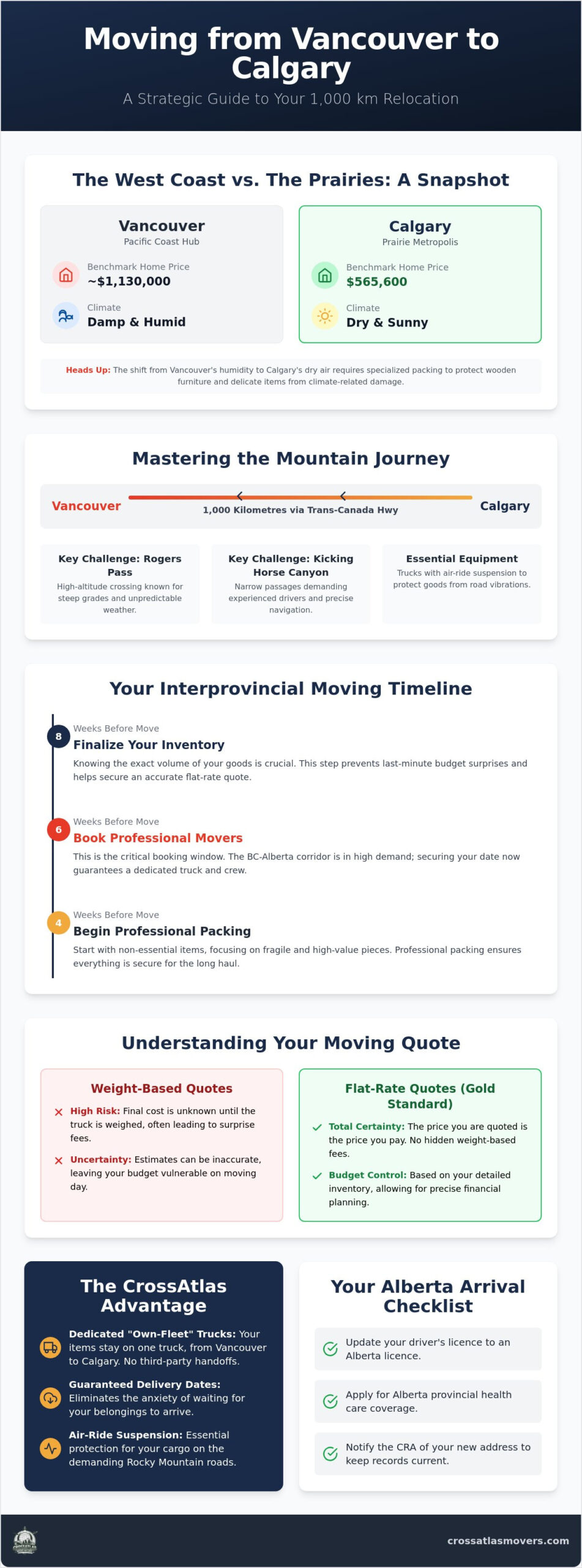
Did you know that the benchmark home price in Calgary is nearly half that of Metro Vancouver, sitting at $565,600 as of early 2026? It’s a statistic that makes the decision to relocate feel like a clear win for your financial future. We understand that while the destination is promising, the process of moving from vancouver to calgary often feels overwhelming. You’re likely balancing the stress of a 1,000-kilometre journey through the Rockies with the fear of hidden costs or damage to your most valued possessions during the long haul.
Our goal is to replace that uncertainty with a sense of total control. This guide provides the expert interprovincial guidance you need to master the logistics, manage your budget effectively, and ensure your belongings arrive safely regardless of the mountain weather. We will walk you through everything from the latest 2026 vehicle registration requirements to the specific steps for protecting your furniture from Alberta’s dry climate. You can look forward to a transition that’s as organized and reliable as the new life you’re building in the Prairies.
Key Takeaways
- Master the logistics of the 1,000-kilometre trek through the Rockies, including specific safety strategies for navigating Rogers Pass and the Kicking Horse Canyon.
- Understand why a flat-rate quote is the gold standard for moving from vancouver to calgary, providing total budget certainty without the risk of hidden weight-based fees.
- Navigate the 2026 administrative transition with a clear timeline for updating your Alberta driver’s licence and applying for provincial health care coverage.
- Protect your belongings from climate-related damage by using specialized packing techniques designed for the transition from Vancouver’s humidity to Calgary’s dry air.
- Learn how a dedicated truck fleet and guaranteed delivery dates eliminate the common anxieties of long-distance interprovincial relocations.
The 1,000-Kilometre Transition: Moving from Vancouver to Calgary
Relocating between these two major Western hubs is more than just a change of address; it’s a significant logistical undertaking. The journey spanning nearly 1,000 kilometres represents a shift from the Pacific coast to the high plains of Alberta. Many residents are choosing this path in 2026 to take advantage of Calgary’s relative affordability and robust job market. However, the physical move involves crossing some of the most challenging terrain in North America. Success depends on realizing that this isn’t a local haul. It requires a methodical approach to manage the distance and the distinct provincial regulations that govern interprovincial transport.
Understanding the Interprovincial Move
When you’re moving from vancouver to calgary, your belongings cross provincial borders, which introduces specific legal and insurance considerations. Unlike local moves, interprovincial transport is governed by federal and provincial regulations regarding load weights and driver hours. We’ve found that the most reliable way to manage these complexities is through an “own-fleet” advantage. This means using a company that operates its own trucks rather than outsourcing to third-party contractors. This continuity ensures your items remain on the same vehicle from the moment they leave your Vancouver home until they arrive in Calgary. Additionally, you must prepare for the climate transition. Calgary’s air is significantly drier than Vancouver’s damp coastal environment. This change can affect wooden furniture and delicate instruments, making professional packing and climate-aware handling essential.
Key Milestones for Your Relocation
A predictable move starts with a structured timeline. In 2026, high demand for the BC-Alberta corridor means that the most reputable movers often reach capacity months in advance. Clear planning allows you to avoid the stress of last-minute bookings and ensures you have access to the best resources.
- 8 Weeks Before: Finalize your inventory. Realizing the exact volume of your goods early prevents last-minute budget surprises.
- 6 Weeks Before: This is the “point of no return” for booking professional movers. Securing your date now guarantees a spot on a dedicated truck.
- 4 Weeks Before: Begin the professional packing process for non-essential items, focusing on high-value or fragile pieces.
The primary route for this journey is the Trans-Canada Highway, a vital link that demands respect from even the most seasoned drivers. This legendary road connects the two cities but requires drivers who are experienced with steep grades and unpredictable mountain weather. Professional planning ensures that these geographical hurdles don’t become obstacles to your new beginning. By mapping out these milestones, you can turn a complex interprovincial relocation into a series of manageable, successful steps.
Mountain Logistics: Navigating the Rockies Safely
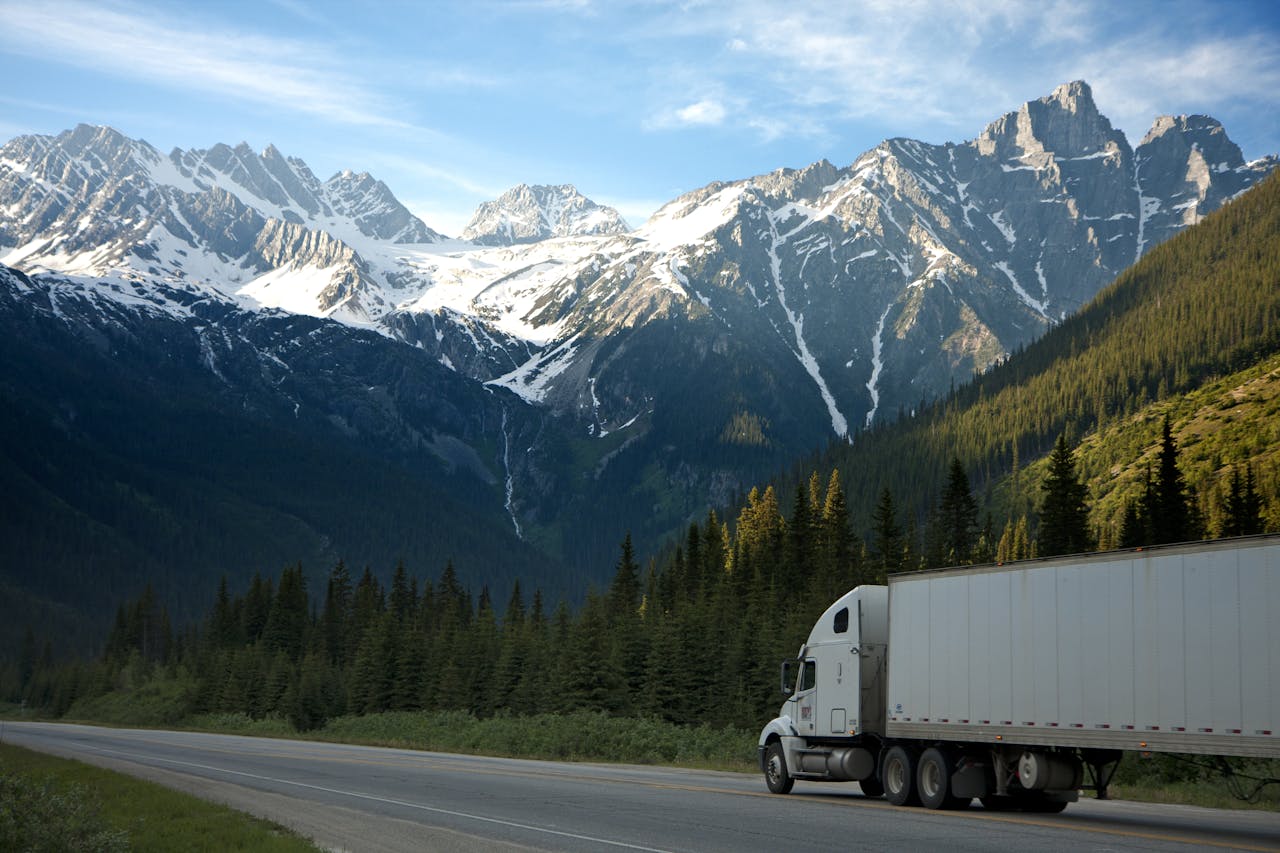
The physical journey of moving from vancouver to calgary is defined by the Selkirk and Rocky Mountain ranges. It’s not just a matter of distance; it’s a technical challenge involving some of the most demanding terrain in North America. The route requires crossing several high-altitude passes where weather conditions can shift from clear skies to heavy snowfall in minutes. Professional movers don’t simply drive these roads. They manage the logistics with precision, using specialized equipment designed to handle the unique stresses of mountain transport. Success on this 1,000-kilometre trek depends on a deep understanding of the route’s geography and a commitment to rigorous safety standards.
The primary path typically utilizes the Coquihalla (Highway 5) before merging with the Trans-Canada Highway. Specific sections, such as Rogers Pass and the Kicking Horse Canyon, are famous for their steep grades and narrow passages. To protect your belongings, expert teams use trucks equipped with air-ride suspension. This technology is vital for long-haul mountain moves because it cushions your cargo against the vibrations and jolts common on winding, high-elevation roads. While the transport team handles the complexities of the road, you can stay productive by ensuring you update your address with the CRA to keep your personal records current during the transition.
Seasonal Considerations: Winter vs. Summer Moves
Logistics change significantly with the seasons in British Columbia’s interior. During winter, heavy trucks must comply with strict mandatory chain requirements and winter tire regulations to navigate icy passes. Professional drivers monitor real-time BC Highway alerts and DriveBC cameras constantly to anticipate closures or dangerous conditions. In contrast, summer moves through regions like Kamloops or Revelstoke bring extreme heat. High temperatures can affect heat-sensitive goods, making climate-aware loading and strategic travel times essential for cargo safety. Our team’s familiarity with these patterns ensures a predictable delivery schedule regardless of the month.
Protecting Cargo During Steep Ascents and Descents
The physics of mountain driving means your cargo is subject to constant gravitational shifts. During steep ascents and descents, items can migrate if they aren’t properly secured. Professional packing is the most effective way to prevent transit damage caused by these forces. Every item is padded, and the truck is loaded to eliminate “void space,” which prevents shifting. For high-value items like artwork or delicate electronics, custom crating provides a rigid, protective shell that withstands the rigours of the climb. If you want to ensure your valuables are protected by these high standards, choosing specialized long distance moving services is the best way to eliminate “Rockies risk.” This methodical approach guarantees that your items arrive in Calgary in the same condition they left the coast.
Calculating Costs: Flat-Rate vs. Weight-Based Quotes
Financial transparency is the foundation of a stress-free relocation. When you’re moving from vancouver to calgary, the 1,000-kilometre distance means that even small inaccuracies in a quote can lead to significant cost overruns. Most traditional movers use a weight-based model. This approach requires the truck to visit a weigh scale before and after loading, with the final price determined by the difference. The inherent risk is obvious; you won’t know the actual cost of your move until your belongings are already in transit. This uncertainty often leads to “sticker shock” at the destination, especially if your inventory was slightly heavier than the initial estimate.
A flat-rate model serves as the gold standard for long-distance moves. It eliminates the gamble of the weigh scale by providing a fixed price based on a thorough inventory assessment. This predictability allows you to plan your budget with confidence, knowing that the price you’re quoted is the price you’ll pay. Beyond the moving fees themselves, remember that settling in Alberta offers immediate financial relief. You’ll benefit from the absence of Provincial Sales Tax (PST), representing a 7% savings on many local purchases as you set up your new home. Avoiding “low-ball” estimates is essential, as these often omit necessary charges that reappear as hidden fees once the truck arrives in Calgary.
The Problem with Weight-Based Estimates
The primary issue with weight-based estimates is the lack of accountability during the re-weighing process. If a mover provides an unrealistically low estimate to win your business, they can easily justify a higher final bill by citing unexpected weight. This practice creates immense anxiety for families who need to know their exact moving costs to manage their relocation budget. A fixed-rate quote removes this burden by shifting the responsibility to the mover. It ensures that the logistical complexities of the Rockies don’t translate into financial surprises for the client.
What Should Be Included in Your Quote?
A comprehensive quote should be all-inclusive to prevent surprises. When reviewing a contract, ensure it covers fuel surcharges, basic furniture disassembly, and insurance coverage. It’s also vital to look for guaranteed delivery dates. In a fixed-price agreement, these dates provide the logistical certainty you need to coordinate your arrival. As you finalize your financial plan, consult the official Alberta government moving guide to understand additional costs like vehicle registration and provincial health care applications. For more detail on protecting your budget from unexpected charges, read our guide on Flat Rate Moving Quote Canada: Avoiding Hidden Fees. This methodical approach ensures your move remains predictable from the first box to the last.
Preparing for Alberta: Your Interprovincial Checklist
The administrative shift is just as critical as the physical transport of your furniture. When you’re moving from vancouver to calgary, you aren’t just changing cities; you’re changing your legal jurisdiction. This transition requires a methodical approach to ensure your healthcare, driving privileges, and tax records remain uninterrupted. While our teams handle the heavy lifting, your focus should be on the specific timeline of provincial requirements that begin the moment you cross the border into Alberta. Managing these details early prevents the stress of last-minute paperwork during your first week in a new province.
Administrative Essentials: BC to Alberta
Alberta requires new residents to switch their driver’s licence and vehicle registration within 90 days of arrival. It’s vital to remember that any vehicle registered outside of Alberta must pass a formal Out-of-Province Vehicle Inspection before it can be registered locally. Regarding healthcare, you should apply for the Alberta Health Care Insurance Plan (AHCIP) immediately. Coverage typically begins on the first day of the third month after you establish residency. Starting July 2, 2026, your Personal Health Number will be integrated into your Alberta driver’s licence, simplifying your wallet. You must also notify the CRA of your change of province to ensure your tax filings and benefit payments are processed correctly under Alberta’s tax brackets.
Home Preparation for the Long Haul
Preparing your home for a 1,000-kilometre journey involves more than just taping boxes. Decluttering is the most effective way to reduce your moving volume and overall costs. We recommend a “keep, donate, or discard” audit at least six weeks before your move date. For appliances, ensure they’re unplugged and defrosted at least 24 hours before the truck arrives to prevent leaks during the 12-15 hour drive. A final walk-through of your Vancouver home is the last line of defence. Check every cupboard, crawl space, and attic to ensure nothing is left behind. To ensure every detail of your transition is managed with professional precision, consider booking our specialized province to province moving solutions.
The “Essential Box” Strategy
While the truck carries the bulk of your life, certain items must stay with the homeowner. We suggest packing an “essential box” for each family member to survive the transit and the first night. This should include three days of clothing, basic toiletries, chargers, and important documents like your new Alberta rental agreement or home purchase papers. Having these items accessible during the 12-15 hour journey eliminates the frustration of searching through sealed crates when you’re exhausted. This level of organization turns a daunting relocation into a series of predictable, successful milestones. By separating your immediate needs from your long-term storage, you create a buffer of comfort that makes the first night in Calgary feel like home.
The CrossAtlas Advantage: Seamless Vancouver to Calgary Moves
Choosing a partner for your relocation is a decision built on trust. CrossAtlas Movers operates as a family-owned expert specializing in the BC-Alberta corridor. We recognize that moving from vancouver to calgary is a high-stakes transition for your family or business. Our approach combines the scale of a major carrier with the personal accountability of a boutique service. We take ownership of every stage of the journey. This ensures that the same high standards of care are applied from the moment we wrap your first piece of furniture in Vancouver until the final box is placed in your new Calgary residence.
Why an Owned Fleet Matters
Accountability is often lost when moving companies outsource their long-haul routes to third-party contractors. We eliminate this risk by maintaining our own dedicated fleet of trucks. This ensures that the professionals handling your goods are our own employees who are trained in our specific safety protocols. Our mountain-ready trucks undergo rigorous maintenance schedules to handle the steep grades of the Rockies with ease. This commitment to equipment quality is a hallmark of our service, whether you are heading to the Prairies or utilizing our Vancouver to Toronto moving guide for even longer relocations. When we control the fleet, we control the quality of the outcome.
Commitment to Transparency and Safety
Our flat-rate pricing model is designed to lower your heart rate. By providing a fixed quote, we remove the stress of potential weight-based surcharges at the destination. You receive a predictable budget and a guaranteed delivery date, allowing you to coordinate your first day in Calgary with absolute precision. Safety remains our priority, particularly for high-value or fragile items. We use professional packing techniques and specialized custom crating to protect your assets from the vibrations of the mountain passes and the shift to Alberta’s drier climate. Our teams are trained to handle everything from heavy oak furniture to delicate electronics with methodical precision.
Realizing the value of professional labour for heavy or delicate items is the first step toward a successful move. We take pride in being a dependable partner that offers both technical expertise and old-school integrity. You deserve a transition that is as organized as it is safe. Our goal is to remove the burden of logistics so you can focus on the opportunities awaiting you in Alberta. Request your free, flat-rate quote from CrossAtlas Movers today.
Your Seamless Transition to Calgary Starts Here
A successful relocation hinges on two primary factors: meticulous preparation and a partner you can trust. By mastering the logistical demands of the Rockies and staying ahead of Alberta’s 2026 administrative requirements, you’ve already simplified your journey. You now understand the value of financial transparency through flat-rate quotes and the security of a dedicated truck fleet. These elements turn the complex task of moving from vancouver to calgary into a predictable and manageable process.
At CrossAtlas Movers, we bring a methodical expertise to every long-haul journey. As a family-owned and operated business since our inception, we take personal pride in your transition. We eliminate the stress of the unknown with our fixed-rate pricing guarantee and a dedicated fleet of mountain-ready trucks. Our approach ensures that your high-value items arrive safely while you focus on the opportunities awaiting you in Alberta. Get Your Free Vancouver to Calgary Moving Quote today. We look forward to helping you establish your new home with confidence and ease.
Frequently Asked Questions
How much does it typically cost to move from Vancouver to Calgary?
The total cost depends on the volume of your inventory and the specific services required for the 1,000-kilometre journey. While industry averages vary based on home size, a flat-rate quote is the most reliable way to secure a predictable budget for moving from vancouver to calgary. This model provides a fixed price that accounts for current labour rates and fuel costs without the risk of post-move adjustments or weight-based surprises.
How long does the actual transport take between Vancouver and Calgary?
The direct drive between these cities typically takes 12 to 15 hours under normal conditions. However, a full relocation usually spans two to three days once you include the time needed for professional loading and unloading. Using a company with a dedicated fleet ensures your belongings don’t sit in a warehouse, providing a more direct and predictable delivery schedule for your new home in Calgary.
Do I need a special permit for interprovincial moving?
Residents don’t need a special personal permit to move household goods across provincial borders in Canada. The legal requirements primarily fall on the transport company, which must comply with interprovincial safety and weight regulations. Your primary administrative focus should be on the 90-day window to update your Alberta driver’s licence and vehicle registration after you arrive in the province.
What happens if my move date changes due to weather in the Rockies?
Safety is the absolute priority when navigating the unpredictable conditions of Rogers Pass or the Coquihalla. If severe weather or highway closures occur, our teams monitor real-time BC Highway alerts to adjust the schedule for safe passage. Because we provide fixed-rate quotes, you aren’t penalized for delays caused by mountain weather, ensuring your budget remains intact even if the Rockies demand a tactical pause.
Is professional packing worth the extra cost for a long-distance move?
Professional packing is highly recommended for this route due to the significant climate shift and mountain terrain. Calgary’s dry air can affect wooden furniture that was previously kept in Vancouver’s humid environment. Expert packing and custom crating provide a physical buffer against load shifting during steep mountain descents and help stabilize items as they acclimatize to the new provincial climate.
Can I move my car along with my household goods?
You can certainly include your vehicle as part of your relocation plan. Many families choose to have their cars transported professionally to avoid the stress of driving through the Rockies themselves. We coordinate this process to ensure your vehicle arrives safely, though you must remember that an Out-of-Province inspection is required before you can receive your Alberta licence plates and registration.
What is the best time of year to move from Vancouver to Calgary?
Late spring through early autumn is generally the best time for moving from vancouver to calgary to avoid the most severe mountain weather. While relocations happen year-round, the summer months offer more predictable road conditions on the Trans-Canada Highway. If you choose a winter move, it’s essential to work with a mover whose fleet is fully equipped with winter-rated equipment and experienced mountain drivers.
How do I know if a moving quote includes all hidden fees?
To ensure a quote is truly all-inclusive, look for a flat-rate guarantee that explicitly covers fuel surcharges, insurance, and all labour costs. Weight-based estimates are often the source of hidden fees because the final price is unknown until after the truck is weighed at a scale. A transparent, fixed-price contract from a reputable provider eliminates “sticker shock” by confirming all costs before the first box is loaded onto the truck.