
If you believe that a corporate move is simply a logistical hurdle to be cleared, you might be overlooking the single greatest risk to your 2026 operational continuity. For many Canadian executives, the thought of relocating an entire office brings up visions of damaged servers, lost productivity, and those frustrating hidden fees that often appear on long-distance quotes. It’s a high-stakes event where the safety of your specialized equipment is just as vital as your bottom line.
We understand that you need more than just a transport service; you need a strategy that keeps your board of directors informed and your employees focused. This guide provides a comprehensive, step-by-step framework to help you organize your transition, minimize downtime, and successfully vet a business relocation moving company that prioritizes reliability. We’ll walk you through the latest 2026 Canada Revenue Agency moving deductions, provincial registration requirements, and the specific milestones you need to hit to ensure a move that is completed on time, without damage, and within your C$ budget.
Key Takeaways
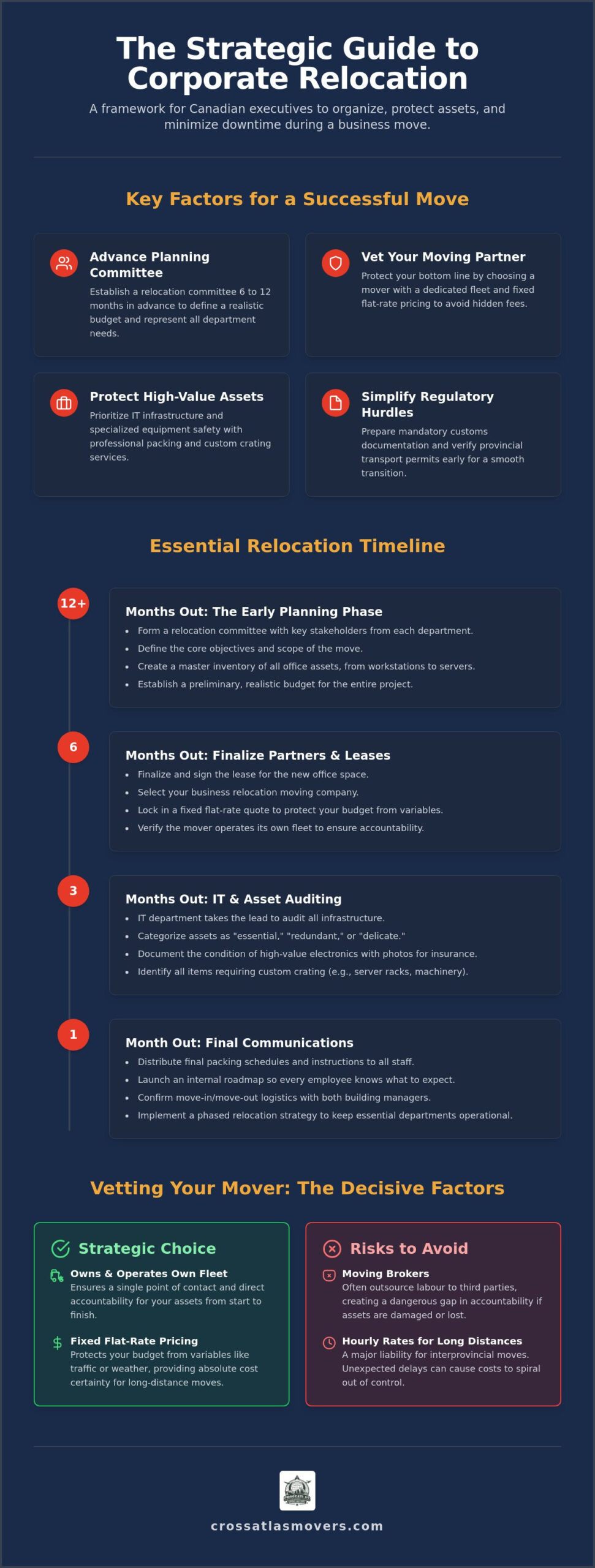
- Establish a relocation committee 6 to 12 months in advance to define a realistic budget and ensure every department’s needs are represented.
- Protect your bottom line by vetting a business relocation moving company that offers fixed flat-rate pricing and operates its own dedicated fleet of trucks.
- Prioritize the safety of high-value IT infrastructure and specialized equipment by utilizing custom crating and professional packing services.
- Simplify cross-border and interprovincial transitions by preparing mandatory customs documentation and verifying specific provincial transport permits early.
- Minimize operational downtime by using a phased relocation strategy that keeps essential departments functional throughout the entire physical move.
Essential Timeline for a Seamless Business Relocation
A successful corporate move doesn’t happen over a weekend; it’s the result of a deliberate, year-long strategy. In the Canadian market, where vast distances and unpredictable seasonal weather can complicate logistics, starting 12 months in advance is essential for protecting your equipment and your sanity. This period allows your team to transition from reactive scrambling to methodical execution. You’ll need this time to secure a business relocation moving company that aligns with your specific operational needs, especially if you require specialized transport for high-value assets.
By the six-month mark, your focus should shift toward finalizing the new lease and selecting your moving partner. This is the ideal window to lock in a flat-rate quote, which serves as a vital budget-protection tool for your Finance department. Gaining a deeper perspective by understanding the moving industry and its various service models will help you identify the “own fleet” advantage. This ensures your assets aren’t being handed off to third-party contractors during a long-haul move between provinces.
As the three-month milestone approaches, your IT department must take centre stage to audit infrastructure and specialized equipment. Finally, during the last 30 days, your priority is clear communication. Distribute final packing schedules to all staff and launch an internal roadmap so every employee knows exactly what to expect on moving day. This structured approach prevents the board of directors from facing unexpected downtime or hidden costs.
The Early Planning Phase
Success begins by defining the “why” of the move. Whether you’re expanding into a new province or consolidating offices to realize cost savings, this clarity helps your relocation committee organize department priorities. You should identify key stakeholders early, including an on-site manager who will oversee the transition. This phase is also the time to create a master inventory of all office assets. Listing everything from ergonomic workstations to network switches ensures nothing is left behind or unaccounted for during the haul.
Inventory and Asset Auditing
Once your inventory is complete, you must categorize every item by priority. Labelling assets as “essential,” “redundant,” or “delicate” allows your team to plan the packing sequence effectively. It’s vital to document the condition of high-value electronics with high-resolution photos for insurance purposes before any packing begins. For specialized machinery or server racks, determine which items require custom crating. Standard boxes are rarely sufficient for long-distance transport; precision-engineered crates provide the security needed to ensure zero damage upon arrival at your new Canadian headquarters.
Vetting Your Business Relocation Moving Company: A Selection Framework
Choosing a business relocation moving company is one of the most critical decisions an HR or operations manager will make during a transition. It’s not merely a matter of hiring a truck; it’s about trusting a partner with the physical foundation of your company. In the Canadian market, the distinction between a dedicated service provider and a moving broker can mean the difference between a seamless launch and weeks of operational downtime. You need a partner that offers professional authority and the personal accountability of a family-owned business.
The most significant security measure you can take is verifying that your provider owns and operates its own fleet of trucks. Many large franchises act as brokers, outsourcing the actual labour to third parties. This creates a dangerous gap in accountability; if a server rack is damaged or a delivery date is missed, the broker often lacks direct control over the resolution. A company with its own fleet ensures that the same team handles your assets from the moment they leave your old office until they’re safely positioned in the new one. This single point of contact provides the security your board of directors expects.
Budget certainty is equally vital. While hourly rates might seem appealing for local shuffles, they are a liability for long-distance moves. Traffic at the GTA border or unexpected weather in the Rockies can cause hourly costs to spiral. A fixed flat-rate pricing model protects your corporate budget from these variables. Beyond the physical transport, you must also ensure your business remains compliant with provincial registration requirements when moving between jurisdictions. Securing a corporate relocation partner who understands these nuances helps mitigate legal and financial risks.
The Dangers of Moving Brokers
Brokers often present themselves as established carriers but lack the physical infrastructure to handle your move. This leads to sub-contracting, where your high-value IT equipment might be handled by workers who haven’t been properly vetted. Family-owned operations typically offer better personal accountability. They take pride in ownership and value punctuality, ensuring that your delivery dates are guaranteed rather than estimated. Always ask for proof of a dedicated fleet before signing any contract.
Understanding Commercial Quotes
There’s a fundamental difference between a non-binding estimate and a binding flat-rate quote. A non-binding estimate is a “best guess” that can change once the truck is weighed, often leading to surprise surcharges. Red flags include extremely low-ball quotes that seem too good to be true. To ensure budget certainty, always request a flat rate moving quote Canada. This ensures that the price you’re quoted is the price you’ll pay, allowing your Finance department to plan with confidence.
Protecting Assets: Professional Packing and Custom Crating Logistics
Relocating office equipment across provincial lines is a rigorous test of durability. While standard cardboard boxes are sufficient for stationery and files, they often fail to protect sensitive electronics from the constant vibrations inherent in a 2,000-kilometre journey. A specialized business relocation moving company uses a tiered approach to protection, distinguishing between items that need basic cushioning and those requiring precision-engineered security. This methodical packing strategy ensures that your high-value assets arrive in the same condition they left, preventing the hardware failures that lead to post-move downtime.
The science of securing IT infrastructure involves more than just bubble wrap. Servers, workstations, and peripherals are prone to internal damage from micro-vibrations and static discharge. Professional teams use anti-static materials and high-density foam inserts to stabilize internal components. While your physical assets are being secured for transport, your administrative team should be finalizing the legal frameworks required for your new location. For instance, Registering an extra-provincial corporation is a vital step if your move involves expanding or relocating into British Columbia. Managing these administrative and physical tracks in parallel ensures a smooth transition.
Sensitive business documents require a strict chain of custody. Utilizing locked security consoles and sequential indexing allows your team to track the movement of confidential data from one province to another. By using high-quality, double-walled materials and specialized loading techniques, a dedicated fleet can mitigate the risks of shifting loads during interprovincial transport. This level of precision is what separates a generic haulage service from a true corporate partner.
High-Value Equipment Protocols
Sensitive electronic components demand anti-static packing techniques to prevent invisible board-level damage. For heavy machinery or delicate boardroom art, custom-built wooden crates provide the only reliable defence against the pressures of long-haul transit. For companies in specialized sectors like surveying or geomatics, verifying the integrity of precision equipment using a GNSS network like WizNET is a crucial part of the post-transit recalibration process. We also implement a desk-to-desk labelling system. This ensures that every server rack and workstation reaches the correct department and specific desk at the destination, allowing your IT team to begin setup immediately upon arrival.
Professional Labour Standards
Loading a dedicated truck is an engineering task that requires trained professionals to ensure maximum stability. Many companies attempt DIY packing to save on C$ costs, but this frequently leads to denied insurance claims because the packing didn’t meet industry standards. Positioning professional packing services as a downtime-reduction tool is a strategic move. It allows your employees to remain productive at their desks until the final hours before the move, while experts handle the heavy lifting and technical protection.
Navigating Interprovincial and Cross-Border Regulatory Requirements
Moving a business across a border or between provinces introduces a layer of regulatory complexity that local movers simply aren’t equipped to handle. It’s no longer just about packing boxes; it’s about navigating customs, provincial transport permits, and commercial registration requirements. A qualified business relocation moving company acts as your logistical navigator. We ensure that your equipment doesn’t get stalled at a weigh station or a border crossing due to improper documentation.
For cross-border moves, the landscape has shifted significantly in 2026. Commercial importers must now utilize the CBSA’s CARM client portal for all trade-related accounting. Additionally, with the scheduled USMCA review in July 2026, staying compliant requires a partner who monitors these changes daily. Whether you’re coordinating air freight for a global expansion or sea freight for international relocation, the precision of your paperwork is just as important as the security of your crates. Understanding the full scope of these changes is essential, and a dedicated global mobility moving company can provide the expertise needed to navigate 2026’s evolving customs landscape and relocation budget pressures.
Interprovincial moves carry their own set of hurdles. While agreements like the New West Partnership Trade Agreement (NWPTA) streamline registration between western provinces, moving a company into Ontario or the Maritimes often requires specific extra-provincial registration. Every province has unique regulations regarding commercial vehicle weight limits and transport permits. As a dedicated business relocation moving company, our methodical experts ensure these details are handled well before the trucks depart, providing the guaranteed delivery dates your board requires.
Moving Across the Border
Moving commercial goods into the United States requires a rigorous approach to documentation. You’ll need detailed inventories, CBP Form 3299 for certain assets, and a clear understanding of visa requirements for any employees crossing the border. A specialist canada usa moving company manages the customs clearance process on your behalf. We focus on pre-clearance strategies to avoid costly delays at the border, ensuring your high-value IT equipment arrives on schedule.
Interprovincial Considerations
When moving from British Columbia to Ontario, your logistics plan must account for varying provincial regulations. Each jurisdiction has its own set of rules for extra-provincial business registration. It’s helpful to reference a Vancouver to Toronto movers guide to understand the specific logistical insights required for such a vast distance. Our team ensures that every permit is in place, so your transition remains seamless and compliant across every provincial line.
Secure your corporate move by speaking with our long-distance logistics team today.
Minimizing Operational Downtime During the Final Transition
The arrival of the moving truck at your new headquarters marks the beginning of the most critical phase: the resumption of full operations. While the physical transport is complete, your success is measured by how quickly your team returns to peak productivity. A methodical business relocation moving company doesn’t just drop off crates; they execute an unloading strategy designed to get your essential departments online first. By adopting a “phase-in” strategy, you can relocate non-essential storage and administrative archives before moving your core revenue-generating teams. This staggered approach ensures that your client-facing operations experience the smallest possible window of interruption.
Once the workstations are positioned, your post-move checklist must prioritize IT connectivity and hardware setup. Testing every network port and verifying server rack stability are non-negotiable steps before employees arrive on day one. Simultaneously, you must address the decommissioning of your old space. This involves more than just a final sweep; it requires sustainable disposal of redundant furniture and ensuring the premises are returned to the landlord according to the lease terms. For businesses seeking high-standard clearing and professional disposal services, Himoo Sàrl provides a prime example of how these sensitive logistics should be managed to ensure compliance and efficiency. Establishing the new centre of operations requires a steady hand and a clear roadmap to prevent the chaotic feeling of a “lost week” of work.
The Loading and Unloading Sequence
Precision in the loading phase directly impacts the speed of your setup. We utilize a “last-in, first-out” protocol for critical IT infrastructure and essential department furniture. This ensures that the items your team needs most are the first to be unloaded and positioned. Coordinating with property management at the new building is vital for reserving elevator blocks and loading bays. When the moving team follows a detailed floor plan, they can place every desk and cabinet with surgical accuracy. This level of organization allows your staff to walk into an environment that feels familiar and ready for work.
Employee Reorientation
A successful move concludes with the human element. Providing a “Welcome Kit” helps staff realize the benefits of the new space immediately, offering maps of the local area and instructions for new building systems. Setting up a dedicated “Help Desk” for the first 48 hours provides a safety net for minor logistical issues, such as missing cables or chair adjustments. Celebrating the transition with a small event can boost morale and signal a fresh start for the company. When the transition is handled with care and professional authority, your employees feel supported rather than burdened by the change.
Mastering Your 2026 Corporate Transition
A successful relocation is defined by what happens before the first box is even packed. By following a methodical timeline and prioritizing the security of your IT infrastructure through custom crating, you protect your company from the most common causes of operational downtime. You now have the roadmap to navigate provincial registrations and complex customs documentation with the precision your board of directors expects.
Selecting the right business relocation moving company is the final piece of the puzzle. It’s about finding a partner that combines the accountability of a family-owned operation with the security of a dedicated fleet of trucks. This choice ensures that your specialized equipment is never outsourced to third-party contractors and your budget remains protected from hidden fees.
Ready to secure your move? Request a Flat-Rate Business Relocation Quote from CrossAtlas Movers to benefit from guaranteed delivery dates and a team that treats your assets with the highest level of professional care. Your new centre of operations is just a well-planned move away, and we’re here to ensure you arrive on time and ready for business.
Frequently Asked Questions
How do I choose the best business relocation moving company for a long-distance move?
The most reliable choice is a company that owns and operates its own fleet rather than outsourcing to a broker. This ensures a single point of accountability and a consistent team handling your assets from start to finish. You should also verify their experience with interprovincial regulations and their ability to provide a binding flat-rate quote to protect your corporate budget.
What is the average cost of a business relocation in Canada?
Total costs are determined by the volume of goods, the distance of the haul, and the level of specialized packing required. While local shuffles are often billed hourly, long-distance moves are typically calculated by weight or volume. To ensure budget certainty for your Finance department, always request a fixed-rate quote that includes all fuel and transport fees up front.
Do business moving companies provide insurance for high-value IT equipment?
Professional companies offer various levels of valuation coverage to protect your investment. For sensitive IT infrastructure, it’s essential to opt for full replacement value protection rather than basic weight-based liability. Most providers require specialized custom crating for high-value electronics to ensure they are fully covered under the terms of the insurance policy.
What is the difference between an office mover and a corporate relocation service?
An office mover generally focuses on the physical transport of furniture and boxes within a local area. A business relocation moving company provides a more comprehensive service that includes long-distance logistics, cross-border customs management, and interprovincial regulatory compliance. They act as a strategic partner to help manage the entire transition for your employees and operations.
How far in advance should I book a business relocation moving company?
You should aim to finalize your contract at least 4 to 6 months before your intended move date. While the internal planning process often begins a year in advance, securing your specific dates early is vital for long-distance moves. This lead time ensures that a dedicated fleet and a specialized packing crew are reserved for your company’s exclusive use.
Can a moving company handle international office relocations from Canada?
Yes, specialized firms have the expertise to coordinate international moves through air and sea freight partners. These moves require a deep understanding of global customs documentation and commercial import regulations. A qualified partner will manage the complex logistics of moving business assets across international borders while ensuring all local Canadian export requirements are met.
What items are typically excluded from a business relocation quote?
Common exclusions include hazardous materials, pressurized canisters, and certain perishable items that cannot be safely transported over long distances. High-value assets that require specialized dismantling by a third-party technician, such as heavy industrial machinery or complex laboratory equipment, may also require a separate service agreement. Always review the “non-allowables” list provided by your mover before packing begins.
How can we minimize employee downtime during a cross-country move?
Utilizing a “last-in, first-out” protocol for IT infrastructure is the most effective way to reduce downtime. By ensuring that server racks and workstations are the first items unloaded at the destination, your technical team can begin the setup process immediately. We also recommend a phased relocation strategy where non-essential departments are moved first to keep core operations functional for as long as possible.