
A successful long-distance moving day is a methodical transition of custody, not just a day of heavy lifting. If you are feeling a sense of trepidation about the arrival of the moving truck, you aren’t alone. Most people worry about hidden costs or the safety of their belongings during a cross-country journey. Understanding exactly what to expect on moving day long distance is the best way to replace that anxiety with a sense of control. It’s about seeing the process as a series of organized steps that protect your investment and your peace of mind.
We agree that the uncertainty of paperwork and inventory requirements can be overwhelming. You deserve a move that feels predictable and transparent from the moment our crew arrives at your door. This article provides a comprehensive walkthrough of the logistics, documentation, and professional standards you’ll encounter during the loading process. We will preview the inventory tracking methods that keep your items safe, explain the essential Bill of Lading contract, and outline the communication chain that stays active until your shipment reaches its new destination.
Key Takeaways
- Finalize your “First-Night Box” and confirm your arrival window early to establish a calm, organized start to the morning.
- Understand exactly what to expect on moving day long distance by prioritizing a methodical walkthrough and ensuring all furniture is professionally wrapped for the cross-country journey.
- Master the inventory and condition report by learning common industry codes, ensuring your documentation provides a precise record of your items’ status before they are loaded.
- Maintain peace of mind during the transit period by setting up a reliable communication chain with your coordinator and performing a final sweep of your empty residence.
- Realize the benefits of a flat-rate pricing model and a dedicated fleet to eliminate the stress of hidden fees and ensure personal accountability on-site.
The Morning of Your Long-Distance Move: Final Preparations
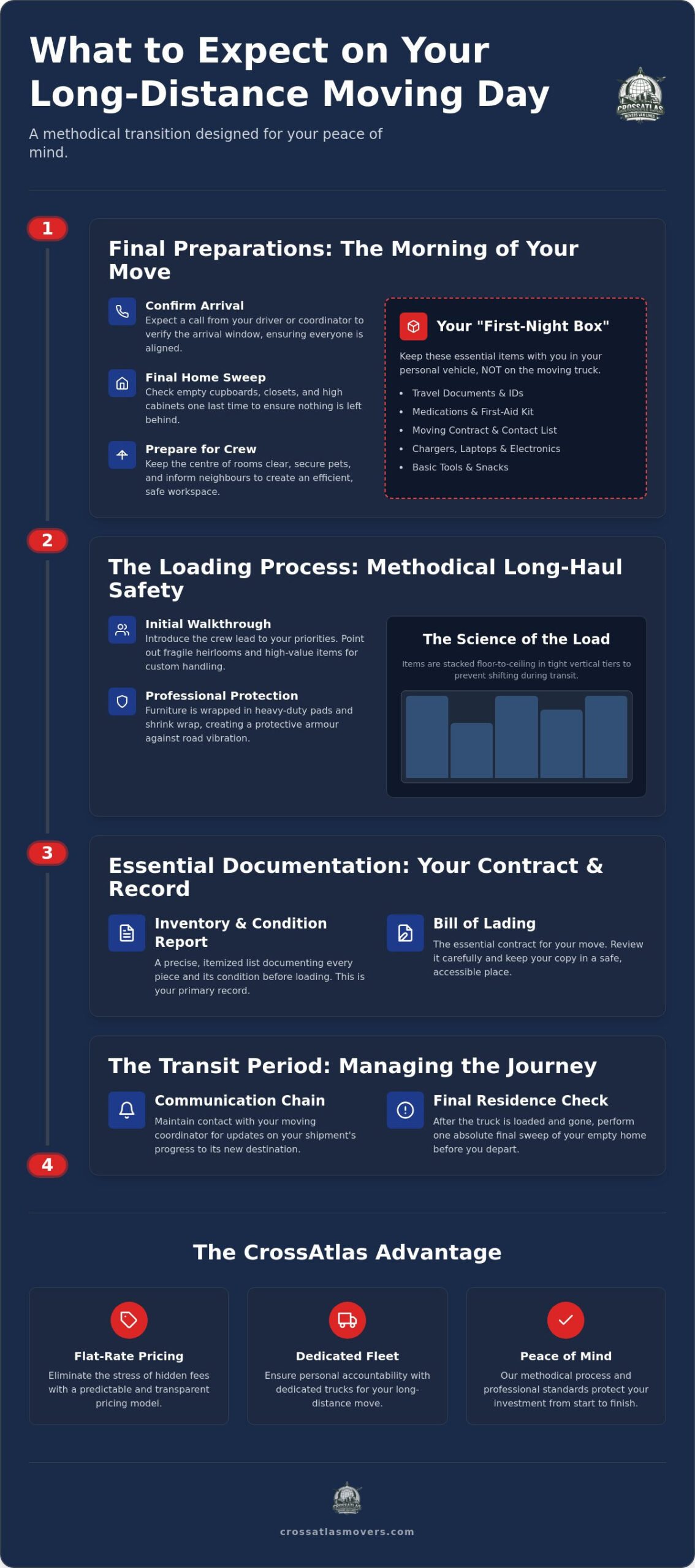
The sun hasn’t quite risen, but your cross-country journey begins now. One of the most critical parts of what to expect on moving day long distance is the early confirmation of logistics. You should receive a call from your moving coordinator or the driver to verify the arrival window. This simple check ensures everyone is aligned before the heavy lifting begins. It’s the first step in a methodical day designed to protect your belongings and your schedule. Understanding what to expect on moving day long distance helps you maintain a sense of calm and control from the very first hour.
Moving is often cited as a highly stressful activity, especially when crossing provincial or national borders. To lower your heart rate, start your morning with a final walkthrough of empty cupboards and closets. It’s easy to overlook a stray coat in the back of a hall closet or a forgotten appliance in a high cabinet. Once the crew arrives, the pace of the day accelerates. This quiet moment of verification provides the necessary peace of mind that nothing is being left behind in the rush.
The Essentials Box: What to Carry Yourself
Certain items are too vital to be placed in the back of a moving truck. Your “First-Night Box” should stay with you in your personal vehicle. This includes travel documents, medications, and basic tools you might need the moment you arrive at your new home. Never pack your moving contract or contact list; keep them accessible on your phone or in a physical folder. Organizing chargers, snacks, and personal electronics for the journey ensures you don’t have to rummage through sealed boxes at a rest stop or hotel along the way.
Preparing Your Home for the Crew
A professional crew operates best when they have clear pathways and a logical staging area. Try to keep the centre of each room clear of small debris or loose items. This allows the movers to bring in furniture pads and wrapping materials without obstruction. Efficiency on moving day is a partnership between you and the team.
- Secure pets in a quiet room or a kennel to prevent accidents or escapes.
- Inform neighbours about the truck’s placement to ensure a smooth loading process and maintain good relations.
- Perform a final visual check to ensure all boxes are properly organized and labelled with their destination rooms.
Protecting your floors is equally important. While professional teams often bring runners, having your own floor protection ready shows a high level of care for the property. This proactive approach helps the crew focus entirely on the safe handling of your furniture. It’s about creating an environment where precision and safety are the top priorities for everyone involved.
The Loading Process: A Methodical Approach to Long-Haul Safety
Once the initial morning preparations are complete, the physical transition of your home begins. Understanding what to expect on moving day long distance involves recognizing that the loading phase is a precise engineering task rather than just a feat of strength. The process starts with an initial walkthrough where you introduce the crew lead to your specific priorities. This is the moment to point out fragile heirlooms, high-value electronics, or items that require custom handling. By establishing these priorities early, you ensure the team can plan the truck’s “puzzle” with your most important belongings in mind.
A long-distance move demands a higher standard of protection than a local relocation. On a cross-country journey, your furniture will experience thousands of kilometres of road vibration and several provincial border crossings. To mitigate this, professional crews use a methodical wrapping process. We apply heavy-duty furniture pads and shrink wrap to create a protective armour for every piece. This prevents surface scratches and provides structural support during transit. Because of this meticulous attention to detail, you should realize that loading for a long-haul trip naturally takes significantly longer than a local move.
The Science of the Load
Professional loading is a calculated effort to ensure highway safety and item security. Crews employ a “high-tier” loading strategy, where items are stacked tightly from the floor to the ceiling in vertical sections. This method prevents the load from shifting forward or backward during sudden stops or steep inclines. Weight distribution is also critical; placing heavier items at the base and over the truck’s axles ensures better balance and handling for the driver. For exceptionally fragile or oddly shaped items, custom crating provides a rigid secondary layer of safety that standard boxes cannot offer.
Communication with the Crew Lead
Your crew lead acts as the methodical expert on-site and your primary point of contact. It’s essential to clearly identify “do not move” items, such as the essentials box or personal documents you plan to carry yourself. If you notice a specific piece of furniture that requires extra padding or have a question about how a box is being stacked, provide that feedback directly to the lead. They are responsible for maintaining professional standards and ensuring your inventory is handled with care. Choosing a partner with their own fleet of trucks ensures that this chain of accountability remains unbroken from the moment the ramp is lowered until the final item is placed in your new home.
Essential Documentation: Understanding Your Inventory and Bill of Lading
While the moving crew handles the physical lifting, your role shifts to that of a methodical supervisor. A key part of what to expect on moving day long distance is the formal transition of legal custody through detailed paperwork. The most vital document you will encounter is the Inventory and Condition Report. Unlike a simple DIY list, this official record details the state of every item before it enters the truck. It serves as the definitive reference point for the entire journey and ensures that both you and the moving team are in complete agreement about the condition of your belongings.
Professional movers use a standardized shorthand to describe pre-existing wear on furniture. You will likely see codes such as “SC” for scratched, “CH” for chipped, or “D” for dented. It is important to review these notations carefully during the loading process. If a mover notes a scratch on a dining table that you believe is pristine, address it immediately. This transparency protects the integrity of the move and prevents confusion upon delivery. This level of detail is a hallmark of a professional long-haul operation and provides a layer of security for your investment.
The Bill of Lading is the actual contract for the transportation of your goods. It includes the terms of service, the agreed-upon delivery window, and the final costs. Before the truck departs, you must verify that the “flat-rate” quote you were originally provided matches the figures on this final paperwork. This verification step is essential for your peace of mind; it eliminates the fear of hidden fees and confirms the financial predictability of your relocation. Understanding what to expect on moving day long distance means knowing your rights and ensuring the paperwork reflects the professional standards you were promised.
The Tagging System
Every box and piece of furniture receives a unique, colour-coded tag with a specific identification number. The crew cross-references these tags with the master inventory to ensure nothing is overlooked during the thousands of kilometres in transit. We recommend performing a “walk-behind” during this process. Following the mover as they tag items allows you to verify that the labels are secure and the descriptions are accurate before the doors are sealed.
Signing Off with Confidence
Before you sign the Bill of Lading, take a moment to ensure your delivery address and contact information are 100% accurate. Even a small typo can cause significant delays during a cross-country journey. Under Canadian moving regulations, you have specific rights regarding the handling of your shipment and the accuracy of your estimate. Signing with confidence means you have reviewed the inventory, confirmed the price, and understand the communication chain that will remain active until the truck arrives at your new home.
The Transit Period: Managing the Gap Between Loading and Delivery
Once the moving truck pulls away from your curb, the “transit gap” begins. This is the period between loading and delivery that often causes the most anxiety for families. Understanding what to expect on moving day long distance includes knowing how to manage these days of silence effectively. Before you lock the door for the last time, perform a final “Empty House” walkthrough. Check the back of every cupboard, the high shelves in the garage, and the corners of the attic. This final sweep ensures that the transition of custody is truly complete and nothing essential is left behind.
During this period, clear communication protocols are your best tool for peace of mind. You should have a direct line to your moving coordinator or the driver. Establish how and when you will receive updates before you leave the driveway. It’s also vital to understand the difference between “Guaranteed Delivery Dates” and delivery windows. A guaranteed date provides a specific arrival time, whereas a window offers a range of days. Knowing which one is in your contract allows you to plan your own travel and temporary accommodation without the stress of the unknown.
You must also prepare for the arrival of a 53-foot trailer at your new destination. These vehicles require significant space to turn and park. If your new home is on a narrow street or in a busy city centre, you may need to coordinate with local authorities for parking permits or “no parking” signs. Identifying these logistical hurdles before the truck arrives prevents delays and ensures a smooth unloading process. If you are still in the planning stages, you can request a flat-rate quote to see how our methodical approach simplifies these complex logistics.
Tracking Your Belongings
We manage our own fleet of trucks, which allows for direct tracking and personal accountability. You won’t have to worry about sub-contractors or unknown drivers handling your shipment. It’s essential to stay reachable by phone throughout the transit period. While we plan for efficiency, weather delays on major Canadian highways, such as the Coquihalla or the Trans-Canada, can occasionally impact schedules. Our coordinators provide real-time updates so you are never left guessing about the location of your goods.
Preparing for the Unloading Day
Before the truck arrives, ensure all utilities are realized and active at your new residence. You don’t want to be unloading furniture in a house without heat, water, or electricity. Take the time to plan your furniture layout in advance. Knowing exactly where each large piece belongs speeds up the unloading process and helps the movers work more efficiently. For more tips on settling into a new province, reference our comprehensive interprovincial guide to ensure every detail of your transition is covered.
Choosing a Partner for the Long Haul: The CrossAtlas Advantage
Selecting the right partner is the final piece of the puzzle when determining what to expect on moving day long distance. While many companies act as brokers and sub-contract your shipment to unknown third parties, we maintain a family-owned operation with our own dedicated fleet. This structure ensures personal accountability on-site; the team loading your belongings is the same organization responsible for their safe arrival. This continuity of care eliminates the “unknown driver” variable and provides a consistent standard of service that large, fragmented corporations often struggle to match.
Professional packing services also play a significant role in reducing moving day stress. When our experts handle the packing, you gain the assurance that every item is secured using industry-leading materials and techniques. This methodical approach to preparation allows you to focus on the emotional transition of your relocation rather than the logistics of bubble wrap and tape. By combining professional packing with our “capable protector” persona, we remove the physical and mental burdens of the move, allowing you to step into your new life with confidence.
Flat-Rate Pricing: No Clock-Watching on Moving Day
A major distinction in what to expect on moving day long distance compared to a local move is the pricing structure. Local moves often rely on hourly rates, which can create a high-pressure environment where you feel the need to rush the crew to save money. Rushed loading is unsafe loading. In contrast, our model uses a fixed-price contract. This eliminates “hidden fee” anxiety and ensures that our team can take the necessary time to wrap, pad, and secure your items properly without the clock ticking against your budget. You can learn more about how our flat-rate moving quotes protect your financial interests during complex transitions.
Professionalism You Can Trust
The CrossAtlas commitment to punctuality and transparency is at the heart of everything we do. We realize that a cross-border or international relocation involves layers of regulatory compliance that require a seasoned expert’s touch. Our crew leads are trained to manage these complexities with quiet efficiency, ensuring your paperwork is in order and your inventory is tracked with precision. We take pride in our “old-school” work ethic, where a handshake and a clear contract still mean something. If you are ready to experience a move defined by reliability and care, take the first step today by requesting your free, no-obligation quote from our team.
Step Into Your New Chapter with Confidence
Transitioning to a new province or country is a significant milestone that requires precision and professional care. By understanding what to expect on moving day long distance, you’ve already taken the most important step toward a predictable and successful relocation. A methodical approach to your inventory and a clear understanding of your Bill of Lading will transform a high-stress event into a manageable, organized process. Focus on the excitement of your new destination while our experts handle the complexities of the road.
At CrossAtlas Movers, we believe you deserve a partner who values integrity as much as you do. As a family-owned and operated business, we provide personal accountability and a dedicated fleet of trucks to ensure consistent service quality. Our commitment to flat-rate pricing eliminates the anxiety of hidden fees; the price we quote is the price you pay. Get Your Guaranteed Flat-Rate Moving Quote from CrossAtlas Movers Today and let us protect what matters most to you. Your new beginning is just around the corner, and we’re here to ensure you arrive with total peace of mind.
Frequently Asked Questions
How long does the loading process typically take for a long-distance move?
Loading a standard two- to three-bedroom home typically takes between four and eight hours. This timeline is longer than a local move because the crew must employ a methodical high-tier loading strategy to prevent shifting during thousands of kilometres of transit. The total volume of your belongings and the complexity of your furniture will ultimately determine the exact duration of the loading phase.
Do I need to be present for the entire moving day?
You or a designated representative must be present for the entire loading process to ensure a smooth transition. This is essential for conducting the initial walkthrough, verifying the condition report, and signing the final Bill of Lading. Your presence allows you to communicate priorities clearly and perform the final “Empty House” sweep before the driver seals the truck doors.
What happens if the movers find more items than were on the original quote?
If our crew identifies items that weren’t included in your original inventory, we will address the discrepancy before loading begins. Since we provide flat-rate pricing based on a specific volume or weight, adding significant items may require a revised quote to reflect the extra space required. We prioritize transparency, so any adjustments are discussed and documented to ensure there are no surprises upon delivery.
How do movers protect my furniture from damage during a cross-country trip?
Every piece of furniture is protected with heavy-duty padding and industrial-strength shrink wrap to create a secure barrier against road vibration. This armour prevents surface scratches and structural damage over long distances. For high-value or exceptionally fragile pieces, we use custom crating to provide a rigid layer of safety that standard wrapping techniques cannot match during a provincial border crossing.
Should I tip my long-distance moving crew on loading day?
Tipping is never required but is always appreciated as a gesture for exceptional service and hard work. In Canada, many clients choose to provide between $20 and $50 per crew member for a full day of loading. Providing cold water, snacks, or a simple lunch is another thoughtful way to show appreciation for the team’s efforts during a high-stress transition.
What is a Bill of Lading, and why is it so important for my move?
The Bill of Lading is the legal contract between you and the mover for the transportation of your goods. It outlines the terms of service, delivery windows, and final costs, making it a critical part of what to expect on moving day long distance. You should never allow the truck to leave without a signed copy of this document in your possession as it serves as your receipt.
Can movers transport my pets or plants across provincial borders?
Professional movers cannot transport pets or live plants in the moving truck due to safety and climate control limitations. Animals require specialized transport or should travel with you in your personal vehicle to ensure their well-being. Additionally, various provincial regulations regarding soil and pests often restrict the movement of certain plant species across borders, making personal transport a necessity.
What should I do if it rains or snows on my moving day?
Our crews are prepared to work through various weather conditions by using floor runners and extra plastic wrapping to protect your home and belongings. While rain or snow may slightly slow the pace of loading to ensure safety, the process will typically proceed as planned. Understanding what to expect on moving day long distance in inclement weather helps you prepare by clearing ice or snow from walkways before the crew arrives.