
A cross-country move is a massive logistical operation, not just a simple transport service, and your success depends on a structured 8-week countdown. If you’re feeling a sense of anxiety regarding the safety of your furniture during a long-haul transit or the possibility of surprise fees, your concerns are completely valid. Relocating your family across Canada involves many moving parts that require expert coordination and a steady, methodical approach. You don’t just need a truck; you need a reliable plan that removes the burden of uncertainty from your shoulders.
This comprehensive cross country moving checklist is designed to provide that peace of mind through a detailed, week-by-week timeline. We promise to help you master every detail of your relocation, ensuring your household goods arrive safely while maintaining transparent pricing without hidden surcharges. This guide previews exactly what you must handle each week, from the initial sorting of your possessions to the final logistics of provincial documentation. By following this structured path, you’ll realize that a move of this scale can be handled with the calm confidence of a perfectly timed transition.
Key Takeaways
- Establish a Moving Command Centre eight weeks before your departure to organize every logistical detail and maintain a clear, stress-free timeline.
- Use this cross country moving checklist to audit your inventory by comparing replacement values against transport costs, helping you downsize effectively for the long haul.
- Ensure the safety of your goods across provincial borders by employing professional packing standards, including the use of double-walled boxes for heavy items.
- Secure a seamless transition by managing essential administrative tasks, such as scheduling utility transfers and setting up mail forwarding with Canada Post well in advance.
- Maintain control on moving day by conducting a final walkthrough and carefully verifying the Bill of Lading before the truck begins its journey across Canada.
Planning Your Cross Country Move: The 8-Week Master Timeline
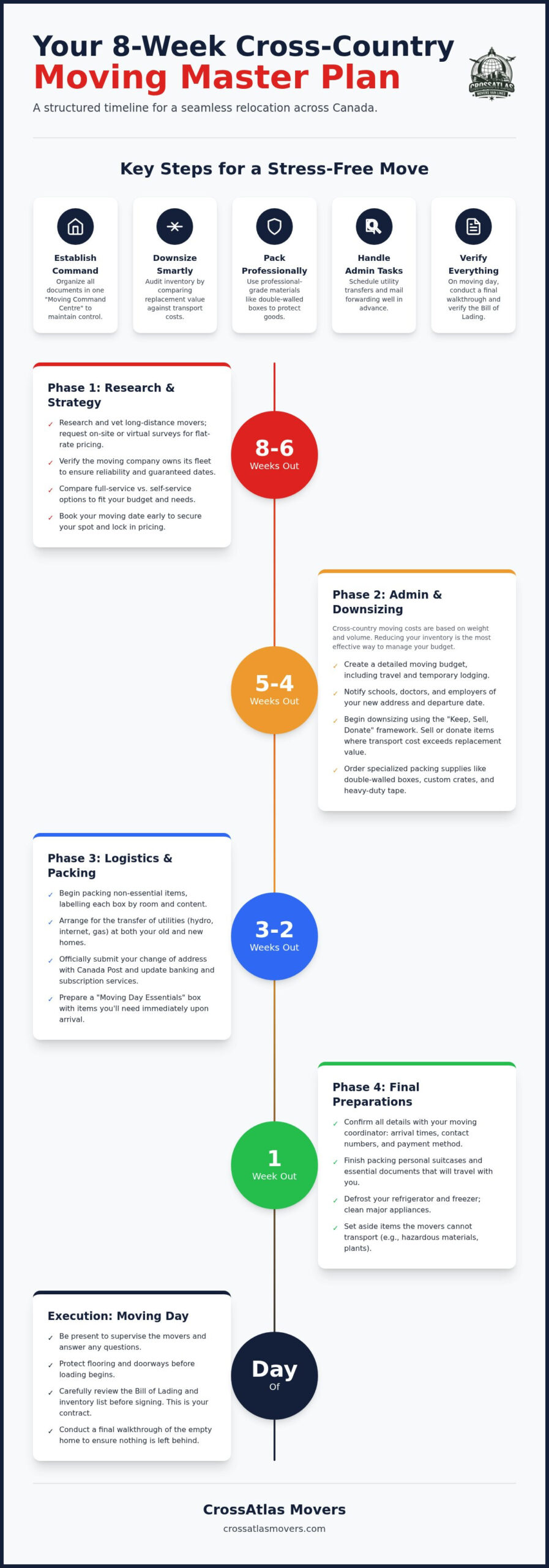
A long-distance relocation across Canada is a complex undertaking that requires a steady hand and a clear roadmap. To manage this process effectively, your first step is to establish a “Moving Command Centre.” This can be a physical binder or a dedicated digital folder where you centralize all contracts, receipts, and your cross country moving checklist. Having a single source of truth prevents the loss of vital documents and ensures you remain the methodical expert of your own transition. By organizing your paperwork early, you create a foundation of security that lasts until the final box is unpacked.
Researching cross country movers should begin at least two months before your target date. During this phase, request on-site or virtual surveys to ensure you receive accurate, flat-rate pricing rather than vague estimates. A critical detail often overlooked is verifying whether the company owns its fleet. Companies that operate their own trucks, rather than relying on third-party brokers, provide superior reliability and can offer guaranteed delivery dates. This level of accountability is essential for a smooth transition, as it eliminates the anxiety of your belongings sitting in a warehouse while a broker searches for a driver.
Weeks 8 to 6: Research and Strategy
Compare service levels between full-service long-distance movers and self-service options to determine which fits your budget and energy levels. While self-service might seem cost-effective initially, the “capable protector” role of a professional team often provides better value by preventing transit damage. Always check for “No Hidden Fees” clauses in your initial moving contracts. Booking your date early is essential; it secures your spot in the carrier’s schedule and provides a firm foundation for the rest of your planning. Understanding the key differences between long distance movers vs van lines Canada at this stage can help you make a more informed decision about which service model best suits your family’s needs and budget.
Weeks 5 to 4: The Administrative Foundation
Success in the second month relies on a robust administrative setup. Create a detailed budget that accounts for travel, temporary lodging, and insurance coverage. It’s time to notify schools, doctors, and employers of your upcoming interprovincial move. Simultaneously, start gathering specialized packing supplies. High-value or fragile items require custom crating or heavy-duty materials to withstand the thousands of kilometres ahead. This proactive approach ensures that when the packing begins, you have every tool necessary for a damage-free delivery.
By following this cross country moving checklist, you’re not just moving house; you’re executing a well-planned logistical operation. Taking these steps eight weeks out ensures that the transition remains predictable and transparent, allowing you to focus on the excitement of your new Canadian home rather than the stress of the journey.
Inventory Management: Why Downsizing is Key for Long-Haul Success
Success in a long-haul relocation depends on your ability to distinguish between essential belongings and unnecessary weight. In Canada, moving costs are primarily dictated by a “Weight vs. Volume” pricing model. This means that every extra kilogram or cubic foot of space used in the truck directly increases your final bill. By integrating a rigorous downsizing phase into your cross country moving checklist, you transform your inventory from a burden into a streamlined asset. It is often more economical to sell mid-range furniture and purchase new items at your destination than to pay for their transport across several provinces.
A detailed inventory list serves as your primary defence during the insurance process. Should any damage occur during the thousands of kilometres in transit, having a pre-existing record of condition and value is indispensable. While a standard move out of state checklist might focus on the basics, an expert approach involves evaluating the replacement value of every item. If the cost to ship a heavy dresser exceeds its market value, it belongs in a “Moving Out” sale rather than on the truck. Use your cross country moving checklist to evaluate every item’s replacement value against its transport cost to ensure you aren’t paying to move items that have reached the end of their functional life.
The “Keep, Sell, Donate” Framework
Methodically categorize every room to reduce your shipment’s total volume. Utilize online marketplaces to sell electronics or furniture that are cheaper to replace. For larger-scale items that don’t sell, coordinate with local charities for donations well before the movers arrive. This process ensures only the most meaningful and valuable possessions occupy space in the fleet truck. If you’re looking for a precise understanding of how your inventory affects your costs, consider requesting a quote for flat-rate, long-distance moves to see the benefits of a leaner shipment.
Documenting High-Value Assets
Protecting your high-value items requires more than just careful packing. Take high-resolution photos of all electronics, antiques, and artwork to establish their condition before they leave your home. Keep original receipts for these items to simplify potential insurance claims. Items such as fine art or delicate heirlooms often require custom crating to survive the vibrations of a long-haul journey. Make sure you write a single sentence defining each high-value item on the Bill of Lading to ensure it is legally recognized during transit. This small administrative step provides the necessary protection for a truly smooth transition.
Packing for Distance: Protecting Belongings Across Provincial Borders
A cross-country journey puts significant physical stress on household goods. Unlike a local move where items stay on a truck for an hour, a long-haul trip involves thousands of kilometres of vibration and varying temperature changes. To ensure your belongings survive the trip, your cross country moving checklist must prioritize structural integrity. Use double-walled boxes for heavy items like books or kitchen appliances to prevent the bottoms from bursting during transit. This simple choice provides a critical layer of protection against the constant movement inherent in a long-haul journey across the Canadian landscape.
Precision in labeling is equally important for an organized arrival. Mark every box clearly with its destination room and a brief summary of its contents. This methodical approach saves hours of frustration when you begin the unpacking process at your new home. However, you must also be aware of what cannot go on the truck. Hazardous materials, perishables, and live plants are generally prohibited for cross-country trips due to safety regulations and the length of the journey. For those seeking maximum security and a hands-off approach, hiring full service long distance movers Canada ensures that every item is packed according to industry-leading safety standards.
Professional Packing vs. DIY
The decision between packing yourself and hiring professionals often comes down to the scale and value of your move. For a 3,000+ kilometre relocation, the time savings of professional labour are substantial. Beyond efficiency, professional packing often affects your transit insurance coverage. Many carriers only provide full replacement value protection for items they have packed themselves. Specialized items like mirrors, marble tops, and delicate glass require custom crating to withstand the road. A professional team brings the expertise and materials needed to secure these high-value assets, providing a level of safety that DIY methods rarely match.
The “First Night” Essentials Kit
Even with a guaranteed delivery date, you should prepare for your first 24 hours in a new home. Pack a separate suitcase containing toiletries, essential medications, and basic tools. This kit should also include important documents, phone chargers, and a change of clothes for every family member. It is vital to keep this suitcase in your personal vehicle rather than the moving truck. Having these essentials immediately accessible prevents the stress of searching through dozens of boxes just to find a toothbrush or a charging cable after a long day of travel. Including this step in your cross country moving checklist ensures your first night in a new province is spent in comfort rather than chaos.
The Essential Admin Checklist: Managing the Logistics of Relocation
While the physical transport of your belongings is a major milestone, managing the administrative transition of your life is equally critical for a smooth arrival. A robust cross country moving checklist must account for the legal and digital shift between provinces. Neglecting these details can lead to service interruptions or lapses in essential coverage. By approaching these tasks with methodical precision, you ensure that your legal identity moves with you, removing the burden of last-minute paperwork during your first week in a new home. If your relocation is employer-sponsored, reviewing a well-structured employee relocation policy can help you understand what costs and administrative steps your company may be responsible for covering.
Your first priority should be setting up mail forwarding with Canada Post at least two weeks before your departure date. This service provides a vital safety net while you update your address with the Canada Revenue Agency (CRA), your financial institutions, and insurance providers. Updating your bank and credit card information is particularly important; it ensures your billing address matches your new location, preventing potential issues with online transactions or identity verification. Organization at this stage creates a transparent record of your move, allowing you to focus on the journey itself.
Utilities and Service Transfers
To avoid arriving at a cold or dark home, schedule your utility connections well in advance. Ensure your internet and hydro services are active on the day of your arrival. Parallel to this, confirm the final meter reading date with your current providers to avoid being billed for usage after you’ve vacated the premises. Don’t forget to cancel local memberships, gym subscriptions, and recurring delivery services that are tied to your old neighbourhood. If you want to simplify your move further, booking province to province moving services allows you to focus on these administrative tasks while experts handle the heavy lifting.
Provincial Document Updates
Each province has specific regulations regarding driver’s licences and vehicle registrations. Most provinces offer a grace period, often between 30 to 90 days, to update your documents. Researching these provincial health insurance wait periods is also essential; for example, several provinces require a three-month residency period before coverage begins. During this gap, you may need to maintain private insurance or ensure your previous provincial plan remains active. Registering your vehicle and updating your auto insurance is not just a legal requirement but a necessary step to reflect your new location. Finally, transferring your voter registration ensures you’re ready to participate in your new community’s future provincial elections.
Executing Moving Day: Navigating the Final Transition with Confidence
Moving day represents the final transition in your logistical journey. It is the moment where your 8-week preparation meets execution. To maintain a sense of security, you must approach this day with the steady composure of an expert. Your cross country moving checklist reaches its conclusion here, but your focus must remain sharp to ensure nothing is left behind. By following a methodical closing process, you can hand over your keys with the peace of mind that every detail has been managed.
Before the truck departs, conduct a comprehensive walkthrough of every room, closet, and storage space. It’s easy to overlook items in the attic or the back of a kitchen cupboard during the rush of loading. Once the house is empty, verify the Bill of Lading and the inventory list with the driver. This document is your primary legal protection during the long-haul journey across Canada. Provide the moving crew with your direct contact information and the exact delivery address to maintain clear communication across provincial lines. For those navigating specific long-distance routes, reviewing a Vancouver to Toronto moving guide provides valuable insights into the transit times and regional logistics of such a vast relocation.
Final Home Preparation
Cleaning the home thoroughly once the truck is loaded is a vital step to fulfil your sale or lease agreement. It demonstrates personal accountability and ensures the next occupants arrive to a welcoming space. Turn off all lights, lock every window, and secure the keys according to your previous arrangements. Take high-resolution photos of your utility meters. These images serve as a final record for your billing and prevent any disputes regarding usage after your departure. This simple administrative step is the final piece of your cross country moving checklist before you head to your new destination.
Partnering with Reliable Cross Country Movers
Selecting a family-owned company for your relocation ensures a level of care that large corporate entities often lack. These specialists act as a “capable protector” for your belongings, treating your family’s history with the respect it deserves. Reliability in 2026 depends on guaranteed delivery dates; you shouldn’t have to live in an empty house because of a broker’s scheduling error. Confirm that your final price reflects your initial flat-rate quote. This transparency removes the fear of surprise surcharges, allowing you to step into your new Canadian home with absolute confidence in your transition.
Master Your Transition Across Canada
Relocating across the country is a significant life event that requires more than just transport; it demands a methodical approach to every administrative and physical detail. By following this cross country moving checklist, you’ve established a timeline that prioritizes safety and precision from the initial downsizing phase to the final walkthrough. You now have the tools to manage your transition with the quiet efficiency of a seasoned professional, ensuring your belongings arrive safely at your new doorstep.
A successful move is built on a foundation of trust and personal accountability. CrossAtlas Movers is a family-owned and operated specialist dedicated to being the capable protector of your household goods. We provide guaranteed delivery dates using our own fleet of trucks and offer transparent flat-rate pricing to ensure you don’t face hidden fees or 2026 pricing surprises. Get your free flat-rate cross-country moving quote from CrossAtlas Movers today. We look forward to helping you realize a smooth and stress-free transition to your new Canadian home.
Frequently Asked Questions
How far in advance should I book cross country movers?
You should book your movers at least eight to twelve weeks before your desired moving date. This lead time is essential to secure a spot on a carrier’s schedule, especially during the busy spring and summer months. Early booking ensures you can follow your cross country moving checklist without the stress of last-minute logistics or limited availability for your specific route.
What is the average cost of moving cross country in Canada?
The cost of a long-distance relocation in Canada depends on the total weight of your belongings, the distance travelled, and the level of service you select. Factors such as professional packing and specialized crating for high-value items will also influence the final investment. Most reputable companies provide a flat-rate quote after an on-site or virtual survey to ensure transparent pricing for your specific needs.
Can I pack my own boxes for a long-distance move?
You can certainly pack your own boxes, though it’s important to understand how this choice affects your transit protection. Many moving companies only provide full replacement value insurance for items their professional teams have packed. If you choose the DIY route, ensure you use double-walled boxes and high-quality materials to withstand the thousands of kilometres of vibration during a cross-country journey.
What items are prohibited from being transported in a moving truck?
Prohibited items typically include hazardous materials such as propane tanks, aerosol cans, and flammable liquids like gasoline or paint thinner. Perishable foods and live plants are also excluded because they cannot survive the duration of a long-haul trip. You should also keep personal valuables, such as jewellery and essential legal documents, with you in your personal vehicle rather than on the truck for maximum security.
How do I transfer my provincial health insurance when moving?
You must apply for health insurance in your new province as soon as you arrive, as coverage is not automatically transferred. Most provinces have a three-month residency waiting period before you become eligible for their specific plan. During this transition, your previous province will generally continue to cover your basic healthcare needs, but you should verify this with both provincial authorities to avoid any gaps in your medical protection.
What is a Bill of Lading and why is it important?
The Bill of Lading is the official contract between you and the moving company that outlines the terms, conditions, and details of the transport. It serves as your receipt and a legal record of the goods being shipped across the country. You must review this document carefully and ensure it accurately reflects your inventory and the agreed-upon price before the truck departs your home to ensure total transparency.
How long does it typically take to move across Canada?
A cross-country move typically takes between seven and twenty-one days, depending on the total distance and the specific route. Factors such as weather conditions and the number of stops the truck makes can influence the delivery window. Choosing a mover that offers guaranteed delivery dates provides the security of knowing exactly when your belongings will arrive at your new residence, allowing you to plan your arrival with confidence.
Should I buy extra insurance for a cross-country move?
Purchasing additional transit protection is highly recommended for long-distance moves to safeguard your investment against unforeseen events. While basic liability is often included, it typically only covers a small fraction of an item’s actual value. Full replacement value protection ensures that your household goods are covered for their current market value. This provides essential peace of mind during a high-stakes relocation where goods travel thousands of kilometres.