
The largest national moving network might actually be the most complicated choice for your family’s cross-country relocation. With over 4 million Canadians moving in 2025 alone, the choice between long distance movers vs van lines canada has never been more significant for those seeking a smooth transition. Many families realize too late that a massive network can sometimes lead to fragmented accountability, especially when sub-contractors or weight-based pricing models enter the picture.
It’s natural to feel anxious about hidden fees appearing after your truck is weighed or to worry about your delivery date shifting without notice. You deserve a moving partner that values transparency. This guide will clarify the operational differences between these two models so you can choose a reliable, cost-effective partner for your 2026 move. We’ll explore how specific pricing structures and fleet ownership models impact your final invoice and your overall peace of mind.
Key Takeaways
- Learn the structural differences between national networks and independent long distance movers vs van lines canada to select the most reliable partner for your relocation.
- Understand how the agent and subcontractor model impacts accountability, ensuring you know exactly who is responsible for your goods at every stage.
- Compare weight-based estimates with flat-rate pricing to avoid hidden fees and maintain total control over your moving budget.
- Recognize the reliability of companies that operate their own truck fleets, which often results in more precise delivery dates and professional handling.
- Evaluate the benefits of family-owned accountability for cross-country moves, focusing on direct communication and personal care for your belongings.
Defining the Players: Van Lines vs. Independent Long Distance Movers in Canada
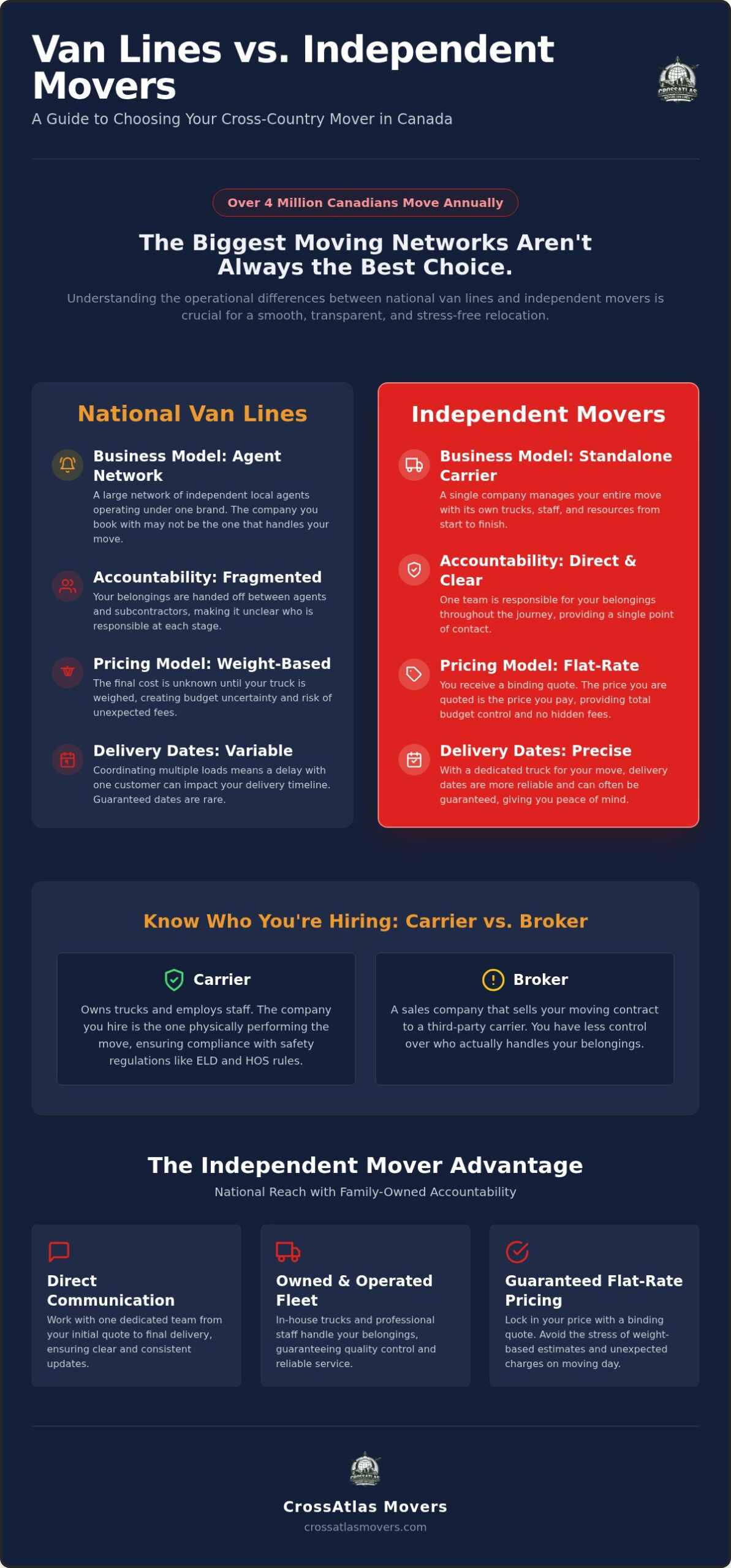
The first step in any successful relocation is identifying who will actually handle your possessions. When evaluating long distance movers vs van lines canada, you’re choosing between two fundamentally different business models. A moving company can operate as a single carrier or as part of a massive national network. This distinction matters because it dictates how many sets of hands will touch your furniture and who is ultimately responsible if a challenge arises during the journey. Understanding these roles helps you avoid the common pitfalls of fragmented logistics.
What is a Canadian Van Line?
A van line is a network of independent local agents that pay to operate under a single national brand. While the logo on the truck looks familiar, the agents themselves are often separate businesses with their own owners and staff. This model offers a broad reach into remote Canadian regions, but it introduces logistical complexity. Your move might start with a local agent in the Maritimes and finish with a different agent in British Columbia. This hand-off process can sometimes lead to fragmented communication or shifts in delivery timelines as goods move through the network. The national brand sets the standards, but the local agent performs the work.
What Defines an Independent Long Distance Mover?
An independent mover is a standalone carrier that manages every aspect of your relocation with its own resources. They use a directly owned fleet model, meaning the same company employs the driver and the packing crew. This setup eliminates the need for third-party agents and maintains a single chain of command. You’ll find that communication is often more direct because you’re speaking with the team that has physical control of your shipment. It’s a methodical approach that prioritizes accountability from the moment the truck is loaded until the final box is placed in your new home.
It’s also vital to understand the difference between a carrier and a broker. A carrier owns the trucks and employs the staff, whereas a broker only sells the moving contract to another company. With 2026 regulations like Electronic Logging Devices (ELD) and Hours-of-Service (HOS) rules, working directly with a carrier is safer. These federal requirements ensure drivers are well-rested and that transit times are realistic. By choosing a carrier rather than a broker, you ensure that the people you hire are the ones performing the work. This is especially important for those moving to Alberta, which has led the country in net interprovincial migration for 15 consecutive quarters. For such high-demand routes, direct accountability is the best way to ensure your delivery date is met.
How Van Line Networks Operate: The Agent and Subcontractor Model
When you book with a national brand, you aren’t necessarily hiring the people who will drive the truck or handle your furniture. This hand-off process is a core component of the network model. A local agent in your city typically performs the initial estimate and packing. They then transfer your belongings to a long-haul driver who works for the national brand or another agent. Finally, a delivery crew at your destination unloads the goods. When evaluating long distance movers vs van lines canada, you must decide if you’re comfortable with your possessions changing hands multiple times during their journey across the country.
This logistical chain makes guaranteed delivery dates difficult to secure. Because the long-haul driver is often coordinating loads from several different agents to fill a single trailer, a delay with one customer impacts everyone else on that truck. If an agent in Winnipeg is late loading their portion, your delivery in Vancouver could be pushed back by days. This lack of direct control is a significant factor in the anxiety many families feel during a relocation.
The Subcontracting Reality
Subcontracting in the moving industry is the practice of delegating the physical transport to a third-party agent. This often means your move is “sold” to a driver from a different company within the network who might have different packing standards or labour quality than the agent who gave you the initial quote. While the national brand sets overall guidelines, the actual execution depends on the specific agent assigned to your file that week. This can lead to inconsistencies in how fragile items are protected or how the inventory is managed. If you value a consistent experience, you might prefer a partner that manages residential moving services with a dedicated, in-house team.
Accountability Gaps in Large Networks
Who do you call if a box goes missing between provinces? In a large network, the lines of responsibility are often blurred. The local agent might claim the item was loaded correctly, while the long-haul driver insists it wasn’t on the truck when they took over. Navigating corporate customer service to resolve these “split accountability” issues can be frustrating compared to the direct care provided by a family-owned operation. You often find yourself caught between different businesses that all operate under the same logo but maintain separate bottom lines.
Accountability is especially critical when filing a claim for damages. Because multiple crews handled your goods, the national brand must determine which agent is financially responsible for the repair or replacement. This internal investigation can delay your settlement for weeks. For those preparing for a relocation, using a Cross Country Moving Checklist: Everything to Do Before You Move can help you document the condition of your items before they enter this complex system. Having clear evidence is your best protection when dealing with the fragmented nature of a van line network.
Pricing Transparency: Flat-Rate Fees vs. Weight-Based Estimates
The final invoice should never be a source of anxiety. When you compare long distance movers vs van lines canada, the pricing structure is often the most significant point of departure. Van lines typically rely on a weight-based model, where your final cost is determined by a scale ticket after the truck is loaded. This creates a period of uncertainty between the initial estimate and the delivery. Conversely, a flat-rate model provides a fixed price based on a detailed inventory, ensuring the amount you see on your quote is the amount you pay on moving day. For 2026 Canadian relocations, families increasingly favour this certainty to maintain strict control over their housing transition budgets.
The Uncertainty of Weight-Based Quotes
Van lines often use complex tariff books to calculate costs. These documents link the weight of your goods to the distance travelled, but they can be difficult for consumers to interpret. The primary risk is the re-weighing process. If your shipment is heavier than the original estimate, your bill increases automatically. Beyond the base rate, several variables can inflate the final total:
- Fuel Surcharges: In 2026, fuel surcharges of 3 to 8 percent are common additions to base rates. These are often variable and can change between your quote date and your move date.
- Accessorial Charges: Costs for long carries, stair fees, or shuttle services if a large van cannot reach your new home.
- Packing Materials: Surcharges for specialized boxes or tape that weren’t included in the initial “rough” estimate.
This model places the financial risk on the homeowner, as the final price isn’t confirmed until the truck crosses a certified scale.
The Security of Flat-Rate Moving
A fixed-rate contract protects your budget from market volatility and estimation errors. When you choose a flat-rate partner, a professional assessor creates a comprehensive inventory of your home. The resulting quote is a binding agreement. This means you don’t have to worry about the weight of your heavy oak table or how many stairs are at your destination; the price is locked in. A truly flat quote should encompass labour, transport, and professional packing services. This transparency is a cornerstone of a Full Service Moving Company Canada: The 2026 Buying Guide, which highlights how fixed pricing eliminates the “hidden fee” trap. By removing the scale from the equation, you gain peace of mind and the ability to plan your post-move finances with precision.
Choosing a flat-rate model also aligns with the current trend of moving to smaller cities and suburbs. Since these moves often involve varying distances and differing home layouts, a fixed price ensures that a complex driveway or a third-floor walk-up won’t result in a surprise surcharge on delivery day. It’s a methodical approach that prioritizes the client’s financial security over industry-standard “estimates” that too often shift after the work has begun.
Evaluating Service Quality for Cross-Country Relocations
Service reliability during a 2026 relocation depends on more than just a brand name. When comparing long distance movers vs van lines canada, you must look at how a company manages its physical assets and its workforce. High-quality service starts with verifying credentials like active cargo insurance, Workers’ Compensation Board (WCB) compliance, and memberships in the Canadian Association of Movers (CAM). These aren’t just administrative details; they’re your primary protection against liability. A professional mover will provide these documents readily, demonstrating a methodical approach to safety and risk management.
The structure of your delivery window also signals the level of service quality you can expect. Many large networks offer a “delivery spread,” which is a range of several days or even weeks when your goods might arrive. This uncertainty forces families to live out of suitcases or incur extra hotel costs. In contrast, a dedicated service provider often provides a guaranteed delivery date. This precision allows you to coordinate utility hook-ups and work schedules with confidence, removing one of the most significant burdens of a cross-country move.
The ‘Own Truck’ Advantage
Dedicated fleets offer a level of security that sub-contracted networks cannot match. When a company owns its trucks, your belongings stay on the same vehicle from the moment they’re loaded until they reach your new home. This eliminates warehouse transfers, which is where the vast majority of loss or damage occurs in the moving industry. You also benefit from having the same crew handle your items at both ends of the journey. This consistency ensures that the people unloading your heavy furniture already know the best way to navigate it through a narrow hallway. Dedicated fleet owners maintain stricter oversight of vehicle maintenance, which reduces the risk of mechanical breakdowns on the Trans-Canada Highway.
Packing Standards for Long Hauls
A standard cardboard box isn’t designed for the vibrations and shifts of a 4,000km journey across the Canadian Shield. For a move like this, professional packing is a necessity rather than a luxury. High-value electronics, fragile glassware, and fine art require custom crating to survive the transit. If you’re planning a major move, our Vancouver to Toronto Moving Guide: The Complete Long-Distance Relocation provides specific insights into protecting your goods for the long haul. Using heavy-duty materials and specialized techniques ensures your belongings arrive in the same condition they left. For total peace of mind and professional handling of your inventory, consider booking our Long Distance Moving Services for your next province-to-province relocation.
The CrossAtlas Advantage: National Reach with Family-Owned Accountability
Deciding between long distance movers vs van lines canada often feels like a choice between the scale of a national corporation and the care of a local business. CrossAtlas Movers eliminates this compromise by providing a national reach managed through a family-owned structure. We operate as a direct carrier, which means we maintain total control over the logistics of your move from the initial estimate to the final delivery. This model ensures that the accountability remains with us throughout the entire process, providing a level of reliability that fragmented networks simply cannot replicate.
Our approach removes the uncertainty inherent in the traditional van line system. Because we own our fleet and employ our own crews, we don’t rely on agent hand-offs or third-party subcontractors. This is particularly vital for Cross-Border Moving Services and international relocation, where the complexity of customs and long-haul transport requires a single, dedicated point of contact. For those planning a global move, working with a qualified international moving company that understands shifting customs regulations and freight options is equally essential to protecting your belongings and your budget. You’ll always know exactly who is handling your goods, and you’ll have direct access to a coordinator who understands the specific details of your file. This direct communication simplifies your transition and ensures your requirements are realized exactly as planned.
Punctuality is a cornerstone of our service model. While large networks often struggle with delivery spreads, we provide guaranteed delivery dates to help you plan your new life with precision. We understand that your time is valuable. By managing our own schedules and maintaining our own equipment, we can commit to specific timelines that lower your stress levels and allow for a seamless move-in experience.
A Professional Partnership, Not Just a Service
We view ourselves as a capable protector of your household goods. This persona drives our commitment to transparency and meticulous care. Our flat-rate pricing model is designed to be a direct alternative to the weight-based estimates used by many long distance movers vs van lines canada. When we provide a quote, it includes all necessary labour, transport, and fuel costs, ensuring there are no hidden fees on your final invoice. This financial certainty allows you to focus on your family rather than worrying about a scale ticket.
Safety is integrated into every step of our process. We support your relocation with Professional Packing and custom crating for high-value or fragile items. Our teams are trained to use high-quality materials that withstand the rigours of interprovincial travel. Whether you are moving province to province or across the continent, our methodical expert approach ensures that your belongings are protected with the same care we would use for our own family.
Ready to Plan Your Relocation?
Starting your journey with a reliable partner is simple. To get an accurate flat-rate quote, we’ll conduct a thorough inventory of your home to understand the scope of your move. This ensures your quote is binding and comprehensive. Our team is ready to guide you through the next steps for booking your 2026 cross-country or cross-border move with the steady, composed support you deserve. Get your guaranteed flat-rate moving quote today and experience a relocation defined by transparency and personal accountability.
Planning a Predictable Move Across Canada
Choosing the right partner for your 2026 relocation requires a balance of national capability and personal accountability. While the debate between long distance movers vs van lines canada often focuses on network size, the most important factor is knowing who is responsible for your goods from start to finish. You deserve a transition defined by transparency, not by the uncertainty of weight-based estimates or subcontractor hand-offs. Our family-owned approach eliminates common anxieties by utilizing our own dedicated fleet, ensuring your belongings stay on one truck throughout their journey.
This methodical control allows us to provide guaranteed delivery dates and a flat-rate pricing model with no hidden fees. We specialize in interprovincial and cross-border relocations, acting as a capable protector for your possessions so you can realize a smooth transition to your new home. We take pride in our work and value the trust you place in our team. Our expert staff is ready to manage every detail of your upcoming journey with precision and care.
Ready to experience a predictable, high-quality move? Request Your Free Flat-Rate Moving Quote today.
Frequently Asked Questions
What is the main difference between a van line and an independent mover in Canada?
The primary distinction is the business structure and the level of direct accountability. A van line is a cooperative network of locally owned agents operating under a national brand name, whereas an independent mover is a single company that manages the entire relocation using its own staff and equipment. This means independent carriers offer a direct chain of command, while van lines involve multiple hand-offs between different agents.
Is it cheaper to use a van line or an independent moving company?
Cost-effectiveness depends on price certainty rather than just the initial estimate. Van lines often provide lower initial quotes based on estimated weight, but the final bill can increase if the shipment is heavier than expected. Independent movers using flat-rate models provide a fixed price upfront. For families choosing between long distance movers vs van lines canada, the cheaper option is often the one that eliminates surprise surcharges on delivery day.
How do van lines calculate the cost of a long-distance move?
Van lines use standardized tariff books that link the weight of your household goods to the distance of the haul. They weigh the truck empty and then again after loading to determine the net weight of your shipment. This model often includes additional fees for fuel surcharges, which in 2026 typically range from 3 to 8 percent, along with accessorial charges for stairs or long carries at your new residence.
What are the risks of using a moving company that subcontracts labour?
Subcontracting often leads to fragmented accountability and a higher risk of damage to your belongings. When a move is delegated to a third party, your goods may be transferred between different trucks or stored in warehouses during transit. This lack of a single, dedicated crew means that quality control is harder to maintain, and resolving claims for lost or broken items becomes significantly more complex for the consumer.
Can independent movers handle cross-border moves to the United States?
Yes, established independent movers are fully equipped to manage cross-border relocations to the United States. They must maintain specific federal carrier authority and adhere to international customs regulations. Choosing an independent carrier for these moves often provides a smoother experience because a single team handles the paperwork and transport, reducing the logistical friction often found in larger, multi-agent networks. Families planning to relocate south of the border can find a detailed overview of the process in our guide on how to move from Canada to USA, which covers everything from CBP documentation to long-haul logistics.
Why is flat-rate pricing better than weight-based pricing for long distances?
Flat-rate pricing is superior because it removes the financial risk from the homeowner and places it on the mover. In a weight-based system, you won’t know your final cost until after your belongings are already in transit. A flat-rate quote is based on a comprehensive inventory and remains fixed regardless of the final scale weight. This transparency is essential for managing the high costs associated with province-to-province moves.
Do independent movers have the same nationwide reach as van lines?
Many independent movers maintain a robust nationwide presence that rivals larger networks. By specializing in high-traffic interprovincial corridors, these companies provide consistent service between major Canadian hubs. While they may not have an agent in every small town, their dedicated fleets allow them to service most residential areas with greater precision and more reliable delivery dates than a fragmented network can typically offer.
How can I verify if a moving company owns its own truck fleet?
You can verify fleet ownership by requesting the company’s National Safety Code (NSC) or Commercial Vehicle Operator’s Registration (CVOR) number. Additionally, ask the estimator if the crew that loads your home in the origin city will be the same team unloading it at the destination. Companies that own their fleet will typically have branded equipment and permanent, full-time employees rather than temporary day labourers or third-party contractors.