
What if the safety of your most cherished heirlooms during a cross-country move wasn’t a matter of luck, but a precise engineering task? Most people feel a genuine sense of anxiety when picturing their delicate glassware or expensive electronics travelling thousands of kilometres across the country. It is difficult to ignore the fear of sentimental loss or the high cost of replacing specialized items if something goes wrong during the transition.
You can replace that stress with confidence by learning the exact techniques and materials professional fragile item packing movers use to ensure your belongings arrive in perfect condition. We understand that your valuables are more than just objects; they are parts of your life that deserve the highest level of protection. This article explores the methodical science behind secure relocation, detailing how custom crating and high-quality materials create a fail-safe environment for your most delicate items. By the end, you’ll understand how a structured, professional approach turns a high-stress move into a predictable and successful journey.
Key Takeaways
- Understand how professional teams neutralize road vibrations and stacking pressure to maintain the structural integrity of your valuables.
- Discover why specialized fragile item packing movers prioritize professional-grade newsprint and corrugated shielding over standard household supplies.
- Learn the “Floating” and “Burrito Wrap” methods used by experts to isolate delicate components from mechanical shock.
- Explore the benefits of engineered custom crating as the gold standard for protecting high-value items during international or cross-border transit.
- Realize how professional packing services help you maintain full liability coverage and save significant time during a complex move.
Understanding the Risks of Long-Distance Transit for Delicate Belongings
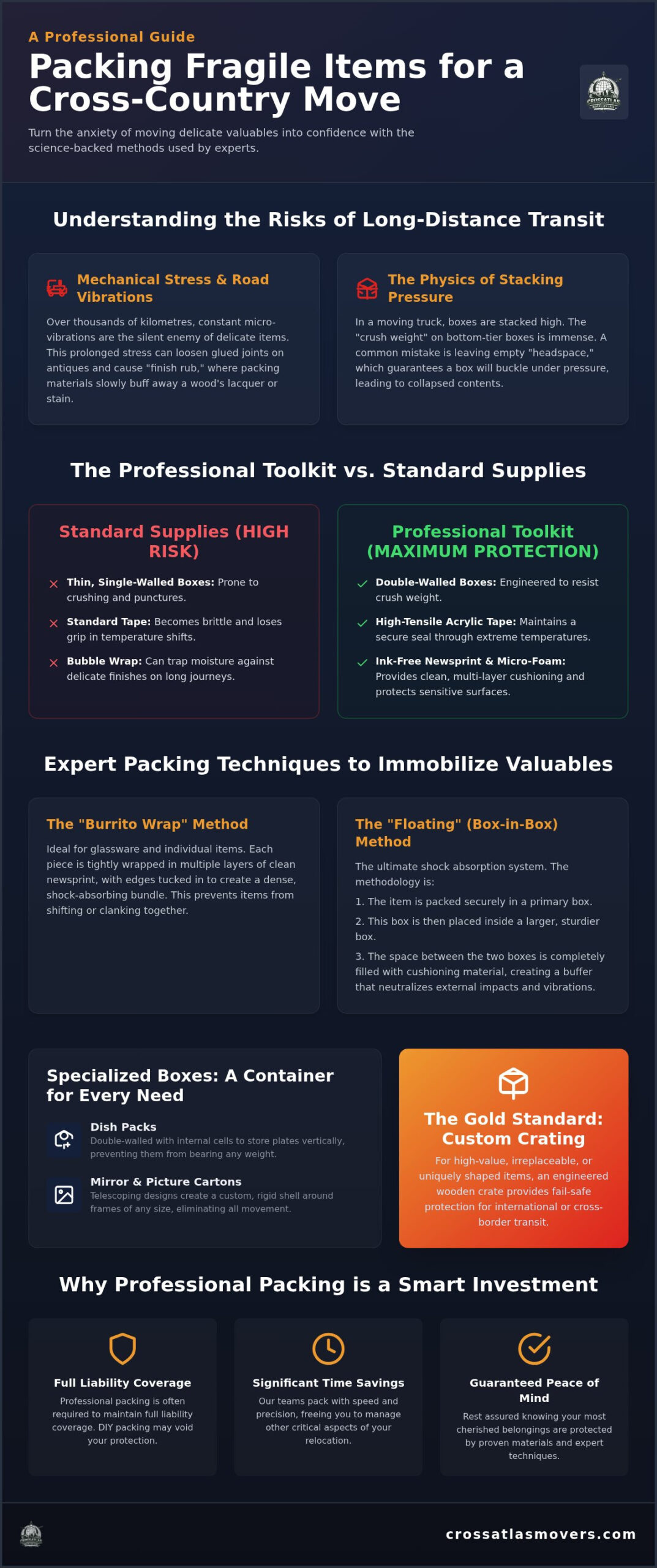
Transitioning from a local move to a province-to-province relocation changes the physical demands on your belongings. While a local move might involve a thirty-minute drive, a cross-country journey subjects your items to several days of continuous movement. Experienced fragile item packing movers recognize that time is a multiplier for risk. Every kilometre travelled increases the cumulative exposure to mechanical stress, making standard packing methods insufficient for long-haul transport.
Mechanical Stress and Road Vibrations
Constant micro-vibrations are the silent enemies of fine furniture and antiques. As a truck travels from Ontario to British Columbia, these vibrations can gradually loosen glued joints or cause delicate frames to shift. Standard household tape often becomes brittle or loses its grip under this prolonged stress. To counter this, professionals use high-grade Essential Materials for Fragile Item Packing, such as specialized furniture pads. These pads prevent “finish rub,” a common issue where the vibration causes the packing material to buff away the wood’s stain or lacquer over hundreds of kilometres.
The Physics of Stacking in Large Moving Trucks
In a long-distance trailer, space is utilized vertically to maximize efficiency, which introduces the challenge of “crush weight.” Boxes at the bottom of a tier must support the weight of everything above them for the duration of the trip. Professionals calculate this pressure and prioritize double-walled boxes for any item exceeding 10 kilograms. A critical mistake in DIY packing is leaving “headspace” at the top of a box. If a box isn’t filled completely to the brim with cushioning or structural support, the walls will eventually buckle under the weight of the load, leading to collapsed contents.
Environmental shifts also play a significant role. A shipment leaving the humid coast of the Maritimes and heading toward the dry prairies of Alberta will experience significant changes in atmospheric moisture. Wood can shrink or swell, and sensitive electronics can suffer from condensation if not properly sealed. Effective fragile item packing movers don’t just “cushion” an item to prevent it from breaking; they “immobilize” it within its container to neutralize these mechanical and environmental variables. This methodical approach ensures that your most valuable items remain static and secure, regardless of the distance they travel.
The Professional Toolkit: Essential Materials for Fragile Item Packing
High-quality materials serve as the foundation for any successful relocation. While most DIY movers rely on thin boxes from the grocery store, expert fragile item packing movers utilize industrial-grade supplies designed for the rigours of the road. The choice of material depends entirely on the item’s surface and structural vulnerability.
Professional-grade newsprint is often superior to bubble wrap for glassware. It provides a clean, ink-free barrier that allows for tight, multi-layer wrapping without the risk of trapping moisture against delicate finishes. For large, flat surfaces like mahogany tabletops or antique mirrors, corrugated cardboard rolls provide a rigid shield that prevents punctures and distributes pressure. High-end electronics require even more care. Micro-foam and anti-static wraps protect sensitive screens and internal circuits from static discharge and surface scratches that standard plastic can cause. Even the choice of adhesive matters. High-tensile acrylic tape is the industry standard because it maintains its seal during the extreme temperature shifts common in Canada, from coastal humidity to dry prairie air.
Specialized Boxes for High-Value Items
Professional movers don’t use a one-size-fits-all approach to containers. They utilize a variety of specialized boxes to manage weight distribution and external pressure:
- Dish packs: These feature double-walled construction and internal architecture that ensures plates are stored vertically, preventing them from bearing weight.
- Mirror and picture cartons: Telescoping designs create a custom, rigid fit for frames of any size, eliminating movement within the box.
- Wardrobe boxes: For a province to province move, these are essential for maintaining the structural integrity of delicate textiles and preventing crushing.
Cushioning vs. Void Fillers
Understanding the difference between cushioning and void filling is vital for long-haul safety. Cushioning protects against impact, while void fillers prevent internal movement. Crumpled paper is often superior to packing peanuts for heavy items because it doesn’t compress or shift under significant weight. By using “cells” and “dividers,” movers create individual safety zones within a single carton to prevent items from knocking against each other during transit. For framed art, edge protectors and reinforced corners add a final layer of security by absorbing shock at the most vulnerable points. These techniques ensure that even the most delicate porcelain or glass remains stationary throughout the trip. If you feel overwhelmed by these technical requirements, partnering with an expert team can ensure every item is secured with the right toolkit.
Step-by-Step Techniques for Packing Every Type of Fragile Item
Mastering the art of relocation requires more than just high-quality supplies; it demands a disciplined application of proven methods. Professional fragile item packing movers view every box as an engineered environment designed to neutralize external forces. By following a structured process, you can ensure that even the most delicate heirlooms survive the thousands of kilometres between your old home and your new one. Precision is the difference between a broken memory and a successful transition.
Kitchen Fragiles: China, Glassware, and Stemware
The kitchen is often the most time-consuming room to pack because of the sheer volume of breakables. Experts follow a three-step protocol to eliminate movement and absorb shock:
- Step 1: Create a 3-inch “shock floor” at the bottom of the carton using tightly crumpled unprinted newsprint. This base acts as a crumple zone that protects the contents from sudden drops or bumps.
- Step 2: Wrap each item individually using the “Burrito Wrap” method. Place the item on a stack of newsprint, roll it forward while tucking the sides in, and ensure there’s no glass-on-glass contact within the box.
- Step 3: Place heavy plates and platters on their edges, never flat. Stacking plates vertically allows the edges to distribute the weight of the load, whereas laying them flat makes the bottom plate vulnerable to “crush weight” from the items above.
Electronics and Sensitive Technology
High-value electronics require protection from both physical impact and invisible electrical threats. While original packaging is the gold standard, it’s rarely available for every device. Professionals use the “Floating” method, which involves suspending the item in the centre of a box with at least three inches of cushioning on all sides. You should always remove cables, batteries, and accessories to prevent internal friction and potential leakage during the long haul. Anti-static wrap is a specialized protective layer required for motherboard-based items to prevent electrostatic discharge from compromising internal circuitry.
Fine Art, Mirrors, and Antiques
Large, flat glass items like mirrors and framed art are deceptively vulnerable. They are structurally strongest on their edges; laying them flat during a long-distance haul almost guarantees a stress fracture from the vibrations of the road. Before the first layer of wrap is even applied to an antique, a methodical expert will check for structural weaknesses. Antiques often hide issues like loose joinery or brittle glue that you must stabilize with stretch wrap before applying primary cushioning. This proactive approach ensures that the item doesn’t collapse under its own weight while in transit. By treating every object with this level of detail, fragile item packing movers provide the reliability you need for a damage-free move.
Advanced Protection: Custom Crating and the “Box-in-Box” Method
Standard cardboard containers are sufficient for many household goods, but certain valuables require a higher level of structural engineering. When an item possesses extreme monetary or sentimental value, the protection must evolve from simple cushioning to rigid containment. Experienced fragile item packing movers often recommend custom crating or specialized “box-in-box” techniques to neutralize the unique mechanical stresses of a long-haul journey. These methods are designed to provide a fail-safe environment for items that cannot risk even a millimetre of movement.
For exceptionally heavy yet delicate items, such as marble tabletops or large stone statues, professionals use a technique called “skidding.” This involves mounting the item onto a customized wooden platform that allows it to remain perfectly upright and level throughout the trip. Skidding ensures that the item’s weight is distributed evenly across a reinforced base, preventing the structural cracks that can occur if a heavy object is tilted or jarred. This level of preparation is a hallmark of high-tier fragile item packing movers who prioritize the long-term integrity of your collection.
The Engineering of a Custom Crate
A custom crate is a bespoke wooden enclosure built specifically for a single item’s dimensions. Unlike a standard box, a crate provides a rigid, puncture-proof exterior that protects against external impacts and shifting loads in the trailer. Movers measure the item with precision, allowing for a specific amount of internal clearance for foam lining and bracing. This internal architecture is vital for securing large glass tabletops, ornate chandeliers, or delicate musical instruments. By immobilizing the item within a foam-lined wooden cage, we ensure that the object remains static even if the truck encounters rough terrain during a cross country moving operation.
The Box-in-Box Strategy for Sensitive Instruments
The “box-in-box” method is an advanced technique used for high-sensitivity items like scientific equipment or rare violins. This strategy involves placing the primary, packed container inside a secondary, larger carton. The space between the two boxes, known as the “buffer zone,” is filled with high-density foam or specialized paper to create a shock-absorption layer. This double-layered approach provides maximum displacement, ensuring that any external shock is dissipated before it reaches the inner box. To maintain safety, these crates follow strict labeling protocols that grant them top-tier loading priority, ensuring they are never placed under heavier items. If you have high-value assets that require this level of technical care, you can request a custom crating consultation to secure your most important belongings.
Why Professional Packing Services are Essential for Cross-Country Relocations
Choosing to hire fragile item packing movers is a decision that impacts both the physical safety of your belongings and the validity of your insurance coverage. While the technical methods discussed previously ensure physical security, the logistical framework provides financial peace of mind. Long-distance transit involves multiple handlings and thousands of kilometres of vibration; packing services for long distance move transitions ensure that your liability coverage remains intact throughout this journey. Most carriers cannot offer full protection for boxes they didn’t seal themselves, making expert intervention a logical requirement for high-value shipments.
Efficiency is another significant factor that distinguishes a professional relocation. A seasoned crew can often pack an entire household in a single day, a task that typically consumes a week of exhausting DIY effort. This speed is the result of repetitive expertise and a methodical workflow rather than haste. By integrating these services into a flat-rate budget, CrossAtlas Movers removes the uncertainty of hourly fees. You receive a predictable cost that includes all necessary professional materials, from high-tensile tape to the specialized double-walled containers required for heavy breakables.
The Accountability Factor
Understanding the difference between valuation options is critical for any long-distance move. “Released Value Protection” is a basic level of liability, but it often falls short for high-value heirlooms. To access “Full Value Protection,” movers generally require that they pack the items themselves. This policy exists because a moving company can only be held accountable for the integrity of a container they have personally secured. As a family-owned company, we take personal accountability for every carton. This “old-school” work ethic means we treat your valuables with the same care we would our own, providing a level of attentiveness that larger, impersonal corporations often lack.
Preparing for Your Packing Day
While the professionals handle the heavy lifting, your preparation can streamline the entire process. Organize your fragile inventory by room and clearly identify items that require custom crating or specific handling. If any single item is valued at more than $100 per pound, you must include it on a “High-Value Inventory Form” to ensure it receives top-tier loading priority. This documentation is a vital step in securing a transparent, flat-rate quote that covers all technical requirements.
Before your vancouver to toronto movers arrive, perform a final walkthrough to confirm that all electronics are disconnected and small components are bagged. This small investment of time allows our fragile item packing movers to focus entirely on the engineering of securing your valuables. By combining professional techniques with clear accountability, you can move across the country knowing that your most delicate belongings are in the hands of capable protectors.
Securing Your Legacy for the Long Haul
A successful cross-country relocation depends on more than just transportation; it requires a disciplined approach to protecting the items that make your house a home. We’ve explored how professional techniques like the “floating” method and custom crating neutralize the physical risks of the road while ensuring your insurance remains valid. Partnering with fragile item packing movers allows you to focus on the excitement of your new destination rather than the anxiety of potential transit damage.
Our family-owned team brings a sense of personal accountability to every project, treating your heirlooms with the precision they require. By utilizing a dedicated truck fleet, we maintain total control over the environment of your belongings, ensuring they stay on one vehicle throughout the entire journey. Our custom crating specialists are prepared to engineer specific solutions for your high-value treasures, providing the highest level of security available in the industry. You can move forward with the certainty that your valuables are protected by methodical experts who value integrity and punctuality.
Get a flat-rate quote for your long-distance move and professional packing today. We are ready to help you start your next chapter with complete peace of mind.
Frequently Asked Questions
Do professional movers pack fragile items differently than I would?
Professional fragile item packing movers use a technical approach called immobilization to prevent any internal movement within a carton. While many DIY packers focus on adding layers of soft cushioning, experts prioritize building a rigid internal structure using unprinted newsprint and specialized dividers. This methodical technique ensures that the item doesn’t shift when the truck encounters vibrations or sudden changes in momentum during a long-distance haul.
Is it worth paying movers to pack my fragile items for a long-distance move?
Investing in professional packing is often necessary to secure Full Value Protection for your shipment. Most moving companies cannot accept liability for the contents of a box packed by the owner because they cannot verify the internal safety techniques used. Beyond the financial protection, a professional crew completes in a single afternoon what usually takes a homeowner several days of high-stress labour.
What is the safest way to pack a flat-screen TV without the original box?
The safest way to transport a flat-screen TV without its original packaging is by using a heavy-duty telescoping TV carton. Professionals first wrap the screen in non-abrasive micro-foam to prevent surface scratches, followed by several layers of bubble wrap for impact protection. The TV is then secured vertically within the adjustable box using foam corner blocks to ensure it remains stationary and upright throughout the journey.
Will movers take responsibility if I pack the fragile items myself?
Moving companies generally do not assume responsibility for damage to items inside boxes that were packed by the owner. Their liability is typically limited to the external condition of the carton; if the box arrives crushed, a claim may be possible, but internal breakage in an intact box is usually excluded. Professional fragile item packing movers provide the documentation and expert techniques required to maintain your coverage and accountability.
What items do professional movers consider “too fragile” to move?
Most professional movers can handle almost any household item, but they may decline extremely unstable antiques or items with pre-existing structural failure. Hazardous materials, such as pressurized cans or flammable liquids, are strictly prohibited regardless of their fragility. For exceptionally rare items like museum-grade pottery, a mover might require a specialized third-party appraisal and custom crating before agreeing to transport the piece.
How does custom crating differ from using a heavy-duty cardboard box?
Custom crating provides a rigid wooden exterior that is completely puncture-proof, unlike even the strongest double-walled cardboard boxes. While a heavy-duty box can still flex under extreme pressure, a crate creates a static environment that prevents any external force from reaching the item. This level of protection is the gold standard for large glass surfaces, heavy marble, and high-value heirlooms that require total immobilization.
Can I use towels or blankets to pack fragile items for a cross-country move?
You should avoid using towels or blankets to wrap fragile items because these materials compress and shift significantly during a cross-country move. As the fabric settles under the weight of the load, it creates “voids” in the box that allow items to knock against each other. Professional newsprint and micro-foam are designed to maintain their volume and provide consistent protection without adding unnecessary weight or bulk.
What is the “box-in-box” method and when should it be used?
The “box-in-box” method involves placing a smaller, packed container inside a larger one with a three-inch buffer zone of high-density cushioning between them. This technique is used for highly sensitive items like violins or delicate electronics that require extreme shock absorption. The outer box acts as a primary crumple zone, dissipating mechanical energy before it can reach the inner container and its contents.