

Choosing the cheapest shipping method for your international relocation might actually be the most expensive mistake you make. When comparing air freight vs sea freight moving, many families focus only on the initial quote and overlook the hidden costs of temporary housing or replacing essentials while waiting for a ship to dock. Moving across borders is already a high-pressure event. It’s natural to feel anxious about your possessions being lost at sea or stuck in a port for months while you live out of a suitcase in a new city.
We understand that you need a transition that feels secure and predictable. This article helps you master the logistics of your move by showing you how to balance your budget against your timeline. You’ll learn how to evaluate shipping quotes without fear of hidden fees and discover how a hybrid strategy can minimize your relocation stress. We’ll compare the safety of air transport against the volume capacity of ocean containers, giving you a clear path to a successful move with CrossAtlas Movers.
Key Takeaways
- Learn how to balance your relocation budget against your timeline by identifying which household goods belong on a plane and which are better suited for a shipping container.
- Master the pricing differences of air freight vs sea freight moving to understand how chargeable weight and container volume impact your total costs.
- Reduce the stress of long transitions by aligning your arrival expectations with realistic global transit times for both air and sea routes.
- Discover how to implement a split shipment strategy to ensure your daily essentials arrive quickly while your larger furniture moves economically.
- Simplify the complex international customs process and eliminate hidden fees through a flat-rate pricing model and professional coordination.
Air Freight vs Sea Freight: The Core Differences for International Moving
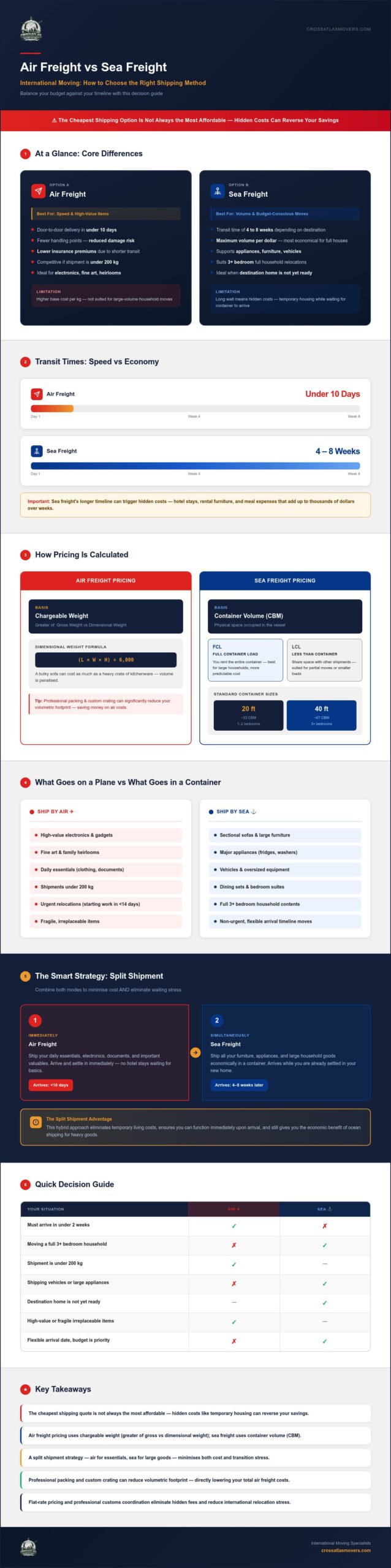
Deciding on the right transport mode is the most significant logistical hurdle in an international relocation. Air freight involves transporting your goods via dedicated cargo planes or the belly hold of passenger aircraft. It is the gold standard for speed and reliability. Sea freight, by contrast, relies on standardized shipping containers loaded onto massive ocean vessels. While sea freight is the backbone of global trade, the choice for a family moving abroad often comes down to a specific trade-off: the cost of transport versus the cost of time.
You must consider more than just the freight quote. A lower price for sea transport might be offset by the expenses of living in a hotel while you wait for your furniture to arrive. Conversely, paying a premium for air transport could save you thousands in temporary living costs. The nature of your belongings also dictates the mode. Fragile, high-value items often benefit from the shorter transit times and reduced handling associated with air travel. Bulky items, such as sectional sofas or dining sets, are far more practical to move via ocean. The cost-to-speed ratio is at the centre of this choice, and our experts help you calculate these variables to protect your budget.
When Air Freight is the Logical Choice
For many, air freight vs sea freight moving decisions are based on immediate needs and the value of the items being shipped. Air transport is often the only viable option for urgent relocations, such as when a professional must start a new position in a different country within a fortnight. Airport logistics are also incredibly tight, providing an extra layer of security for high-value electronics, fine art, or family heirlooms. If your total shipment weighs less than 200 kg, the minimum volume requirements and port fees of sea freight often make air transport surprisingly competitive in price. Key advantages include:
- Rapid door-to-door delivery usually completed in under 10 days.
- Reduced risk of damage due to fewer handling points and shorter transit.
- Lower insurance premiums because the goods are in transit for less time.
When Sea Freight Dominates the Market
Ocean transport remains the preferred method for full residential moves where volume is the primary concern. When you are relocating an entire house, including appliances and vehicles, the volume capacity of a 20-foot or 40-foot container is unmatched. It is the most budget-conscious choice for families who can manage a flexible arrival date. Most sea shipments take between 4 and 8 weeks to reach their destination. Families with the luxury of time find that sea freight allows them to maximize volume per dollar, ensuring all your comforts of home arrive together at a much lower price point. This mode is best for:
- Large households moving three or more bedrooms of furniture.
- Relocations where the destination home is not yet ready for occupancy.
- Shipping heavy items like refrigerators, washing machines, or cars.
Calculating Costs: Chargeable Weight vs Container Volume
Understanding the math behind your shipping quote is the only way to avoid sticker shock when your final bill arrives. While both modes of transport move your belongings from point A to point B, they use entirely different units of measurement to determine the price. When evaluating air freight vs sea freight moving, you must look beyond the base rate and understand how your specific inventory affects the calculation.
Air carriers prioritize the limited space within a plane’s fuselage. A large box of pillows takes up significant room but weighs very little, while a small crate of books is heavy but compact. To ensure they are compensated fairly for the space used, airlines use a system called chargeable weight. Sea freight, meanwhile, is priced based on volume. Whether you are filling an entire container or just a few cubic metres, the physical space you occupy in the vessel’s hull is the primary cost driver.
Demystifying Volumetric Weight for Household Goods
Chargeable weight is the greater value between the gross weight and the dimensional weight of your cargo. To calculate dimensional weight, movers multiply the length, width, and height of each box and divide by a standard factor, which is often 6,000 for international air shipments. This means a bulky sofa can cost as much to ship as a heavy crate of kitchenware. Professional packing is a necessity here. By utilizing custom crating and minimizing dead space, our team can significantly reduce your volumetric footprint and lower your total air freight costs. For a deeper look at how airlines and shipping lines calculate these costs differently, our guide on air vs sea freight for international moves provides a comprehensive framework for evaluating your specific inventory.
FCL vs LCL: Choosing Your Sea Freight Method
Sea freight pricing offers two distinct paths: Full Container Load (FCL) and Less than Container Load (LCL). FCL gives you exclusive use of a 20-foot or 40-foot container. It is generally the faster ocean option because the container is sealed at your residence and moves directly to the port without intermediate stops. LCL involves sharing container space with other shippers. While LCL is cost-effective for smaller moves, it often adds 10 to 14 days to your timeline. The carrier must wait to consolidate enough shipments to fill the container before the vessel can depart from a Canadian port.
The break-even point for choosing sea over air typically occurs when a shipment exceeds 2 cubic metres or weighs more than 250 kg. Below these levels, the minimum fees associated with ocean ports, such as Terminal Handling Charges (THC) and port security fees, can make sea freight more expensive than a quick air shipment. It is helpful to request a flat-rate quote that accounts for these port-side variables. This ensures you aren’t surprised by C$500 in arrival fees that weren’t clearly outlined in your initial estimate.
Transit Times and Reliability in Global Shipping
When planning an international relocation, time is often your most valuable commodity. The gap between air and sea transit is substantial. Air freight typically offers door-to-door delivery within 3 to 10 days, making it the premier choice for families who need to settle into their new lives quickly. Sea freight requires a much longer commitment; average timelines range from 30 to 60 days. This duration depends heavily on the distance between ports and the specific shipping lanes utilized. While ocean travel is slower, it remains the standard for large-scale moves where speed is less critical than volume.
Reliability is another factor where air freight vs sea freight moving options diverge. Air schedules are highly predictable. Flights depart daily between major global hubs, and while weather can cause short delays, the impact is rarely more than 24 hours. Sea freight is more vulnerable to external disruptions. Port congestion, seasonal peaks in global trade, and labour disputes can leave containers sitting on docks for weeks. In 2026, global supply chain dynamics continue to fluctuate, making the steady nature of air transport an attractive insurance policy against uncertainty.
The “Last Mile” Challenge in International Moving
The total time your belongings are in transit isn’t just about the time spent on a plane or ship. Inland transport at your destination can add several days to the process. We manage this complexity by utilizing our own truck fleet for the Canadian portion of the journey. This level of control allows us to provide a guaranteed delivery date for the domestic leg of your move. However, customs clearance remains the biggest wild card in any international schedule. Every country has unique regulations; a single missing document can lead to an inspection that adds a week to your timeline regardless of the transport mode.
Safety and Risk Management
Risk profiles differ significantly between the two modes. Air freight involves fewer touches because the goods move quickly through highly secure, automated airport terminals. Sea freight involves more physical movement. Containers are hoisted by cranes and subjected to the swaying of a vessel on the open ocean for weeks at a time. To mitigate these risks, professional packing is essential. Our team utilizes custom crating for fragile items to prevent shifting and protect against the moisture common in marine environments. Because of these variables, all-risk insurance coverage is a non-negotiable component of a secure move. It provides the peace of mind that your investment is protected from port to port.
The Strategic Approach: Implementing a Split Shipment
Many families treat the choice between air freight vs sea freight moving as an all-or-nothing decision. This binary view often leads to unnecessary stress or inflated costs. A more sophisticated strategy involves a split shipment. By dividing your household goods into essential and secondary loads, you can leverage the speed of air travel for what you need immediately while using the economy of sea transport for the rest of your home. This approach provides a balance that protects both your timeline and your bank account.
Your air shipment should act as a survival kit. It typically includes professional attire for a new job, school supplies for children, basic kitchenware, and important legal documents. Receiving these items within a week allows you to move into your new residence almost immediately. Your secondary load, consisting of large furniture, seasonal clothing, and library collections, travels via ocean container. This hybrid model ensures you aren’t waiting two months for a bedsheet while also avoiding the astronomical costs of flying a heavy oak dining table across the ocean.
How to Organize Your Split Shipment
Success with this method requires meticulous planning during the packing phase. You must create a distinct priority packing list to ensure no critical items are accidentally loaded into the sea container. Coordinating the arrival dates is equally important. Ideally, your air freight should clear customs just as you arrive at your new destination. This synchronization prevents you from needing to purchase duplicate items or spend weeks in a furnished rental. For a detailed breakdown of how to prepare your inventory, see our cross country moving checklist.
Cost-Benefit Analysis of the Hybrid Model
While air freight is more expensive per kilogram, the total cost of air freighting five or six large boxes is often less than the expense of a week in a hotel. You also avoid the environmental and financial waste of buying disposable essentials at your destination only to discard them when your sea container arrives. This efficiency is why the hybrid model is the preferred standard for corporate relocation services. It prioritizes employee productivity by getting them settled quickly and comfortably.
Minimizing the emotional toll of a move is just as important as the financial savings. Living in an empty house for two months is draining for any family. A split shipment provides a sense of normalcy and comfort from day one. To see how this strategy fits into your specific budget, you can contact us for a comprehensive moving plan tailored to your international destination.
Navigating Customs and Logistics with CrossAtlas Movers
The physical transport of your goods is only one half of a successful international relocation. The other half involves managing the rigorous documentation required by border agencies. Whether you are weighing the merits of air freight vs sea freight moving, the complexity of customs remains a constant factor. Our team takes ownership of this process, coordinating with global partners to ensure your belongings meet all regulatory requirements without unnecessary delays or unexpected costs.
We provide a flat-rate pricing model that includes this high-level international coordination. This transparency is designed to eliminate the anxiety many families feel regarding hidden port fees or administrative surcharges. By handling the logistics from your current Canadian residence to your new doorstep, we provide a seamless transition that allows you to focus on your family rather than paperwork. Our professional packing and custom crating further ensure that every item, from fragile glassware to heavy furniture, is secured for the specific demands of long-haul transit.
Customs Documentation for Canadians Moving Overseas
Navigating international borders requires a precise understanding of various legal forms. You must distinguish between a “Packing List,” which describes the physical contents of each box, and a “Valued Inventory,” which is used for insurance and duty assessment. For Canadians relocating abroad, it is also vital to correctly document “Goods to Follow” to claim available tax exemptions in your new jurisdiction. A Bill of Lading serves as both a receipt for cargo and a contract for its carriage. Missing even a minor detail on these forms can lead to your shipment being held in a bonded warehouse, incurring daily storage fees that quickly derail a budget.
Why a Family-Owned Mover Makes the Difference
International moving is a deeply personal event that requires more than just a logistical provider; it requires a partner. As a family-owned business, we prioritize personal accountability in a way that large, faceless aggregators cannot match. You aren’t just another container number in a database. We maintain direct communication throughout the entire air freight vs sea freight moving process, providing updates that keep you informed and at ease. This “old-school” work ethic ensures that your move is handled with the precision and care it deserves.
Ready to start? Request a flat-rate international moving quote from CrossAtlas and let our methodical experts handle the complexities of your global transition.
Secure Your International Transition with Confidence
The decision in the air freight vs sea freight moving process ultimately depends on your unique priorities for speed and budget. While air transport offers rapid delivery for your daily essentials, sea freight remains the most economical path for a full household relocation. Implementing a split shipment strategy allows you to settle into your new home quickly while keeping your total expenses manageable. Success isn’t just about the mode of travel; it’s about the precision of the planning and the reliability of the partners you choose.
At CrossAtlas Movers, we remove the burden of international logistics from your shoulders. We provide expert custom crating for international safety and dedicated support for all customs documentation to ensure a predictable arrival. Our commitment to transparency means you receive a no hidden fees guarantee, allowing you to plan your new life with financial certainty. When you’re ready to take the next step in your global journey, we’re here to provide the methodical care your move deserves.
Get Your Free, Flat-Rate International Moving Quote
Moving across the world is a monumental milestone. With the right strategy and a dependable partner, you can look forward to your new beginning with excitement and peace of mind.
Frequently Asked Questions
Is air freight or sea freight safer for fragile antique furniture?
Air freight is often considered the safer option for fragile antiques because it involves fewer handling stages and a much shorter journey. However, sea freight is a reliable choice when you use professional custom crating to stabilize the item against the movement of the vessel. We prioritize high-quality packing materials to ensure your heirlooms remain secure regardless of the transport mode you select.
How much does it cost to ship a standard 20-foot container internationally?
International shipping costs for a 20-foot container are influenced by the destination port, seasonal demand, and current global fuel surcharges. Because these variables change frequently in the Canadian market, we provide a flat-rate quote to protect you from price fluctuations. This approach ensures you know the total cost of your relocation before the container is even loaded onto the vessel.
Can I ship my car in the same container as my household goods?
You can certainly ship your vehicle in the same container as your household goods when opting for a Full Container Load (FCL). This is an efficient way to utilize the space in a 40-foot container during a large residential move. Our team manages the specialized blocking and bracing required to secure the car safely alongside your furniture to prevent any movement during the ocean crossing.
What items are prohibited from being shipped via air freight?
Air carriers prohibit hazardous materials such as aerosol cans, flammable liquids, and certain lithium batteries due to safety regulations in pressurized cabins. These items are often restricted or require specialized documentation that differs from standard household goods. We help you identify these restricted items during the packing phase to ensure your air shipment clears airport security without any unnecessary delays.
How far in advance should I book an international moving company?
It is best to book your international moving company at least 8 to 12 weeks before your intended departure date. This lead time is necessary to secure vessel space or flight allocations and to complete the complex customs paperwork required for global relocations. Early booking also allows us to coordinate the professional packing team and ensure your preferred delivery dates are guaranteed.
What happens if my sea freight shipment is delayed at the port?
If a sea freight shipment is delayed at the port, it may incur demurrage or storage fees charged by the terminal. These delays are often caused by port congestion or customs inspections that are outside of a mover’s direct control. We mitigate this risk by maintaining constant communication with port authorities and global partners to move your container through the terminal as efficiently as possible.
Are there hidden fees in international moving quotes I should watch for?
Common hidden fees in air freight vs sea freight moving quotes include terminal handling charges, port security fees, and documentation surcharges at the destination. Many families are surprised by these arrival costs if they aren’t clearly outlined in the initial estimate. We provide a flat-rate quote that includes these international coordination costs to give you full financial transparency from the start.
Does insurance cover the full value of my items during an overseas move?
Standard carrier liability typically only covers a small fraction of an item’s value based on its weight. To protect the full value of your possessions, you should opt for “All-Risk” transit insurance. This comprehensive coverage ensures that you are compensated for the replacement value of your goods in the unlikely event of damage or loss during the overseas journey. To understand how to choose the right air vs sea freight for international moves strategy that aligns with your insurance and budget needs, our 2026 guide offers a definitive framework for making that decision with confidence.