
Did you know that over 126,000 people are currently making the trek south each year? Emigration from Canada to the United States has reached a ten-year high, as many professionals and families seek out new career opportunities and more affordable housing markets. Learning how to move from Canada to USA involves much more than just packing a truck; it requires a strategic approach to international logistics and a clear understanding of federal requirements.
We understand that the process can feel overwhelming, especially when you are faced with the confusion of CBP documentation or the fear of hidden fees buried in a moving quote. It is natural to feel anxious about the safety of your fragile items during such a long-haul transit. You deserve a transition that is defined by precision and transparency rather than stress and unexpected surprises.
This guide will help you master the logistics of your move south by demystifying visa pathways and customs protocols. We will provide a clear roadmap for handling CBP Form 3299, explain how to secure a predictable moving cost with a flat-rate model, and help you establish a reliable timeline for when your goods will arrive at your new home. By the end of this article, you will have the tools to organize a seamless cross-border relocation with total confidence.
Key Takeaways
- Learn the essential logistical steps for how to move from Canada to USA, including the critical distinction between your personal immigration and the importation of your belongings.
- Understand how specific visa categories influence your eligibility to import household goods duty-free under current U.S. Customs and Border Protection regulations.
- Discover the benefits of selecting a cross-border mover with a dedicated fleet and flat-rate pricing to ensure a predictable timeline and avoid hidden weight-based fees.
- Gain a clear understanding of the mandatory documentation process, specifically the requirements for completing CBP Form 3299 for unaccompanied articles.
- Identify why professional packing and custom crating are vital for securing comprehensive insurance coverage and protecting high-value items during long-haul transit.
Navigating the Logistics of Moving from Canada to the USA
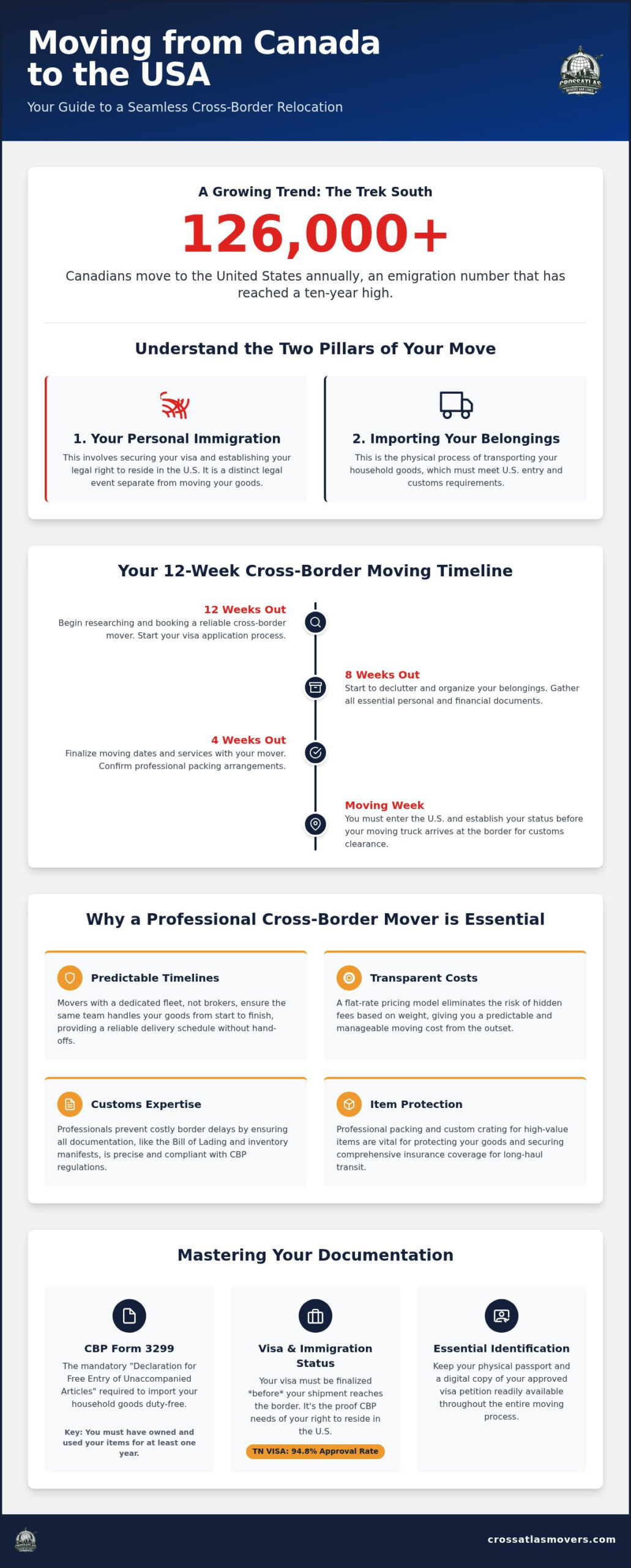
Relocating your entire life across the 49th parallel involves much more than a long-distance drive. In 2026, the logistics of how to move from Canada to USA have become increasingly intricate. With over 126,000 Canadians now moving south annually, border officials have maintained a rigorous standard for processing household shipments. It is essential to realize that your personal immigration status and the importation of your physical belongings are two distinct legal events. Having your visa approved is only the first step; ensuring your furniture and personal effects meet U.S. entry requirements is a separate, equally important task.
Many individuals consider a “do-it-yourself” move to save on costs, but this often leads to unforeseen customs delays and higher expenses in the long run. Without professional guidance, small errors in documentation can result in your shipment being bonded or held at the border, incurring daily storage fees. For the expanding population of Canadian Americans, a successful transition depends on synchronizing these legal and physical movements perfectly. A methodical approach removes the burden of uncertainty and ensures your goods arrive without unnecessary interference.
Why Cross-Border Moves Differ from Domestic Relocations
Domestic moves within Canada are relatively simple, but crossing the border introduces commercial transit regulations and federal oversight. Trucks entering the U.S. for commercial purposes must adhere to strict Department of Transportation (DOT) standards. A Bill of Lading in an international context acts as a critical legal contract; it must be precisely organized to reflect the inventory for customs agents. Unlike local moves, international transit times are affected by border wait times. Choosing a mover with a dedicated fleet, rather than a broker, provides a layer of security because the same team handles your goods from your old home to your new one, ensuring a more predictable delivery schedule.
Setting a Realistic Timeline for Your International Move
We recommend starting your preparations at least 8 to 12 weeks before your desired move date. This timeframe allows you to book reliable cross-border movers and organize your documentation. Coordination is key. You generally must enter the U.S. and establish your status before your moving truck arrives at the border for clearance. You should also allocate several days for professional packing and the creation of a detailed inventory. A professional team doesn’t just pack boxes; they create the precise manifest required for duty-free entry, which is a vital component of a stress-free relocation.
Essential Documentation and Visa Pathways for Canadians
Securing the correct visa is the functional foundation of your relocation. It’s not merely an entry permit; your visa status directly dictates your eligibility to import household goods duty-free. Under current regulations, you must have owned and used your items for at least one year to avoid duties. For many professionals, this legal step is the most daunting part of learning how to move from Canada to USA. In the first quarter of 2026, data showed that for every skilled professional entering Canada, 1.4 were leaving for the United States, making the visa processing system busier than ever.
Your visa status must be finalized before your moving truck reaches the border. U.S. Customs and Border Protection (CBP) requires proof of your legal right to reside in the country before they will release your shipment. We recommend keeping your physical passport and a digital copy of your approved petition readily available throughout the transit period. If you are feeling overwhelmed by the logistics, our team can help you coordinate your Cross-Border Moving Services to align perfectly with your visa approval date.
Common Visa Categories: TN, H-1B, and Family Sponsorship
The TN (NAFTA) visa remains a primary choice for Canadian professionals, boasting a 94.8% approval rate in fiscal year 2025. However, applicants must be aware of the policy update from June 2025, which strictly enforces education requirements and no longer allows work experience to be substituted for a degree. For those on the H-1B path, the premium processing fee is currently $2,965 as of March 1, 2026. If you are moving via family sponsorship, expect government filing fees to range between $1,500 and $2,500. Each of these pathways requires specific documentation that your movers will need to present at the border on your behalf.
Organizing Your Essential Legal and Financial Records
We recommend creating a “Moving Folder” that contains both physical and digital copies of your essential records. This should include birth certificates, marriage licences, and educational transcripts. You will also need your tax records for both the CRA and the IRS to manage any potential departure tax or residency issues. Organizing these records early prevents last-minute panic and ensures a smooth hand-off to your relocation team. For a detailed timeline on when to gather these documents, consult our How to Move from Canada to the USA in 2026: A Step-by-Step Guide. Having everything in order allows us to act as your capable protector at the border, resolving any questions customs officers might have without delaying your shipment.
Comparing Cross-Border Movers: How to Evaluate Your Options
Selecting a partner for your international relocation is a decision that impacts both your budget and your peace of mind. Many people start by looking for the lowest price, but in the cross-border industry, the cheapest quote often masks significant risks. When you are determining how to move from Canada to USA, you must evaluate the operational structure of the company you hire. A successful move is built on the expertise of dedicated customs coordinators who understand the nuances of 2026 border protocols.
Avoid moving brokers who simply sell your contract to the highest bidder. These middlemen rarely have control over the actual movers or the equipment used, which can lead to communication breakdowns. Instead, prioritize companies with a physical presence and a history of cross-border expertise. Watch for red flags such as a lack of a physical office address or requests for “cash-only” payments. A reliable, family-owned business takes personal accountability for your shipment, acting as a capable protector of your belongings throughout the journey.
The Advantage of Flat-Rate Pricing for International Moves
Weight-based estimates are the industry standard, yet they remain the primary source of “hidden fee” complaints. When a truck is re-weighed at a certified scale near the border, any discrepancy can result in hundreds of dollars in additional costs. Flat-rate pricing eliminates this anxiety by providing a fixed price based on your specific inventory. This comprehensive model should include fuel surcharges, tolls, and basic insurance. Transparency in pricing allows you to maintain a predictable budget without the fear of last-minute surprises at the destination.
Why a Dedicated Fleet and Own Trucks Matter
Accountability is often lost when your goods are shuffled between multiple trailers in a van-line network. Every time your furniture is moved, the risk of scratches or structural damage increases. A dedicated fleet means your items are loaded onto one truck and stay there until they reach your new home. This methodical approach not only protects your fragile items but also allows for much more accurate guaranteed delivery dates. Knowing exactly who is driving the truck and where your shipment is at all times provides a foundation of trust that a broker simply cannot match.
Clearing Customs: Managing Your Household Goods and Personal Effects
Once your visa is secured, the focus shifts from legal status to the physical transit of your life. This is often the most complex phase of learning how to move from Canada to USA, as it involves satisfying the rigorous requirements of U.S. Customs and Border Protection (CBP). The border clearance process is a distinct event that requires its own set of meticulous documentation. Understanding how to categorize your items and prepare for inspection will prevent your shipment from being delayed or held in a bonded warehouse, which can lead to significant storage fees and logistical headaches.
CBP distinguishes between “Household Effects” and “Personal Effects.” Household effects include items like furniture, carpets, books, and appliances. Personal effects generally refer to more intimate items such as clothing, jewellery, and photographic equipment. For a smooth entry, you must provide a detailed inventory list that clearly describes the contents of every box. Avoid vague descriptions like “miscellaneous” or “kitchen items.” Instead, specify “stainless steel cookware” or “ceramic dinnerware.” This level of precision reassures border agents and demonstrates that you are a methodical and compliant importer.
Understanding CBP Form 3299 for Household Goods
The “Declaration for Free Entry of Unaccompanied Articles,” or CBP Form 3299, is the most critical document for your relocation. To qualify for duty-free entry, you must have owned and used your household goods for at least one year prior to your move. This form must be completed accurately to avoid unnecessary taxes. If you are using a professional moving service, you will likely need to sign a Power of Attorney. This legal instrument allows your mover to act as your agent, clearing customs on your behalf so you don’t have to be physically present at the border when the truck arrives. If you are ready to begin your journey, our team can provide a comprehensive quote for your International Relocation today.
Prohibited Items and Restricted Goods at the US Border
Precision is vital when managing restricted items. You cannot transport soil, live plants, or certain foodstuffs across the border without specific permits. Firearms are strictly regulated and require specific federal forms for legal importation. If you maintain a collection of wine or alcohol, be aware that state and federal taxes may apply, and some states have strict limits on the volume you can import. Additionally, Canadian vehicles must meet specific EPA and DOT compliance standards to be permanently imported. We recommend verifying that your car has the required compliance labels under the hood before including it in your relocation plans. Our role as your capable protector is to help you identify these potential hurdles long before your shipment reaches the crossing.
Executing Your Move: Professional Packing and Final Preparations
Executing the physical relocation is where your planning finally meets reality. While you have mastered the documentation and chosen your partner, the safety of your belongings during a 2,000-kilometre journey depends entirely on the quality of the preparation. Professional packing is not just a convenience; it is a strategic necessity for international moves. Many insurance providers require professional handling to offer full replacement value coverage for cross-border transits. For high-value items such as grand pianos, delicate antiques, or fine artwork, custom crating provides the structural integrity needed to withstand the constant vibrations and shifts of a long-haul trip.
Before the truck departs, you’ll conduct a final walkthrough of your home with the crew leader. You’ll sign the Bill of Lading, which serves as your official receipt and the legal contract of carriage for your goods. This is the moment to confirm that all inventory details are accurate and that every room is empty. We also suggest preparing an ‘Essentials Box’ to carry in your personal vehicle. This should contain everything you need for the first 48 hours in your new U.S. home, including basic toiletries, essential electronics, and a few changes of clothes. Having these items on hand prevents the frustration of searching through dozens of boxes the moment you arrive at your new doorstep.
The Role of Professional Packing in Customs Clearance
Professional packing directly influences the efficiency of your border crossing. When boxes are clearly labelled and correspond to a professional inventory, customs officers can verify the shipment more quickly. This methodical approach reduces the likelihood of a full physical inspection, which can be intrusive and cause significant delays. By using high-quality, industry-standard materials, such as double-walled boxes and acid-free wrapping, we ensure that your items are protected from the rigours of transit. If a box is opened for inspection, professional packing makes it much easier for agents to repack the items without compromising their safety.
Final Checklist for a Stress-Free Arrival in the United States
Your arrival should be as composed and organized as your departure. Ensure you have confirmed every item on your cross country moving checklist to avoid last-minute oversights. It is wise to have a small amount of local U.S. currency on hand and to verify that your mobile plan includes international roaming or is ready for a local SIM card. At CrossAtlas Movers, we support this final transition with guaranteed delivery dates, so you know exactly when your life will arrive. Learning how to move from Canada to USA with ease means trusting in a process that prioritizes the safety of your goods and the predictability of your schedule.
Taking the Next Step in Your Cross-Border Relocation
Transitioning to a new country is a significant milestone that requires both legal precision and logistical expertise. By aligning your visa status with a detailed customs strategy, you remove the most common barriers to a successful entry. Mastering how to move from Canada to USA is ultimately about choosing a partner that prioritizes transparency and security throughout the entire journey.
As a family-owned business, we take personal accountability for every shipment we handle. We operate our own fleet of dedicated trucks to ensure your belongings never leave our care; this methodical approach allows us to offer flat-rate pricing with no hidden fees or surprises at the border. You deserve a moving experience that is defined by reliability and a clear, guaranteed timeline.
If you are ready to secure a predictable and stress-free transition, we invite you to Get a Flat-Rate Quote for Your Cross-Border Move to the USA. Your new home in the United States is waiting. With the right preparation and a capable protector by your side, you can focus on the exciting opportunities ahead while we manage the complexities of the road.
Frequently Asked Questions
Can I move my own household goods from Canada to the USA?
Yes, you can physically transport your own belongings, but you’ll be responsible for clearing customs yourself at a designated port of entry. This requires you to be present when the goods cross the border to handle the inspection. Most families find that the logistical burden and the risk of being turned away due to paperwork errors make professional services a more secure choice.
How much does it typically cost to move from Canada to the US?
Moving costs are determined by the distance of the relocation and the volume of items being transported. It is vital to distinguish between a weight-based estimate and a flat-rate quote. Weight-based models often lead to hidden fees after re-weighing at the border, whereas a flat-rate model provides a fixed price that covers fuel, tolls, and basic insurance from the start.
What paperwork do I need for my belongings to clear US customs?
The primary document required is CBP Form 3299, known as the Declaration for Free Entry of Unaccompanied Articles. You must also provide a comprehensive inventory list and proof of your legal status, such as a passport and a valid visa. Organizing these documents correctly is the most critical step in learning how to move from Canada to USA without facing unexpected delays.
How long does a cross-border move usually take?
A typical cross-border relocation takes between seven and fourteen days from initial packing to final delivery. This timeline depends on the distance between cities and the efficiency of the customs clearance process. Companies with a dedicated fleet of trucks can provide more accurate delivery dates because they don’t rely on third-party transfers or external van lines.
Do I need to be present at the border when my moving truck crosses?
You don’t need to be physically at the border when the truck crosses if you’ve provided your mover with a Power of Attorney. However, you must have legally entered the United States and established your residency status before your shipment can be cleared. Your mover acts as your agent, presenting your documentation to CBP officials to ensure a smooth transition.
Are my household goods taxed when I move to the USA?
Household goods are generally imported duty-free if you’ve owned and used them for at least one year. Items that are less than a year old or those intended for resale may be subject to duties. This “one-year rule” is a standard federal regulation designed to differentiate between personal relocations and commercial importations of new goods.
What items are prohibited when moving from Canada to the US?
Prohibited items include live plants, soil, certain foodstuffs like specific meats or fruits, and hazardous materials such as propane tanks or paint. Firearms are strictly regulated and require specific federal permits for legal importation. Understanding these restrictions is a key part of how to move from Canada to USA safely while avoiding fines or seizures at the border.
How do I choose a reliable cross-border moving company?
You should prioritize companies that own their own fleet and employ dedicated customs coordinators. Avoid brokers who sub-contract your move to unknown third parties. A reliable mover will offer transparent, flat-rate pricing and have a proven history of handling international logistics with the personal accountability and care expected from a family-run business.