

In the first quarter of 2026, 30,092 people emigrated from Canada, the highest Q1 number ever recorded. While you’re likely focused on your new life in the States, the process of moving furniture from canada to us often brings unexpected stress. It’s natural to worry about your belongings being held at the border or damaged during thousands of kilometres of transit. You deserve to feel confident that your property is in safe hands and your paperwork is beyond reproach.
We understand that a move is about more than just boxes; it’s about the life you’ve built and the comfort you’re carrying with you. This article provides a professional, step-by-step checklist to help you master the logistics and customs requirements for a smooth transition. You’ll learn how to navigate the latest 2026 tariff regulations and ensure your furniture arrives in the same condition it left your home.
By following this guide, you can replace confusion with a clear, methodical timeline. We’ll walk you through the essential CBP Form 3299 requirements and explain how to qualify for duty-free entry. Your move should be a milestone, not a burden, and we’re here to ensure your border crossing is entirely stress-free.
Key Takeaways
- Identify which items qualify as “household effects” to ensure your furniture meets the specific 2026 criteria for duty-free entry into the United States.
- Master the essential paperwork, including CBP Form 3299, to prevent your belongings from being delayed or held by border officials.
- Discover why moving furniture from Canada to the US requires export-grade packing materials and custom crating to withstand the rigours of long-distance transit.
- Protect your relocation by learning how to distinguish between dedicated fleet movers and brokers while verifying necessary US operating licences.
- Coordinate a seamless delivery by understanding the “unaccompanied goods” process for clearing customs even if you aren’t present at the border crossing.
The Foundation of Moving Furniture from Canada to the US
Relocating your life across the Canada-United States border is a significant undertaking that requires a methodical approach. When moving furniture from canada to us, you aren’t just transporting wood and fabric; you’re moving the foundation of your home. US Customs and Border Protection (CBP) distinguishes between “personal effects” like clothing and “household effects,” which covers your furniture and major appliances. Understanding this distinction is the first step toward a successful crossing.
Furniture demands a different strategy than standard boxed goods because of its volume and vulnerability. While a box of books is relatively sturdy, a mahogany bed frame or a glass-top table requires specialized wrapping to survive the vibrations of a 1,500-kilometre journey. Choosing to keep your high-quality furniture is often more cost-effective than buying new in the US, especially given the rising costs of wood products and upholstery in 2026. This approach preserves your investment and ensures your new house feels like a home from the moment you arrive.
Distinguishing Household Effects from Commercial Goods
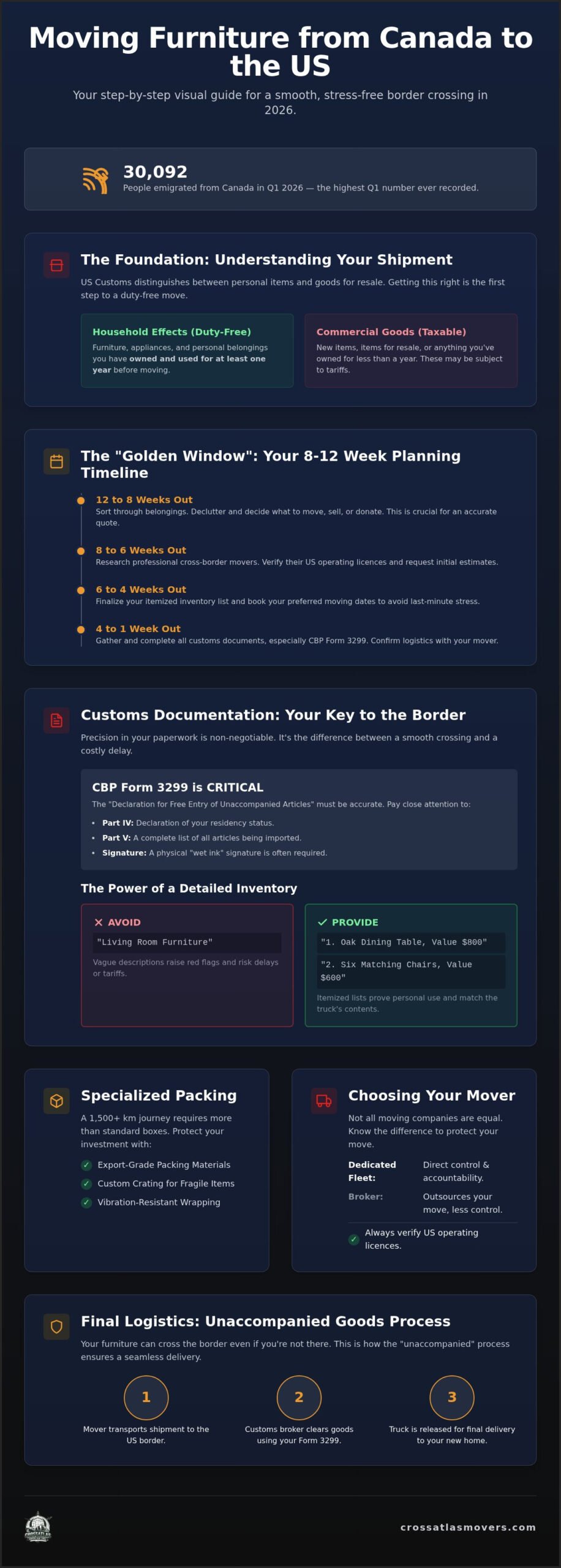
CBP officers must verify that your shipment is for personal use rather than resale. To avoid delays, you must provide a detailed, itemized inventory that matches the pieces on the moving truck. If an item looks brand new, it’s wise to keep your original receipts to prove it isn’t a commercial import intended for the American market. To qualify for duty-free entry, you must have owned and used your furniture for at least one year prior to your relocation. This rule ensures that your move remains a personal transition rather than a taxable trade event.
The Timeline: When to Start Your Move Planning
Successful relocations don’t happen overnight. We recommend an 8 to 12 week planning window to secure your preferred dates and organize your documentation. This period allows you to sort through your belongings, donate items that no longer serve you, and declutter your space before requesting a final quote. This “golden window” gives you the time needed to realize the full scope of how to move from canada to usa while avoiding the stress of last-minute bookings. When moving furniture from canada to us, early preparation is the best way to guarantee a predictable and calm experience.
Customs Documentation: The Essential Paperwork Checklist
The success of moving furniture from canada to us depends heavily on the precision of your paperwork. While the physical transport is a feat of strength, the border crossing is a feat of administrative accuracy. US Customs and Border Protection (CBP) requires specific declarations to ensure your belongings aren’t treated as commercial imports subject to the 2026 tariffs. By organizing your documents early, you remove the risk of your truck being sidelined for an intensive inspection.
Mastering CBP Form 3299
The “Declaration for Free Entry of Unaccompanied Articles,” or Form 3299, is your most important document. This form allows you to claim duty-free status for used household goods. You must pay close attention to Part IV, where you declare your residency status, and Part V, which lists the articles you’re bringing into the country. As of 2026, CBP still emphasizes the need for a physical “wet ink” signature on the original form for many unaccompanied shipments. A common mistake is being too vague in the description of goods. If your form lacks clarity, you risk being caught under the new 50% tariff response on Canadian goods. Our team at CrossAtlas Movers provides a guided review of these forms to ensure every box is checked correctly before the truck reaches the border.
The Power of a Detailed Inventory
A vague manifest is a red flag for border agents. Instead of writing “living room furniture,” your inventory must be a numbered, itemized list such as “1 Oak Dining Table, 6 Matching Chairs, 1 Fabric Sofa.” This level of detail, supported by the legal context found in the Federal Register, proves the items are personal effects. You should also include the estimated replacement value and the current condition of each piece. This isn’t just for customs; it’s also your primary protection for insurance purposes. Taking clear photos of each furniture piece before it’s wrapped provides a secondary layer of proof regarding its condition and personal nature.
Beyond the manifest, ensure your moving company has high-quality copies of your passport and your US work visa or proof of residency. In rare cases, antique wood furniture may require CITES permits if the wood species is protected. Checking these details 12 weeks in advance ensures that moving furniture from canada to us remains a predictable process. When your paperwork is methodical and transparent, you provide the border agent with everything they need to grant you a swift crossing.
Specialized Packing Techniques for Cross-Border Transport
A move across the border involves more than just a long drive; it subjects your belongings to varied road conditions and significant shifts in atmospheric pressure. When moving furniture from canada to us, standard moving blankets are just the beginning. Your furniture will spend several days in a trailer, enduring the constant vibrations of a 2,000 kilometre journey. This environment requires “export-grade” materials that offer far more protection than the supplies used for a local trip across town.
Beyond physical impacts, you must consider the environmental changes your furniture will face. Moving from a humid climate to an arid one, for instance, can cause wood to shrink or crack. Methodical packing creates a micro-environment for each piece, mitigating the effects of “climate shock” and ensuring your heirlooms arrive in the same condition they left your home.
Furniture Protection: Beyond the Moving Blanket
We employ the “Three-Layer Method” to provide a redundant safety system for every large item. This process starts with a high-grade plastic wrap to seal out dust and moisture. Next, we apply heavy-duty moving pads for shock absorption, followed by corrugated cardboard edging to reinforce vulnerable corners and legs. For antique wood furniture, we use breathable materials to prevent moisture from being trapped against delicate finishes during long-duration transit. Professional packing signals to border agents that the shipment is organized and low-risk, which can significantly reduce the likelihood of a full physical inspection.
Custom Crating for High-Value Assets
Certain items are too fragile or valuable for standard wrapping alone. Oversized mirrors, marble table tops, and fine art require custom-built wooden crates to eliminate any chance of movement. It is essential that all wood packaging used in your move is ISPM-15 certified. This international standard ensures the wood has been heat-treated to prevent the spread of pests across the border, a requirement that customs officials monitor closely. While these specialized services add to the Cost to Move from Canada to USA, they provide the peace of mind that your most precious assets are fully protected. By securing all moving parts, such as drawers and delicate hardware, we ensure that safely moving furniture from canada to us is a predictable and successful endeavour.
Evaluating a Canada-USA Moving Company: What to Look For
Selecting a partner for moving furniture from canada to us is the most critical decision in your relocation process. The complexity of crossing an international border requires more than just a truck and a driver; it demands a deep understanding of federal regulations and logistical precision. You must verify that any prospective mover holds valid US Department of Transportation (DOT) and Motor Carrier (MC) numbers. These credentials are legal requirements for operating commercial vehicles within the United States. Additionally, look for a “Bonded” carrier. This status indicates the company has a financial guarantee with customs authorities, which often facilitates a more efficient clearance process at the border.
The Advantage of a Dedicated Fleet
Many consumers are unaware of the distinction between a moving broker and a company with a dedicated fleet. A broker acts as a middleman, selling your contract to the lowest bidder, which often results in your furniture being “trans-loaded” between different trailers. This unnecessary handling is the primary cause of damage during long-distance transit. A family-owned business with its own trucks provides a “one truck, one team” solution. This methodical approach ensures accountability, as the same professionals who pack your heirlooms in Canada are the ones who deliver them to your new residence. This continuity of care projects the image of a capable protector who prioritizes the safety of your property over corporate volume.
Understanding Flat-Rate vs. Weight-Based Quotes
The traditional weight-based estimate often leads to a “weight surprise” at the border scales, resulting in unexpected costs that disrupt your budget. When moving furniture from canada to us, a flat-rate quote is the most reliable way to maintain financial control. A transparent quote should include all fuel surcharges, border fees, and basic insurance without hidden add-ons. This predictable pricing model allows you to plan your relocation with confidence, knowing exactly what your investment will be before the truck arrives. Whether you are searching for usa to canada movers or planning a southbound journey, clarity in pricing is a hallmark of a professional service provider.
Your peace of mind depends on choosing a partner who values punctuality and transparency as much as you do. Request a flat-rate quote from CrossAtlas Movers to experience the security of a dedicated fleet and a guaranteed delivery date for your cross-border move.
Final Logistics: Managing the Cross-Border Delivery
The final stage of moving furniture from canada to us is the most rewarding, but it requires careful synchronization. While your dedicated moving team handles the heavy lifting, you must coordinate your own arrival at the US border. Most residential relocations are processed as “unaccompanied goods,” meaning the furniture travels separately from the owner. This process allows the professional driver to clear customs on your behalf using the documents you prepared in earlier stages. You don’t need to be physically present at the border crossing, but you must have already entered the United States and activated your visa or residency status before the shipment can be legally released for final delivery.
Once the truck arrives at your new residence, the focus shifts to a methodical reassembly and placement of your furniture. Professional movers provide more than just transport; they ensure your home is functional from day one. This includes reattaching table legs, setting up bed frames, and positioning heavy wardrobes according to your floor plan. This level of service removes the physical burden of the move and allows you to focus on the emotional transition of settling into a new country. Every action taken during this phase is designed to provide a smooth transition and immediate comfort in your new environment.
The Delivery Window and Guaranteed Dates
Predictability is the foundation of a stress-free move. A guaranteed delivery date is essential for planning your first days in a new city, as it prevents the cost and inconvenience of staying in hotels or living in an empty house. We recommend arriving at your destination at least 24 hours before the truck to ensure you are ready to receive the shipment. If your travel plans are delayed and the furniture arrives before you, a professional mover will coordinate secure, short-term holding to protect your assets until you can personally oversee the unloading process.
Settling In: The Post-Move Furniture Check
As each piece is brought into your new home, use the numbered inventory list created during the packing phase to verify that every item has arrived. This is the time to conduct a thorough post-move inspection for any shift-related damage that may have occurred during the long haul. While specialized packing minimizes risks, having a clear process for filing a claim is vital for your peace of mind. If you’ve chosen a provider with a “capable protector” policy, any discrepancies will be handled with the same integrity and transparency that defined the start of your journey. Planning for moving furniture from canada to us concludes when your last heirloom is placed exactly where it belongs. Request your flat-rate cross-border quote from CrossAtlas Movers today.
Your Seamless Transition to a New American Home
A successful relocation hinges on two pillars: administrative precision and physical protection. By mastering the CBP Form 3299 and implementing export-grade packing techniques, you ensure your belongings cross the border without delay or damage. Moving furniture from Canada to the US is a significant life event that demands a methodical approach; however, it shouldn’t be a source of anxiety. When you organize your move with a partner who values personal accountability, the logistical burdens of the border simply disappear, leaving you free to anticipate your arrival.
As a family-owned business, we take pride in being your capable protector throughout this journey. We offer specialized custom crating for your high-value pieces and provide flat-rate pricing with zero hidden cross-border fees. This transparency allows you to focus on your new beginning while we handle the complexities of the road, from the first piece packed to the final delivery in your new driveway. We’re ready to help you turn your new house into a familiar home with confidence and ease.
Get a Guaranteed Flat-Rate Quote for Your Cross-Border Move
Frequently Asked Questions
Do I have to pay duty when moving furniture from Canada to the US?
You won’t pay duty on furniture you’ve owned and used for at least one year. These items qualify as duty-free “household effects” under US customs regulations. However, you must file CBP Form 3299 to claim this exemption correctly. While 2026 has seen new tariffs on specific Canadian imports, personal household goods remain exempt as long as they aren’t intended for resale or commercial use in the United States.
Can I move my furniture myself or do I need a canada usa moving company?
While you can rent a truck and move yourself, hiring a professional canada usa moving company is often the more reliable choice. Professional movers manage the complex digital manifests and ensure your paperwork meets current CBP standards. This prevents the stressful scenario of your truck being turned back at the border. A dedicated carrier handles the logistics, allowing you to focus on your personal entry and settling in.
What is CBP Form 3299 and why is it required for my move?
CBP Form 3299 is the “Declaration for Free Entry of Unaccompanied Articles” and it’s essential for any residential relocation. It serves as your formal statement to US Customs that your belongings are personal effects and not commercial merchandise. Without this form, your shipment could be subject to significant tariffs or held indefinitely at the border. It’s the primary document that allows you to import your life’s work without unnecessary taxes.
How long does it take for furniture to clear the border?
Most furniture shipments clear the border within two to four hours if the paperwork is perfectly organized. This timeline assumes your carrier uses the Automated Commercial Environment to manifest the load before arrival. However, if customs officials select the truck for a secondary inspection, the process can take longer. Choosing a bonded carrier with a dedicated fleet helps minimize these delays and ensures a more predictable delivery schedule for your home.
Is my Canadian moving insurance valid in the United States?
Standard Canadian homeowner’s policies typically don’t cover goods once they leave the country. When moving furniture from canada to us, you should verify that your mover provides transit protection that remains valid across state lines. A professional mover offers specialized coverage designed for international relocations. This ensures your investment is protected against damage or loss throughout the entire journey, providing you with a necessary foundation of trust and security.
What happens if customs decides to inspect my furniture truck?
If customs selects the truck for a “tailgate” or “full” inspection, the vehicle is moved to a secure secondary area. Officers will compare the physical items to your numbered inventory list to ensure everything matches your declaration. This is why a precise manifest is so critical for a smooth transition. A professional team stays with the vehicle during this process, acting as a capable protector of your goods until the inspection is complete.
Can I move new furniture across the border?
You can move new furniture, but items owned for less than one year are generally subject to duty. In 2026, certain Canadian wood and upholstered furniture face tariffs ranging from 25% to 50% if they don’t meet the “used for one year” exemption. You must declare these items separately on your inventory and provide original receipts. This transparency helps border agents calculate the correct fees and prevents your entire shipment from being delayed.
Do I need to be present at the border when my furniture crosses?
You don’t need to be physically present at the border when the moving truck crosses. Most relocations are handled as “unaccompanied goods,” which allows the driver to clear customs on your behalf. However, you must have entered the United States and activated your visa or residency status before the furniture shipment can be legally released. This sequence proves to CBP that you’ve established residency and are entitled to import your effects.