

A low-ball moving estimate is often the most expensive mistake a family can make when relocating across the border. While a quote might look attractive on paper, the true cost to move from Canada to USA often hides within unpredictable weight adjustments and complex customs brokerage fees that appear only after your belongings are already in transit. You deserve a transition that feels like a fresh start, not a logistical nightmare filled with hidden surcharges and unexpected border delays.
We understand that the anxiety of watching your life’s possessions disappear into a long-haul trailer is real. You want to realize a move that is defined by precision and safety rather than “rough estimates” and “approximate dates.” This 2026 guide provides a transparent look at the relocation landscape to help you plan with confidence. We will demystify the latest regulatory changes, including the new Visa Integrity Fees and the requirements for duty-free entry under Form 3299. You’ll learn how to compare moving services effectively to ensure a flat-rate experience that protects your budget. We will also break down how to organize a stress-free crossing with a dedicated fleet and guaranteed delivery dates, ensuring your focus remains on your new home rather than the paperwork.
Key Takeaways
- Identify the primary drivers of the “cross-border premium” and learn why distance and volume impact international moves differently than interprovincial ones.
- Compare full-service relocation against DIY methods to see how the total cost to move from Canada to USA is often more predictable with a flat-rate professional service.
- Master the requirements for Form 3299 to ensure your household goods qualify for duty-free entry and avoid unexpected customs brokerage fees.
- Evaluate moving companies based on fleet ownership and U.S. licensing to secure a guaranteed delivery date and professional accountability.
- Recognize the hidden risks of weight-based estimates and learn why a transparent, inventory-based quote is the key to a stress-free transition.
The Reality of Cross-Border Moving Costs in 2026
Moving your household across an international border involves significantly more than just driving a truck south. The “cross-border premium” represents the additional layers of complexity, from regulatory compliance to the specialized labour required for international transit. Unlike a move between provinces, the total cost to move from Canada to USA is shaped by customs clearance protocols and the rigorous standards of the U.S. Department of Transportation. As the Canadian diaspora in the U.S. continues to grow, more families are realizing that a successful relocation requires a methodical approach to logistics rather than just a low price.
In 2026, several specific factors influence the market. New environmental fuel standards have adjusted long-haul transportation costs, while increased border processing requirements have heightened the need for expert documentation. Beyond the physical transit, there is a significant emotional cost to consider. Entrusting your entire life’s inventory to a carrier is a high-stress event. Professional services mitigate this burden by providing a structured framework that removes the guesswork from the transition. It’s about more than just moving boxes; it’s about protecting your peace of mind during a major life change.
What is Included in a Professional Cross-Border Quote?
A comprehensive quote should leave no room for ambiguity. It provides a foundation of security by outlining every anticipated expense before the first box is packed. A professional relocation partner ensures the following elements are clearly defined:
- Transportation and Fuel: This covers the actual movement of the dedicated truck, including current 2026 fuel surcharges that reflect modern logistics standards.
- Valuation and Protection: Professional quotes include basic insurance coverage with options for full-value protection to ensure your belongings are safe during the long-haul journey.
- Customs Coordination: Specialized expertise in Form 3299 and basic brokerage assistance ensures your goods cross the border without unnecessary delays or hidden fees.
Why ‘Estimates’ Often Lead to Budget Overruns
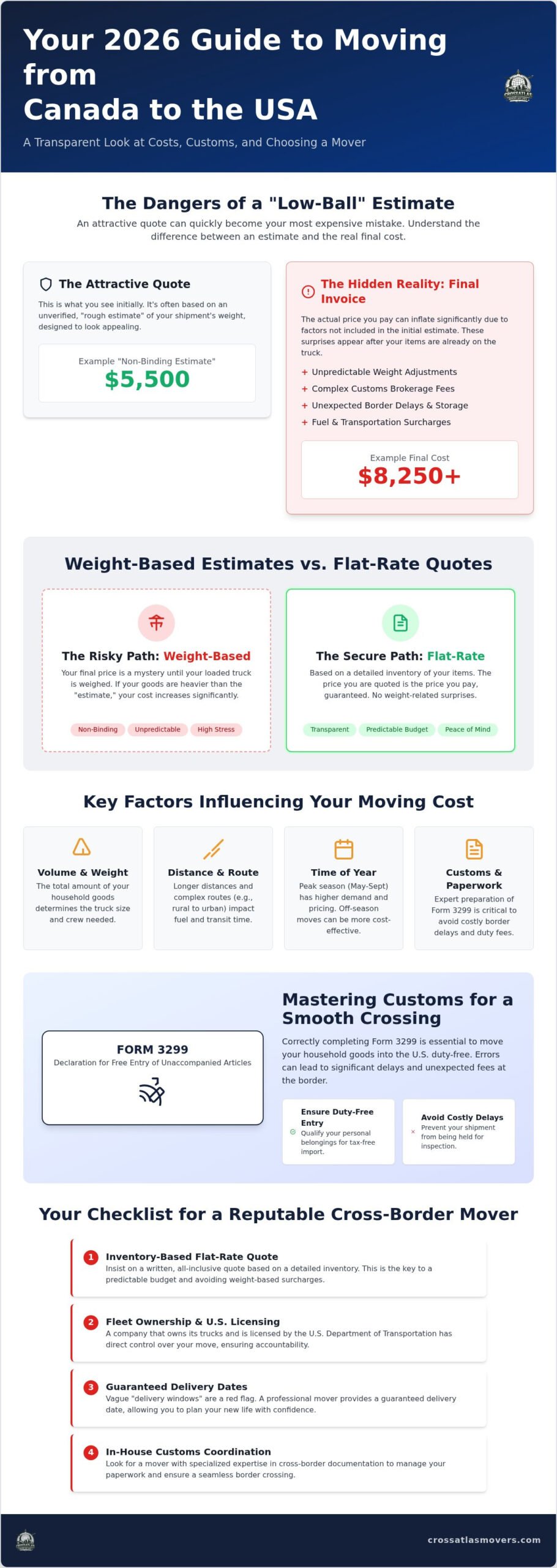
Many families find that the final cost to move from Canada to USA exceeds their initial expectations because they relied on a “non-binding estimate.” These quotes are often based on an approximate weight that isn’t verified until the truck is loaded and weighed at a station. If your shipment is heavier than predicted, your price will climb significantly. We believe in the transparency of a fixed-rate agreement based on a detailed inventory. This approach eliminates the anxiety of weight-based fluctuations and ensures that the price you are quoted is the price you actually pay. A written, all-inclusive agreement provides the predictability you need to manage your relocation budget effectively, allowing you to focus on your new home instead of your bank balance.
Factors Influencing the Cost to Move from Canada to USA
Understanding the cost to move from Canada to USA requires looking beyond a simple mileage calculation. While distance is a primary factor, the total volume of your inventory dictates the size of the truck and the number of crew members required to handle your transition. A larger household naturally occupies more space. This increases the logistical footprint of the move and the labour required for loading and unloading. Route complexity also matters. A move from Toronto to a major hub like New York is logistically simpler than a relocation from a rural town in British Columbia to a suburb in Texas.
Regulatory compliance is another critical variable. To move your goods duty-free, you must accurately prepare the U.S. customs form for household goods, known as Form 3299. Errors on this form can lead to inspection delays and storage fees at the border. These issues quickly inflate your total expenditure. Timing also influences your budget. Peak moving season typically runs from May through September. Planning your relocation during the late autumn or winter months can often result in more favourable scheduling and pricing due to lower seasonal demand.
Professional Packing and Custom Crating
Long-haul international relocations put more stress on your belongings than a local move. Your items will spend days in transit, crossing varying climates and road conditions. Professional packing is a necessary safeguard. Using high-quality materials ensures that items remain secure during thousands of kilometres of travel. For high-value items like electronics or fine art, custom crating provides a rigid protective layer that standard boxes cannot match. Well-organized packing also simplifies the customs process. When an inventory list is clear and items are properly boxed, border agents can verify the shipment more efficiently. This reduces the risk of a time-consuming physical inspection. For a detailed step-by-step approach to protecting your belongings in transit, our guide on moving furniture from Canada to the US covers the latest 2026 tariff regulations and best practices for ensuring your pieces arrive undamaged.
The Flat-Rate Advantage for International Moves
One of the biggest anxieties in cross-border relocation is the “weight surprise.” Many carriers provide a quote based on an estimated weight, but the final price isn’t determined until the truck passes over a certified scale. If your belongings are heavier than the salesperson guessed, you are left with a bill that exceeds your budget. You can avoid this uncertainty by choosing flat rate long distance movers. A fixed-rate quote is based on a comprehensive inventory rather than a fluctuating scale reading. This approach allows you to realize total budget certainty before the truck even arrives. When you are planning a life-changing transition, having a predictable, all-inclusive price is the best way to maintain your financial peace of mind. To ensure your budget remains intact, consider requesting a transparent moving quote that covers every detail from start to finish.
Comparing Moving Methods: Full-Service vs. DIY vs. Containers
Choosing a relocation method is a pivotal decision that defines your entire moving experience. While many people initially focus on the sticker price, the total cost to move from Canada to USA is comprised of both financial outlays and personal labour. A DIY approach often appears more affordable at first glance. However, once you account for the logistical burdens and hidden fees, the gap between “cheap” and “professional” narrows quickly. You must decide whether you want to be the project manager, the truck driver, and the labourer, or if you prefer a seamless transition handled by experts who own their own fleet of trucks.
The container model offers a middle ground where a company drops off a steel box for you to pack. While shipping a container can range between $1,435 and $3,666 depending on the route, this method places the physical strain entirely on your shoulders. You are responsible for maximizing the space and securing every item for a journey that may span thousands of kilometres. If the packing is insufficient, your belongings are at high risk during the constant vibrations of long-haul transit. For many, the “time cost” of managing these details is the most significant expense of all.
DIY Moving: The Hidden Expenses
Driving a rental truck across the border introduces costs that rarely appear in the initial rental quote. Large moving trucks are not fuel-efficient; they consume significant amounts of diesel, especially when fully loaded and climbing through mountain passes. Over a 2,000-kilometre journey, fuel costs can easily reach several hundred dollars. You also need to budget for multi-day expenses such as hotel stays, meals, and specialized insurance that covers international travel. Perhaps the most daunting hidden cost is the stress of navigating U.S. Customs and Border Protection without professional assistance. Managing your own clearance means standing at the booth alone, hoping your documentation is perfect to avoid being turned back or delayed for a secondary inspection.
Full-Service Movers: Why Expertise Pays for Itself
Hiring a full-service team provides a level of security that DIY methods simply cannot match. Professional movers utilize techniques that maximize every square inch of truck space while preventing shifting during transit. This precision protects your furniture from the structural damage often seen in amateur moves. Beyond physical safety, you gain the advantage of guaranteed delivery dates. This allows you to coordinate your arrival with your new job or lease start date, preventing expensive stays in temporary housing. For a deeper look at how to select the right partner, consult our full service long distance movers Canada guide. Investing in expertise ensures that the cost to move from Canada to USA remains a predictable investment in your future rather than a series of expensive surprises.
Navigating Customs and Avoiding Border Surcharges
Border crossing is the most unpredictable phase of an international relocation. While physical transit is manageable, regulatory compliance determines whether your belongings arrive on schedule or sit in a bonded warehouse accumulating fees. The total cost to move from Canada to USA is frequently inflated by border surcharges that arise from poor documentation. We prioritize a methodical approach to paperwork to ensure your household goods cross the line without a single “red flag.”
Central to this process is U.S. Customs and Border Protection (CBP) Form 3299, the Declaration for Free Entry of Unaccompanied Articles. This document allows you to import personal and household effects duty-free, provided you have owned and used them for at least one year. While the form itself has no filing fee, the cost of an administrative error is high. The current version of Form 3299 is set to expire on February 28, 2026; we ensure you are always using the most recent federal documents to avoid rejections. We also help you identify prohibited items, such as specific agricultural products or restricted firearms, that could trigger heavy fines or the seizure of your entire shipment.
The Importance of Accurate Documentation
Accurate documentation is the only way to realize a smooth transition. For Canadian citizens, this involves coordinating your visa status with your physical shipment. You must also account for a “goods to follow” list. This is a secondary inventory of items that aren’t on the truck but will enter the U.S. at a later date. Failing to declare these during your initial entry can result in duties being applied to those items later. To ensure you have every required permit and form ready, review our cross border moving checklist for a comprehensive breakdown of the paperwork involved.
Dealing with Border Inspections
Even with perfect paperwork, some shipments are selected for secondary inspection. This can be a random selection or triggered by a vague inventory description. If your goods are flagged, they may be moved to a Centralized Examination Station. This process often incurs storage and handling fees that the owner is responsible for, which can quickly change the expected cost to move from Canada to USA. Professional movers minimize this risk by providing clear, detailed manifests that leave no room for suspicion. Our experience with CBP protocols allows us to prepare your shipment for maximum transparency, reducing the likelihood of a time-consuming physical search. If you want to ensure your transition is handled with this level of precision, request a flat-rate cross-border quote today.
Choosing the Right Cross-Border Moving Company
Selecting a relocation partner is the final and most critical step in your journey south. While the initial cost to move from Canada to USA is a significant factor, the integrity and accountability of the company you choose will define your experience. We believe that a successful move is built on a foundation of trust and transparency. This is why we emphasize the importance of working with a carrier that owns and operates its own fleet of trucks. When a company controls its equipment, it maintains direct oversight of safety standards, maintenance, and the professional training of the crew handling your belongings.
Legal compliance is equally vital for a secure transition. Any company operating within the United States must possess valid Department of Transportation (DOT) and Motor Carrier (MC) numbers. These credentials are not just bureaucratic formalities; they are your assurance that the mover is authorized to operate across state lines and meets federal safety and insurance requirements. As a family-owned and operated business, we take personal accountability for every shipment. This “old-school” work ethic means you aren’t just another file in a corporate database. You are a family we are helping to settle, and our reputation depends on the precision and care we provide during your relocation.
Vetting Your Mover: Beyond the Price Tag
It is essential to distinguish between a moving broker and a direct carrier. A broker acts as a middleman, selling your contract to the lowest-priced third-party contractor, which often leads to a loss of accountability and communication. In contrast, a carrier handles your move from the initial inventory to the final delivery. Learning how to move from Canada to USA requires a specialized partner who understands the nuances of international logistics. When reviewing potential companies, look specifically for feedback regarding their cross-border performance. Reliability at the border and punctuality during long-haul transit are far more valuable than a low-ball estimate that doesn’t account for the complexities of international travel. Before finalizing your choice, consult the ultimate 2026 checklist for moving furniture from Canada to the US to confirm your chosen mover meets every compliance and handling standard required for a safe, duty-free delivery.
Finalizing Your Relocation Plan
To ensure a seamless experience in 2026, we recommend booking your services at least 8 to 12 weeks in advance. High-quality cross-border movers often have limited availability during peak seasons, and early planning allows for the methodical preparation of all customs documentation. Before signing any contract, ensure that your delivery date is guaranteed in writing. This prevents the frustration of waiting in an empty home for your belongings to arrive. Finally, always insist on a flat-rate quote. This fixed-price model ensures that the cost to move from Canada to USA remains predictable and transparent, protecting you from hidden surcharges or weight-based adjustments. By choosing a partner committed to honesty and precision, you can start your new life in the United States with total confidence.
Realize a Seamless Transition to Your New Home
Relocating to the United States is a significant milestone that requires a methodical approach to logistics and budgeting. By focusing on inventory-based pricing rather than weight-based estimates, you ensure that the total cost to move from Canada to USA remains predictable and manageable. Choosing a carrier that owns its fleet and specializes in cross-border documentation removes the burden of regulatory complexity from your shoulders. We believe that a successful move is defined by the removal of uncertainty at every stage of the journey.
As a family-owned and operated business, we take personal accountability for every household we move. We provide guaranteed delivery dates and ensure there are no hidden fees at the border; this allows you to focus on settling into your new community with total peace of mind. Our team is ready to act as your capable protector during this high-stress transition, combining precision with the care you deserve. Request Your Free Flat-Rate Cross-Border Quote from CrossAtlas Movers and take the first step toward a stress-free relocation. Your journey south represents an exciting new chapter, and we are here to ensure it begins with confidence and ease.
Frequently Asked Questions
How much does it cost to move a 3-bedroom house from Canada to the USA?
Relocating a three-bedroom house typically ranges between CAD $4,300 and $9,300 depending on the total weight and distance travelled. These industry averages for 2026 reflect a move of approximately 1,000 miles. Your final price will also depend on the level of service you select, such as professional packing or custom crating for high-value items. It’s essential to realize that these figures represent the base transportation and don’t include potential customs brokerage or insurance upgrades.
Are moving expenses to the USA tax-deductible for Canadians?
Moving expenses may be tax-deductible if your relocation is for work or full-time study purposes. The Canada Revenue Agency allows you to deduct eligible moving expenses if you move to be at least 40 kilometres closer to a new work location or school. However, because tax laws regarding international relocations are complex, you should consult with a qualified accountant to determine how these deductions apply to your specific situation in both Canada and the United States.
Do I need to be present at the border when my moving truck crosses?
You generally don’t need to be physically present at the border when the moving truck crosses if your documentation is complete. As long as your Form 3299 is properly filed and your mover has a copy of your passport and visa, they can act as your liaison with U.S. Customs and Border Protection agents. This allows you to travel separately to your destination, though you must have entered the U.S. before or at the same time as your goods to clear customs.
What is the average time it takes for a cross-border move?
A cross-border move typically takes between 7 and 14 days depending on the total distance and the time required for customs clearance. For example, a journey from Toronto to Florida covers roughly 2,000 kilometres and requires methodical planning to account for border protocols. We provide guaranteed delivery dates to ensure you can coordinate your arrival precisely. This predictability helps you avoid the stress of temporary housing costs while waiting for your household inventory to arrive.
How do moving companies calculate the cost of an international move?
Most moving companies calculate the cost to move from Canada to USA based on the weight of your shipment and the distance to your destination. In contrast, we utilize an inventory-based flat-rate model to provide total budget certainty. This approach avoids the “weight surprise” common with industry-standard estimates. By assessing the specific items you plan to relocate, we can provide a transparent price that includes fuel surcharges and basic documentation support without unexpected adjustments at the scale station.
What items are prohibited when moving household goods to the USA?
Prohibited items include perishable foods, plants with soil, hazardous materials like propane tanks or aerosol cans, and certain restricted firearms. You should also avoid packing liquids that could leak and damage your belongings during the long-haul journey. U.S. Customs agents are particularly strict about agricultural products that could carry pests. Reviewing a detailed prohibited items list before you begin packing ensures your shipment doesn’t face unnecessary delays or fines during the border inspection process.
Is it cheaper to sell my furniture in Canada and buy new in the USA?
It’s often more cost-effective to move high-quality furniture than to replace it in the U.S., where retail prices and sales taxes can be significantly higher. For instance, the cost of living in states like California is approximately 44.5% higher than in Canada, which extends to the price of new household goods. If your current furniture is in good condition and fits your new home, relocating it avoids the 2026 inflationary prices of new furniture and the logistical hassle of shopping while settling in.
How does the exchange rate affect my moving quote?
The exchange rate directly impacts your moving quote because many operational costs, such as U.S. road tolls and fuel, are paid in U.S. dollars. While your initial quote may be provided in Canadian dollars for your convenience, the underlying expenses fluctuate with the strength of the currency. A professional mover will account for these variables within a flat-rate quote to protect you from sudden price hikes. This ensures the cost to move from Canada to USA remains stable regardless of daily market shifts.