

What if the most daunting part of your overseas adventure isn’t the goodbye, but the fear that your life’s belongings might get stuck in a shipping container halfway across the ocean? Relocating your entire household across borders is a monumental task that often feels like a full-time job. You’re likely balancing the stress of hidden shipping fees with the anxiety of complex customs forms and shifting tax residency rules. It’s common to feel overwhelmed by the volume of paperwork required by the CBSA or the potential for unexpected delays. This 2026 guide provides a comprehensive international moving checklist from Canada to help you master every logistical hurdle with confidence.
We understand that you want a transition where your items arrive safely and your legal obligations to the CRA are crystal clear. You deserve a process that replaces confusion with a steady, methodical plan. In this guide, we’ll walk you through a step-by-step timeline designed specifically for Canadians moving overseas. You’ll learn how to secure guaranteed delivery dates, manage your provincial health coverage, and find movers who offer transparent, flat-rate pricing. By the end of this article, you’ll have the tools to ensure your global relocation is organized, predictable, and entirely stress-free.
Key Takeaways
- Start your planning at least six months before departure to effectively manage the complex logistics and budgeting required for an overseas relocation.
- Ensure total regulatory compliance by using a comprehensive international moving checklist from Canada to manage CRA residency notifications and health coverage transitions.
- Protect your financial interests by selecting a moving partner that provides flat-rate pricing and guaranteed delivery dates to avoid common hidden port fees.
- Guard your belongings against the rigours of sea freight through professional packing and custom crating designed for high-value and delicate items.
- Streamline your final days in Canada by organizing address forwarding and preparing a dedicated essentials kit for your first night abroad.
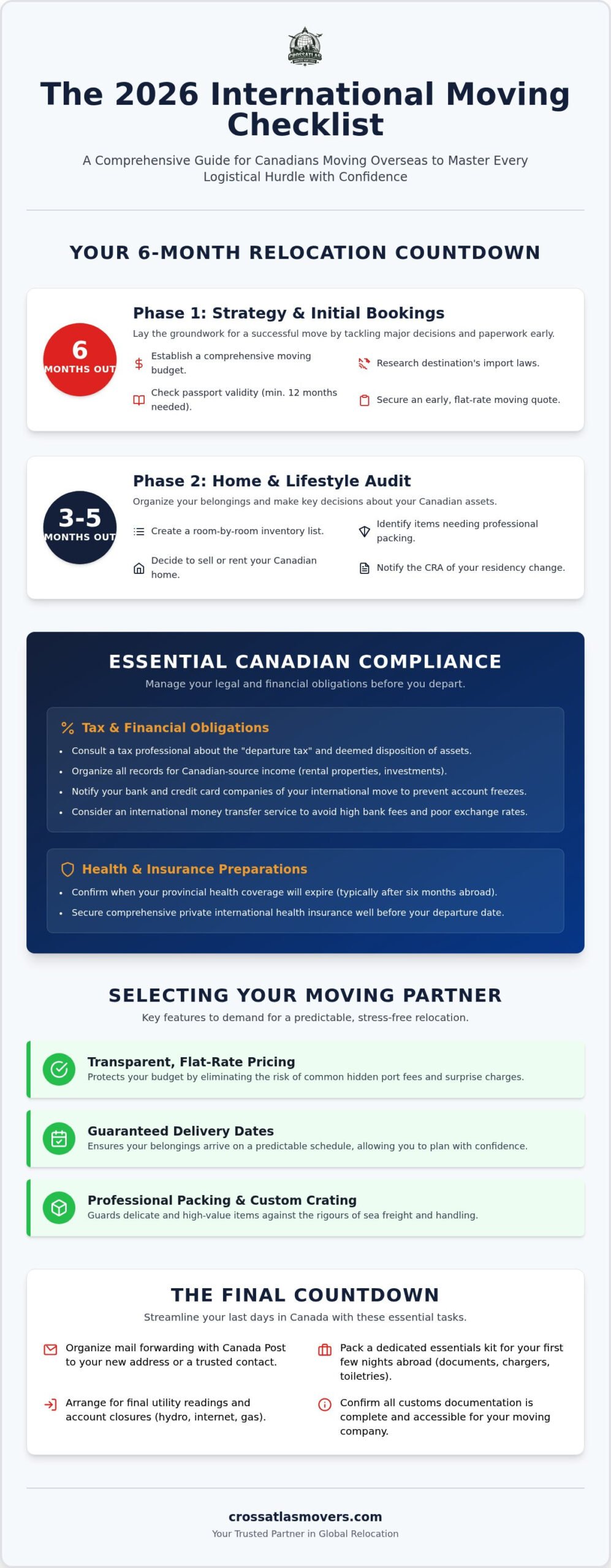
The Six-Month Countdown: Organizing Your Relocation Strategy
The six-month mark represents the critical point of no return for a successful global transition. At this stage, your planning shifts from abstract ideas to concrete logistics. Missing this window often leads to rushed decisions that increase the risk of damaged goods or expired visas. Understanding the psychological effects of relocating is also helpful, as a clear timeline reduces the mental burden by replacing uncertainty with a structured plan. It’s the moment to decide exactly what your new life will look like and what pieces of your current one will join you.
Your financial strategy must account for more than just the freight costs. Ensure your moving budget includes comprehensive transit insurance, temporary housing at your destination, and potential customs duties. Because international shipping rates can fluctuate based on global demand, establishing a baseline in Canadian Dollars early helps prevent financial strain later. Researching your destination’s import laws is equally vital. Some countries impose heavy taxes on vehicles or restrict specific household electronics, making it more cost-effective to sell those items in Canada rather than paying to ship them overseas.
Phase 1: Research and Initial Bookings
Check the expiry dates on your family’s passports immediately. Most nations require at least 12 months of validity beyond your intended arrival date. Since visa processing times vary significantly by country, starting this paperwork now is essential to avoid travel delays. This is also the ideal time to book an initial consultation with an international moving company. An early assessment allows experts to calculate your total cargo volume and provide a transparent, flat-rate quote. This early engagement is a cornerstone of any reliable international moving checklist from Canada, as it secures your spot on the shipping calendar.
Phase 2: Home and Lifestyle Audit
A room-by-room inventory is your most powerful tool for organization. Document every item you plan to take; this list will eventually form the basis of your mandatory customs declaration. Identify any high-value assets, such as fine art, heirloom furniture, or delicate electronics, that require professional packing for long-distance moves. These items need specialized care to survive the rigours of sea freight and temperature changes. Finally, decide the fate of your Canadian residence. Whether you choose to sell your home or hire a property manager to rent it out, this decision has significant implications for your tax residency status and your future obligations to the Canada Revenue Agency.
Essential Documentation and Canadian Regulatory Compliance
Managing the government and administrative side of an overseas move is just as critical as the physical transportation of your belongings. A thorough international moving checklist from Canada must prioritize your legal standing with federal and provincial authorities. Notifying the Canada Revenue Agency (CRA) is a primary step in this process. You need to establish whether you’ll be considered a factual resident or a non-resident for tax purposes once you depart. This determination affects your ongoing tax obligations and your eligibility for various Canadian social benefits.
Tax and Financial Obligations
Consult a qualified tax professional regarding the “departure tax,” which is technically a deemed disposition of certain assets when you leave the country. You’ll need to meticulously organize your records for all Canadian-source income, including rental properties or investment portfolios. To manage your daily finances without interruption, notify your bank and credit card providers of your move. This prevents your accounts from being frozen due to “suspicious” international activity. Many expats find that using a dedicated international money transfer service helps them avoid the high fees and poor exchange rates often associated with traditional bank wires.
Health and Insurance Preparations
Provincial health coverage typically expires after you have been out of your home province for six months. Accessing Living abroad guidance for Canadians provides essential information on how to maintain your status or transition to private global insurance. Request digital and physical copies of medical and dental records for every family member to ensure a smooth continuity of care. You should also verify that your transit insurance covers the entire journey from your Canadian doorstep to your final destination. If you’re feeling overwhelmed by these requirements, partnering with an experienced international relocation service can provide the professional support needed to keep your documentation on track.
Gather original copies of vital records such as birth certificates, marriage licenses, and school transcripts. These documents are often mandatory for local registrations, work permits, or school enrolments in your new country. Keep these papers in a secure, accessible folder that stays with you during travel rather than inside a shipping container. Organizing these files alongside your mover’s Bill of Lading ensures you’re prepared for any customs inquiries. A robust international moving checklist from Canada acts as your roadmap, ensuring no regulatory detail is overlooked during the high-stress weeks leading up to your departure.
Selecting Your International Moving Partner: Beyond the Quote
Choosing a mover is the most impactful decision on your international moving checklist from Canada. Many people mistakenly hire a “van line” broker, which acts as a middleman between you and several different subcontractors. This often results in a fragmented experience where accountability is lost at every border crossing. A dedicated international mover, especially one that owns their own fleet of trucks for the Canadian portion of the journey, provides a seamless chain of custody. This ownership ensures that the team handling your furniture for the Canadian portion of its journey is the same company responsible for its safety until it reaches the shipping port.
The Advantage of Flat-Rate Moving
Variable weight-based quotes are a common trap in the relocation industry. These estimates often change once your goods are weighed at a scale, leading to stressful, unexpected costs right before delivery. A fixed contract with flat-rate pricing removes this volatility, ensuring that the price you agree upon is the price you pay at the destination. When evaluating full service moving company Canada options, look for providers who offer guaranteed delivery dates. This level of transparency protects your budget from the hidden fee trap that frequently plagues overseas shipments, providing much-needed peace of mind during a high-stress event.
Logistics: Sea Freight vs. Air Freight
Determining the right transportation method depends on your volume and timeline. Sea freight is the standard for full household moves because it offers the most economical way to transport large furniture and appliances. Most Canadians opt for a 20ft or 40ft container to move their entire lives across the ocean. Conversely, air freight is ideal for survival kits containing essential clothing, documents, and professional tools you need immediately upon arrival. While air transit is significantly faster, the costs are calculated by weight and volume, making it expensive for anything beyond the essentials.
It’s also vital to understand the difference between door-to-door and door-to-port service models. A door-to-port agreement might seem cheaper initially, but it leaves you responsible for hiring local agents and navigating foreign customs once the ship docks. A comprehensive door-to-door service manages every detail, including the final delivery to your new residence. This methodical approach ensures that your transition is handled by experts who understand the nuances of global logistics, allowing you to focus on settling into your new home instead of managing port authorities.
Professional Packing and Custom Crating for Overseas Transit
Packing for a move across town is vastly different from preparing goods for a multi-week journey across the Atlantic or Pacific. Your international moving checklist from Canada should emphasize the transition from standard single-wall boxes to heavy-duty, double-walled corrugated containers. While a regular box might survive a local truck ride, it often collapses under the pressure of being stacked in a shipping container or handled by port cranes. Professional packing ensures your belongings are stabilized against the vibration and humidity changes inherent in sea freight.
The Art of International Packing
Reliable overseas transit requires specialized wrapping materials like acid-free paper for silver and anti-static wrap for electronics. Every item must be packed tightly to eliminate internal movement, as shifting is the primary cause of damage during rough sea crossings. A clear, multi-part labelling system is also essential. Labels must survive long-term storage and multiple hand-offs between trucks, warehouses, and ships. Many insurance providers only offer full replacement value coverage for items “packed by carrier.” Choosing to let the professionals handle your high-value items protects your investment and ensures your inventory meets strict international shipping standards.
Custom Crating for Fragile Goods
Standard boxes are insufficient for fine art, marble tabletops, or heirloom grandfather clocks. These items require custom-built wooden crates that meet ISPM 15 international standards. This regulation requires all wood packaging to be heat-treated to prevent the spread of pests across borders. Custom crates are designed to suspend the item within a rigid frame, preventing any contact with the outer walls of the crate. This methodical approach to protection is a hallmark of professional packing for global relocations.
Our team builds these crates on-site to ensure a precision fit for oversized or uniquely shaped belongings. This process involves measuring the item’s dimensions and weight distribution to create a structure that absorbs impact and prevents shifting during crane lifts at the port. By investing in custom crating, you remove the risk of structural damage to your most prized possessions.
Finally, you must create a “valued inventory” list for both customs clearance and insurance purposes. This document should detail every item in the shipment and its replacement value in Canadian Dollars. Be aware that certain items are strictly prohibited from leaving Canada or entering your destination country. Common prohibited items include:
- Flammable liquids and aerosols
- Perishable food items and plants
- Ammunition or explosives
- Certain types of untreated wood or animal products
Reviewing these restrictions early prevents your entire container from being flagged for inspection, which can lead to significant delays and additional storage fees at the destination port.
Navigating Customs and the Final Countdown
The final weeks before your departure are when your preparation meets reality. At this stage, your international moving checklist from Canada transitions from a planning document into a live operational schedule. You should focus on preparing a “first-night” essentials kit to carry with you on the plane. This bag must contain your immediate medications, universal power adapters, and physical copies of your destination’s customs declarations. Relying solely on digital copies is risky if your devices lose power or you lack local data upon arrival. Having these items on hand ensures you can navigate the first 24 hours in a new country with composure.
The Final Two Weeks in Canada
Ten business days before you leave, confirm every logistical detail with your interprovincial moving and international team. This synchronization ensures the Canadian leg of the journey aligns perfectly with the global shipping schedule. You must also notify utility providers for electricity, water, and gas to perform final meter readings on your move-out date. Set up mail forwarding through Canada Post to a trusted family member or a professional service to ensure you don’t miss critical tax documents or bank statements. Finally, perform a thorough walk-through of your empty residence to ensure nothing is left behind in attic spaces or storage lockers.
Arrival and Unpacking
Once you land, the customs clearance process begins. Depending on your destination’s regulations, this may involve a review of your “Goods to Follow” list or a brief interview with port authorities. A methodical mover will have already prepared your inventory to match local requirements, reducing the risk of intrusive inspections or unexpected duties. This is where guaranteed delivery dates become invaluable. Knowing exactly when your household goods will arrive allows you to schedule local services at your new home without paying for unnecessary hotel stays. It provides a predictable end to a complex journey.
When the truck arrives at your new residence, inspect the shipment immediately for any signs of transit damage. Use your master inventory list to check off each crate as it is unloaded from the container. If you have secured a comprehensive contract, the team will assist with unpacking and debris removal. This service allows you to focus on the first 72 hours of settling in rather than managing piles of packing material. This structured approach ensures that your first nights in a new country are spent in comfort, surrounded by the familiar items that make a house feel like a home.
Your Journey Beyond Borders Starts with a Solid Plan
Moving overseas is a complex operation that rewards early preparation and methodical execution. By following a structured international moving checklist from Canada, you’ve addressed the critical pillars of a successful relocation: regulatory compliance, precise documentation, and the protection of your physical assets. You’ve seen how to navigate the CRA’s residency requirements and the necessity of custom crating for long-haul sea transit. These steps transform a high-stress event into a manageable, predictable transition.
A stress-free move depends on choosing a partner who values transparency as much as you do. We provide the security of a family-owned business with the resources of a global operation. To secure your timeline and protect your budget, Request a flat-rate international moving quote from CrossAtlas Movers today. Our commitment to excellence includes a no hidden fees guarantee, professional custom crating for your most delicate items, and guaranteed delivery dates. Your global adventure is a significant life milestone. With the right plan and a capable team behind you, you can focus on the opportunities ahead while we handle the logistics of getting you there.
Frequently Asked Questions
How far in advance should I book an international moving company in Canada?
Aim to book your international mover at least three to six months before your scheduled departure date. This lead time is essential for securing your preferred shipping window and ensuring all customs documentation is processed without delay. Early booking also allows for a thorough on-site or virtual survey to determine the total volume of your shipment. This proactive step is a critical part of any international moving checklist from Canada to avoid peak-season availability issues.
Can I ship my car overseas from Canada, and is it worth the cost?
Shipping a vehicle overseas is possible through roll-on/roll-off (RoRo) services or containerized shipping. Whether it’s worth the cost depends on your vehicle’s market value in Canada versus the destination country, as well as local import duties and modification requirements. You must also consider that some countries restrict older vehicles or those with specific emission standards. It’s often more economical to sell a common vehicle in Canada and purchase a new one upon arrival.
What items are prohibited from being shipped internationally from Canada?
Certain items are strictly prohibited from being shipped internationally, including flammable liquids, aerosols, and explosives like ammunition. Additionally, most countries restrict the entry of perishable food items, live plants, and certain agricultural products to prevent the spread of pests and diseases. It’s also important to check for restrictions on specific woods or animal products that may violate international trade agreements. Always review the specific prohibited items list for your destination country before packing.
How is the cost of an international move from Canada calculated?
The cost of your relocation is primarily calculated based on the total volume of your goods measured in cubic feet or cubic metres. Other factors include the distance to the destination port, the chosen shipping method, and the level of service, such as professional packing or custom crating. Reliable movers provide flat-rate pricing to ensure transparency. This prevents the surprise of hidden fees or weight-based surcharges that can occur with less reputable brokers.
Do I need to be present at the port when my household goods arrive?
Most travellers find they don’t need to be physically present at the port if they’ve secured a comprehensive door-to-door relocation service. Your moving partner works with local agents to manage the customs clearance process on your behalf. However, most countries require the owner of the goods to have already entered the country and hold a valid visa before the shipment can be cleared. You must remain reachable by phone or email to resolve any customs inquiries.
Is my Canadian home insurance valid for items in transit overseas?
Standard Canadian home insurance policies don’t provide coverage for household goods once they leave your property for international transit. You must secure specialized transit insurance, often referred to as “All-Risk” marine insurance, to protect your belongings against loss or damage during sea or air freight. This coverage should ideally be arranged through your moving company to ensure it covers the entire journey. This includes the initial packing phase and the final delivery at your residence.
How long does sea freight typically take from Canada to Europe or Asia?
Sea freight transit times vary significantly depending on the final destination and specific shipping routes. A shipment from a major Canadian port like Montreal or Halifax to Europe typically takes four to six weeks. Moves to Asia or Oceania from the Port of Vancouver generally require six to ten weeks. These estimates account for ocean transit only. You should allow additional time for the initial Canadian trucking leg, port loading, and the final customs clearance process.
Can I move my pets internationally, and what are the Canadian export requirements?
Relocating with pets is possible, but it requires meticulous planning and adherence to strict health protocols. Canadian export requirements include a microchip, up-to-date rabies vaccinations, and an International Health Certificate signed by a licensed veterinarian and endorsed by the Canadian Food Inspection Agency (CFIA). Each destination country has its own specific entry rules, which may include mandatory quarantine periods. We recommend starting this process at least four months before your move to ensure all medical timelines are met.