
In the first quarter of 2026 alone, 75,285 Canadians packed their lives into boxes to start fresh in a new province. While the excitement of a new beginning in Alberta or Ontario is undeniable, the logistical reality of interprovincial moving often brings a heavy sense of anxiety. You’re likely worried about more than just the physical labour; you’re concerned about hidden fuel surcharges, the safety of your family’s heirlooms, and the confusing deadlines for switching your driver’s licence or provincial healthcare coverage.
We understand that you want a transition defined by precision and predictability rather than surprises and stress. You deserve a moving experience where your budget is respected and your belongings arrive exactly when promised. This 2026 reference guide provides the methodical roadmap you need to master the legal and financial complexities of relocating across Canada. We will examine provincial residency requirements, explain how to secure a flat-rate quote, and provide a clear timeline for your transition so you can focus on settling into your new home with total peace of mind.
Key Takeaways
- Understand the legal distinctions of interprovincial moving to ensure you comply with the specific provincial and territorial transport regulations that govern long-distance transit.
- Master the “Three-Month Rule” and provincial grace periods to ensure your healthcare coverage, driver’s licence, and vehicle registration remain valid during your transition.
- Learn why a flat-rate pricing model is the most reliable way to avoid hidden fees and fuel surcharges when planning your interprovincial moving budget.
- Discover how professional packing and custom crating protect your belongings against the unique physical stresses of a 3,000-kilometre journey across Canada.
- Establish a predictable relocation timeline that coordinates your departure and delivery dates with precision to eliminate long-haul anxiety.
What is Interprovincial Moving? Defining the Canadian Relocation
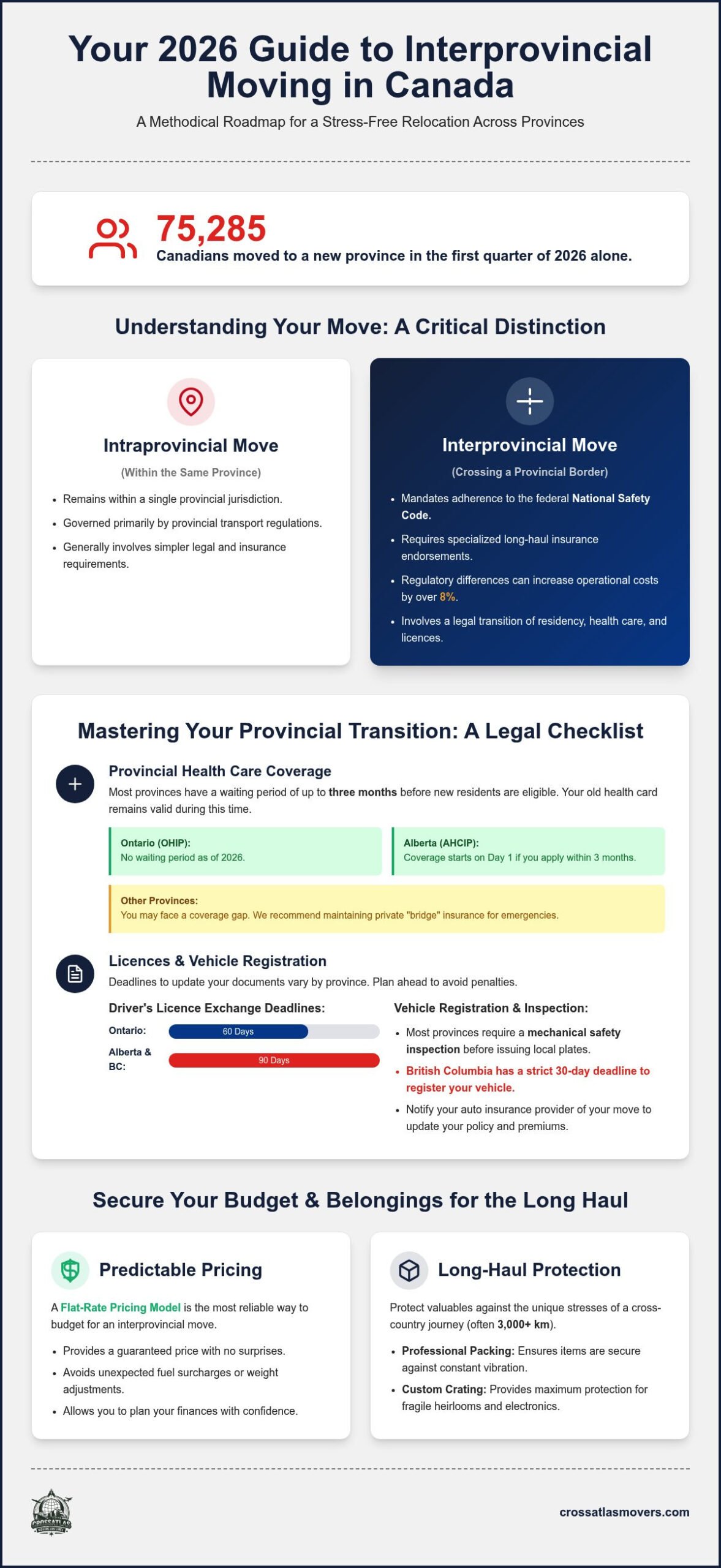
At its core, interprovincial moving is the physical transport of household goods across provincial or territorial borders. While a move within the same province covers significant ground, it remains intraprovincial. Crossing a provincial or territorial border transforms the relocation into a cross-jurisdictional event. This distinction is vital because the diverse Canadian landscape presents unique logistical hurdles. Moving a family thousands of kilometres across vast distances requires more than just a large truck; it demands a methodical approach to the “interprovincial barriers” that often complicate the transport industry. These regulatory differences between provinces can increase operational costs by over 8%, creating inefficiencies that only a seasoned professional can mitigate through precision planning.
Interprovincial vs. Intraprovincial Relocation
When you cross a provincial line, the legal contract of carriage changes fundamentally. Interprovincial carriers must operate under the National Safety Code, which is a rigorous set of federal standards designed to ensure commercial vehicles maintain high safety levels across the country. This oversight provides a reassuring layer of protection for your belongings that local moves don’t always mandate. Insurance requirements also shift once you leave your home province. Reliable carriers maintain specific long-haul endorsements to ensure your goods stay protected against the constant vibrations and extreme temperature shifts common on Canadian highways. Using a mover with a dedicated fleet ensures these safety standards are consistently met without the risks of third-party brokering.
The Evolving Landscape of Canadian Migration
Recent data reveals a steady increase in the number of families seeking new opportunities in different parts of the country. According to Statistics Canada, tens of thousands of people moved between provinces in the first quarter of 2026. While specific provincial migration patterns fluctuate, the movement of Canadians seeking new opportunities across the country remains a significant demographic event. This ongoing trend in Interprovincial migration in Canada is largely driven by economic shifts and the search for affordable living. We track these patterns to ensure our logistics remain responsive to the needs of Canadian families. Ultimately, interprovincial moving is a cross-jurisdictional transition of both goods and legal residency.
Navigating Provincial Regulations: Healthcare, Licences, and Vehicles
Success in interprovincial moving requires more than just loading a truck. It involves a methodical transition of your legal residency across borders. One of the most critical elements to manage is the “Three-Month Rule” regarding provincial health insurance. Most provinces have a waiting period of up to three months before new residents are eligible for coverage. During this interval, your old health card remains valid, but you must apply for a new one shortly after arrival to ensure a seamless transition without out-of-pocket costs.
Transferring Provincial Health Coverage
Applying for a new health card should be a priority once you establish residency. As of 2026, Ontario has eliminated the waiting period for OHIP coverage, while Alberta Health Care Insurance Plan (AHCIP) coverage begins the day residency is established if you apply within three months. In other provinces, you may face a gap. We recommend maintaining private “bridge” insurance during this interval to cover any medical emergencies. This small step provides a vital safety net while you wait for your new province’s system to realize your status.
Vehicle Registration and Out-of-Province Inspections
Your vehicle also needs to “move” provinces legally. Most jurisdictions require a mechanical safety inspection before they will issue local plates to ensure the vehicle meets specific provincial standards. Deadlines for changing your driver’s licence vary; you have 60 days in Ontario and 90 days in Alberta or British Columbia. However, vehicle registration is often stricter. British Columbia requires you to register your vehicle within 30 days of arrival. Moving across provincial lines also impacts your auto insurance premiums, so it’s wise to consult with a provider early. If you’re feeling overwhelmed by these timelines, a partner specializing in province to province moving can help you stay organized during the physical relocation.
Taxes are another logistical reality of a long-distance move. Your province of residence on December 31st determines which provincial tax rates apply to your entire year’s income. This can result in a significant difference in your tax return or balance owing depending on the jurisdiction. Additionally, you must update your address with the Canada Revenue Agency (CRA) and other federal bodies like Service Canada. You can claim interprovincial moving expenses on your federal tax return using Form T1-M if you move at least 40 kilometres closer to a new workplace or school. These deductions apply against income earned at the new location, making the financial transition as smooth as the physical one.
Logistics and Pricing: Flat-Rate vs. Weight-Based Quotes
Choosing a pricing model is the most significant financial decision you’ll make during an interprovincial moving project. The traditional weight-based model relies on the actual mass of your belongings, which is determined by weighing the truck before and after loading. This approach often leads to “weight surprises” where the final bill exceeds the initial estimate. In contrast, a flat-rate model provides a fixed fee based on a detailed inventory. This transparency eliminates the anxiety of fluctuating costs, allowing you to finalize your budget with certainty before the truck even arrives at your door.
Hidden fees can quickly inflate a long-distance quote if you aren’t vigilant. Many carriers now apply fuel surcharges ranging from 3% to 8% to account for the 25% to 30% rise in diesel prices seen in early 2026. Beyond fuel, you should watch for additional line items such as:
- Stair fees: Charges for navigating multiple flights of stairs at either location.
- Long-carry charges: Fees applied if the truck cannot park within a specific distance of your entrance.
- Shuttle services: Costs for transferring goods to a smaller vehicle if the main trailer cannot access your street.
Understanding the Bill of Lading
The Bill of Lading is the most important legal document in your relocation. It serves as your formal contract and a receipt for your goods during their journey across the country. Before signing, ensure it clearly outlines the agreed-upon price, the delivery window, and the valuation coverage for your belongings. This document protects your rights by establishing the carrier’s liability and ensuring the terms of your interprovincial moving agreement are enforceable if disputes arise during transit.
Dedicated Fleet vs. Van Line Brokers
Accountability often hinges on who actually owns the equipment and employs the crew. Van line brokers typically sell your move to a third-party subcontractor, which can lead to fragmented communication and shifting timelines. Selecting a company with a dedicated fleet ensures the same team handles your items from start to finish. This direct ownership allows for greater precision in scheduling and enables the provider to offer guaranteed delivery dates. For a deeper look at these differences, read our Long Distance Movers vs. Van Lines in Canada: 2026 Comparison Guide. By maintaining control over every asset, a family-owned operation can prioritize your specific needs over high-volume brokerage targets.
Protecting Your Belongings for the Long Haul
A 3,000-kilometre journey across the Canadian Shield or through the Rocky Mountains subjects your household goods to intense physical stress. Unlike a local move, interprovincial moving involves multi-day transit where items endure constant road vibrations and significant temperature fluctuations. Stacking is another critical factor; items at the bottom of a trailer must withstand the pressure of goods layered above them for thousands of kilometres. Professional standards ensure your furniture and boxes are secured to prevent shifting, which is the leading cause of damage during long-haul transit. We prioritize the safety of your cargo by using methodical loading patterns that account for these physical forces.
Professional Packing Techniques
Choosing DIY packing for a cross-country relocation often proves risky because standard retail boxes aren’t designed for the rigours of freight transport. We recommend using double-walled corrugated boxes and specialized heavy-duty padding for all fragile items. Our Professional Packing for Long-Distance Moves: 2026 Guide details how to secure your inventory for multi-day journeys. Professionals organize inventory with a methodical tagging system, ensuring every item is accounted for from the moment it leaves your old home until it’s placed in your new one.
Custom Crating for Fragile Goods
High-value assets like marble tabletops, antique mirrors, or delicate electronics require protection that exceeds the capabilities of cardboard. Custom timber crating provides a rigid exoskeleton that shields these items from external pressure and impacts. Custom crating is the primary defence against structural damage during cross-country freight. This specialized approach also protects sensitive materials from the climate variations found between provinces, such as the humidity of the Maritimes versus the dry air of the Prairies. It’s the most reliable way to ensure your heirlooms survive the trip unscathed.
Understanding valuation protection is the final step in securing your move. Basic carrier liability usually covers only C$0.60 per pound per item, which is often insufficient for modern electronics or designer furniture. We suggest opting for full replacement value protection to ensure your investment is completely covered. This provides the ultimate peace of mind, knowing that in the unlikely event of an accident, your belongings will be repaired or replaced at their current market value. If you want to ensure your high-value items are handled with expert care, consider booking our professional packing services today.
Executing the Move: From Departure to Delivery
Executing an interprovincial move requires a master timeline that begins at least eight to twelve weeks before your departure date. Booking your mover early is essential, especially if you plan to relocate during the peak summer season when demand is highest across Canada. Once your date is secured, your focus should shift to a methodical inventory management process. During loading, the moving team records the condition of every item, providing you with a detailed manifest that serves as your primary reference for the duration of the journey. Modern logistics allow professional carriers to keep you informed as the truck crosses provincial borders and time zones, ensuring you always know the status of your shipment.
When the truck arrives at your new home, the unloading process begins with a systematic check against your original inventory list. We recommend inspecting high-value items and custom-crated goods immediately to ensure everything arrived in its original condition. If you notice any discrepancies or signs of transit wear, documenting them on the spot is vital for a smooth valuation claim process. This methodical approach ensures that the final step of your physical relocation is as transparent and organized as the first day of packing.
The Importance of Guaranteed Delivery Dates
Vague “delivery windows” are a common source of anxiety for families, often leaving them living in empty houses or hotels for weeks. We eliminate this uncertainty by providing guaranteed delivery dates at the time of booking. This precision allows you to coordinate your flights, hotel stays, and work schedules with total confidence, knowing exactly when your belongings will arrive. For a step-by-step guide on managing these logistical details, consult our Cross Country Moving Checklist: Everything to Do Before You Move. Having a fixed date transforms the chaos of a long-haul move into a predictable, manageable transition.
Settling into Your New Province
The first 48 hours in your new jurisdiction are critical for establishing your local presence and reducing post-move stress. Your final checklist should include registering for local utilities, updating your residential address for emergency services, and identifying the nearest medical facilities. Taking these small, proactive steps helps your family feel secure in your new environment immediately. If you’re ready to begin planning your transition with a team that prioritizes punctuality and safety, you can request a flat-rate interprovincial moving quote from CrossAtlas Movers today. Moving across Canada is a significant life event, and having a methodical partner ensures you can focus on your new beginning rather than the logistics of the road.
Mastering Your Next Canadian Chapter
Transitioning your life across Canada is a significant undertaking that requires balancing legal residency requirements with physical logistics. By mastering provincial grace periods for healthcare and opting for a flat-rate pricing model, you eliminate the most common sources of relocation stress. Interprovincial moving doesn’t have to be a gamble defined by hidden fees or delivery windows that leave you waiting in an empty home. Instead, it can be a methodical, predictable process that respects both your timeline and your budget.
As a family-owned operation with a dedicated truck fleet, we take personal accountability for every item we transport. We provide guaranteed delivery dates and transparent pricing to ensure your transition is seamless. Get a Guaranteed Flat-Rate Quote for Your Interprovincial Move and experience the security of working with experts who prioritize your peace of mind. Your new beginning in a new province is waiting, and we are ready to help you arrive with total confidence.
Frequently Asked Questions
How much does interprovincial moving cost in Canada?
The cost of relocating between provinces depends on the total volume of your belongings and the distance to your destination. Factors such as professional packing, custom crating, and fuel surcharges also influence the final estimate. While industry averages vary, choosing a flat-rate model ensures your budget remains predictable. This transparency eliminates the risk of weight-based surprises on moving day, allowing you to finalize your financial planning with total certainty.
How long does it take to move furniture between provinces?
Transit times for interprovincial moving typically range from several days to two weeks depending on the route and seasonal demand. A move from British Columbia to Ontario covers nearly 4,500 kilometres and requires methodical logistical coordination across multiple time zones. We provide guaranteed delivery dates at the time of booking so you can plan your arrival and travel with precision. This structured approach prevents you from living in an empty home while waiting for your shipment.
Do I need a new driver’s licence immediately when I move provinces?
You don’t need to exchange your licence the day you arrive, but you must do so within a specific grace period. Most provinces allow between 60 and 90 days to complete the transfer; for example, Ontario requires an exchange within 60 days, while Alberta and British Columbia provide a 90-day window. It’s best to visit a local registry office early to ensure your documentation remains valid and you comply with the specific regulations of your new jurisdiction.
What is the difference between a long-distance move and an interprovincial move?
A long-distance move refers to any relocation over a significant distance, whereas an interprovincial move specifically involves crossing a provincial or territorial border. This distinction is vital because crossing borders introduces different regulatory frameworks, such as the National Safety Code for commercial trucking. Understanding these cross-jurisdictional rules is essential for a smooth transition of your legal residency. It ensures that both your household goods and your personal documentation meet the standards of your new home.
Is my provincial health insurance valid while I am moving?
Your original provincial health insurance remains valid during the transition, but you must apply for new coverage in your destination province. Most jurisdictions have a three-month waiting period before you become eligible for local benefits, though exceptions exist in Ontario and Alberta as of 2026. Applying for your new health card immediately upon arrival ensures you don’t face gaps in coverage. We recommend maintaining private bridge insurance during this interval to cover any unexpected medical emergencies.
Can I move my vehicle as part of my interprovincial household move?
You can include your vehicle in your relocation, though it often requires specialized transport or a dedicated trailer. You must register the vehicle in your new province within a specific timeframe, such as the 30-day deadline in British Columbia. Most provinces require an out-of-province mechanical safety inspection before issuing new plates. This process ensures the vehicle meets local standards and allows you to secure the necessary local auto insurance for your new residence.
What happens if my delivery is delayed during a cross-country move?
Delays in cross-country transit can occur due to weather or mechanical issues, but working with a carrier that offers guaranteed delivery dates reduces this risk. If a delay happens, a professional mover will maintain clear communication and provide real-time updates as the shipment progresses. Choosing a company with a dedicated fleet rather than a broker ensures better accountability. This methodical oversight provides a layer of security that helps lower your stress during the final stages of your move.
Should I choose a flat-rate or a weight-based moving quote?
A flat-rate quote is the superior choice for long-distance relocations because it provides a fixed price based on a confirmed inventory. Weight-based quotes carry the risk of surprises, where the final cost isn’t known until the truck is weighed on moving day. For a predictable budget with no hidden fees, a flat-rate agreement offers the most security for your interprovincial moving project. It allows you to move with the confidence that your financial plan is protected.