

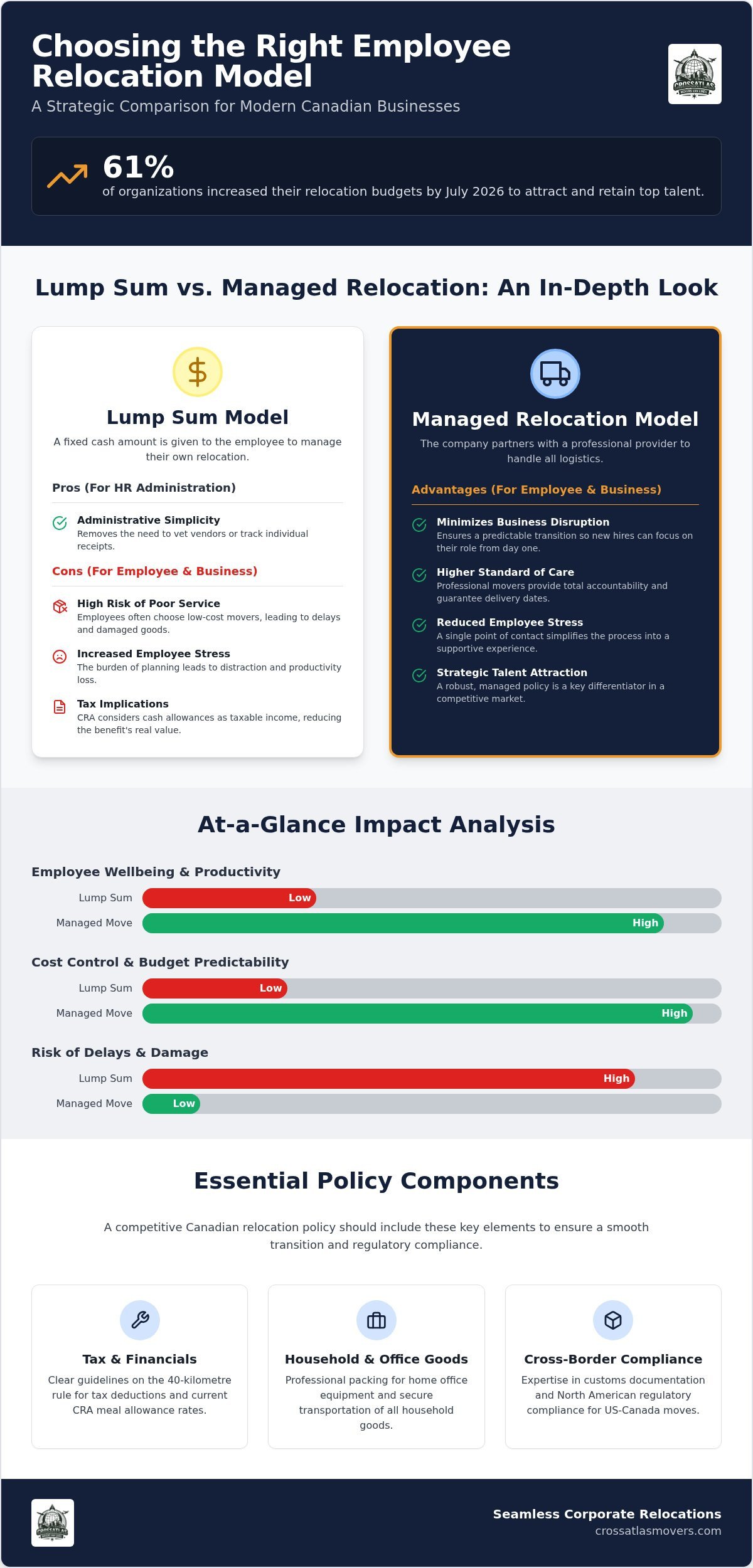
Did you know that 61% of organizations have increased their relocation budgets as of July 2026 to keep pace with the rising costs of talent mobility? While increasing spend is one way to stay competitive, the true advantage lies in how you structure your employee relocation policy to protect both your corporate budget and your people. It’s a common challenge to manage unpredictable moving costs while trying to minimize the stress that often leads to productivity loss for your new hires during a transition.
You likely realize that a relocation is more than just a logistical task; it’s a significant life event that requires a steady, expert hand to ensure everything stays on track. This guide will help you design a competitive policy that attracts top talent through logistical precision and clear cost control. We will walk through essential components like the 40-kilometre rule for tax deductions, current CRA meal allowance rates, and how to select reliable partners who guarantee delivery dates to keep your operations running smoothly.
Key Takeaways
- Learn how a modern employee relocation policy acts as a strategic tool for attracting top talent while maintaining strict corporate cost control.
- Compare the managed relocation model with lump-sum payments to determine which approach best minimizes employee downtime and logistical stress.
- Identify essential policy components, including professional packing for home office equipment and the secure transportation of household goods.
- Navigate the complexities of cross-border moves with insights into customs documentation and North American regulatory compliance.
- Discover the logistical advantage of partnering with a provider that operates its own fleet to ensure guaranteed delivery dates and total accountability.
Defining the Strategic Importance of an Employee Relocation Policy in 2026
An employee relocation policy is a formal document that outlines the specific assistance your company provides to staff moving for work. In 2026, this document has evolved into a critical strategic asset for any organization looking to grow. It ensures that every move is handled with logistical precision and care, providing a predictable framework for both the business and the employee. Relying on ad-hoc agreements often leads to budgetary surprises and legal inconsistencies that can harm your reputation. A standardized policy provides the structural integrity needed to manage costs while ensuring every team member receives equitable treatment. Defining the Strategic Importance of an Employee Relocation Policy involves recognizing it as a blueprint for long-term success and corporate stability.
Beyond Reimbursing Expenses: A Talent Retention Tool
Your employer brand begins long before a new hire sits at their desk. A seamless relocation reflects your organization’s commitment to its people from day one. When a company manages the heavy lifting of a move, it directly reduces relocation stress. This stress is a leading cause of new-hire attrition and productivity loss during the first six months of employment. By removing these burdens, you allow employees to focus on their new roles rather than customs paperwork or delivery dates. In the current competitive Canadian market, robust relocation support is often the deciding factor for specialized talent. Winning the war for talent requires showing candidates that you have a methodical plan for their arrival and a genuine interest in their transition.
The Shift Toward Flexibility and Employee Wellbeing
Modern policies are moving away from rigid, one-size-fits-all models. Instead, successful firms are adopting tiered or flexible benefit structures that address the unique needs of different roles or family situations. This shift acknowledges that moving isn’t just about shifting furniture; it’s about uprooting a life. Addressing the emotional and familial aspects of a move, such as school searches or partner career support, builds deep loyalty. Providing a single point of contact for the employee simplifies the process and instills a sense of security. This methodical approach ensures that the transition feels supportive rather than overwhelming. It turns a complex task into a simplifying resolution for everyone involved, reinforcing your status as a dependable partner in their career journey.
Choosing the Right Relocation Model: Lump Sum vs. Managed Move
Selecting the right framework for your employee relocation policy is a balance between administrative ease and the quality of the employee experience. Every organization must decide how much control they want over the logistical details of a move. While some companies prefer a hands-off approach, others recognize that direct involvement ensures a more reliable transition for high-value hires. In 2026, the choice often comes down to three primary structures: lump sum, managed relocation, or a hybrid core-flex model. Each approach impacts your budget and your employee’s productivity in different ways.
The Lump Sum Model: Pros and Cons for Modern HR
The Lump Sum model involves providing a fixed cash amount for the employee to manage their own move. It offers administrative simplicity for HR departments because it removes the need to vet vendors or track individual receipts. However, this simplicity often comes at the cost of employee wellbeing. When left to their own devices, employees frequently choose low-cost moving services that lack accountability. This often leads to damaged goods, delayed arrivals, and significant stress. It’s also vital to consider the tax implications of cash allowances in Canada. For the 2026 tax year, the CRA continues to view unvouched cash allowances as taxable income. This can significantly reduce the actual value of the benefit for the employee, potentially leaving them out of pocket for essential moving costs.
Full-Service Managed Relocations: Minimizing Business Disruption
A managed relocation model is a methodical approach where the company partners directly with a provider to handle every logistical detail. Partnering with professional corporate relocation services ensures a higher standard of care and personal accountability. This model is particularly effective for reducing business disruption because it provides guaranteed delivery dates. When you know exactly when a household will arrive, you can avoid the escalating costs of temporary hotel stays or extended corporate housing. Using a provider with flat-rate pricing helps HR departments maintain strict budget adherence, removing the risk of hidden fees that often plague the moving industry. If you want to ensure a smooth transition for your team, choosing a managed move protects both your investment and your new hire’s peace of mind.
For executive and mid-level roles, many firms are now adopting Core-Flex policies. These policies provide a core set of benefits, such as professional packing and transportation, while allowing employees to choose flex options like storage or house-hunting support. This model offers a high ROI by providing the security of a managed move with the personal choice employees value. Understanding the key differences between long distance movers vs van lines in Canada can help HR teams select the right provider structure for these tiered programs. Choosing a partner like CrossAtlas Movers allows you to implement these models with precision, using a dedicated fleet to ensure your staff are settled and productive as quickly as possible.
Essential Components of a Competitive Canadian Relocation Policy
Building a competitive employee relocation policy requires a granular focus on the services that truly impact a new hire’s transition. While basic transportation is the foundation, a modern policy must account for the complexities of today’s work environments, including specialized home office equipment and high-value personal assets. A well-defined policy provides clarity, ensuring that every staff member understands what is covered and what is not. This transparency prevents friction during an already stressful period. By focusing on essential logistical components, you create a framework that supports the employee while maintaining strict corporate cost control.
Defining Eligible Expenses and Service Tiers
Effective policies often utilize a tiered approach to balance employee needs with corporate budgets. Executive tiers typically include comprehensive support such as full real estate commission coverage and vehicle shipping. Mid-level managers might receive a package focused on household transit and storage-in-transit, while entry-level hires often receive assistance for essential moving costs and temporary travel expenses. It’s important to clearly define what the company will not cover to prevent budget bloat. Common exclusions often include the transport of non-essential luxury items, such as large recreational equipment or specialized collections. Including moving insurance as a core benefit across all tiers provides a sense of security and demonstrates personal accountability for the employee’s belongings.
Logistics and Packing: Protecting Company Assets and Employee Comfort
The physical move is the most visible part of your policy. Investing in professional packing services is no longer an optional luxury but a necessity for preventing damage claims. Professional packers use high-quality materials and methodical techniques to ensure items arrive in the same condition they left. For employees with specialized home office gear or fragile electronics, custom crating is essential. This level of care protects company-owned assets and reduces the mental load on the employee. A “white-glove” experience, where items are carefully unpacked and placed, allows the employee to settle in quickly. This methodical attention to detail transforms a complex logistical task into a smooth, reassuring transition.
Beyond the move itself, your policy should address the “gap” between residences. This includes travel expenses and temporary housing for a set period, usually 30 days. Real estate and lease cancellation assistance are also vital components. Covering the costs of breaking a lease or providing a stipend for closing costs on a new home can be a significant motivator for talent. These components work together to remove the financial and logistical burdens that often lead to relocation stress. When these elements are handled with precision, your organization stands out as a capable protector of its most valuable asset: its people.
Navigating Cross-Border and International Relocation Complexities
Moving across provincial borders is complex, but crossing international lines requires a different level of precision. Your employee relocation policy must account for the specific logistical hurdles of the Canada-USA border and overseas destinations. Without a methodical plan, these moves can stall at customs. This leads to employee frustration and escalating corporate costs. In 2026, the regulatory environment remains strict. Your policy should provide clear guidance on how the organization facilitates these transitions. Partnering with specialized cross-border moving services ensures that every detail is handled with professional authority and care.
Canada-USA Relocations: Managing Customs and Documentation
Moving employees between Canada and the USA involves more than just a long drive. It requires a deep understanding of work visas, personal manifest lists, and customs bonds. A specialized mover acts as a bridge between the employee and border agents. They ensure all paperwork is completed accurately before the truck reaches the crossing. Common pitfalls, such as incomplete manifests or missing residency documentation, can lead to significant delays. Your policy should outline the company’s role in securing these documents. This provides a sense of security for the new hire. By managing these complexities, you remove the burden of bureaucracy from the employee. This allows them to focus on their new role from day one.
Global Mobility: Scaling Your Policy for Overseas Moves
International transfers often require a mix of sea and air freight. This adds layers of coordination to your logistics. A consistent global policy ensures that employees receive the same high level of care regardless of their destination. Beyond the physical move, consider including cultural orientation and language support in your relocation package. These benefits are vital for long-term retention in overseas assignments. You must also address tax considerations to help employees avoid double taxation. For international moves to Canada, remember the extension of the “Prohibition on the Purchase of Residential Property by Non-Canadians Act” to January 1, 2027. This regulation may impact how you structure housing support for international talent. Providing a single point of contact for global logistics prevents the process from feeling overwhelming. It builds a foundation of trust with your team. To stay ahead of the evolving landscape, reviewing the latest global mobility moving company trends and corporate relocation strategies for 2026 can help HR leaders anticipate regulatory changes and align their policies accordingly.
Partnering with CrossAtlas Movers for Seamless Corporate Relocations
The success of an employee relocation policy depends entirely on the reliability of the partner who executes it. At CrossAtlas Movers, we understand that a move is more than just a logistical task; it’s a high-stress life event that requires professional authority and personal care. We operate as a family-owned business, which means we take personal accountability for every shipment. Unlike brokers who subcontract their work to third parties, we own our fleet of trucks. This allows us to maintain total control over the moving process from start to finish. Our methodical approach ensures that your staff feels supported and secure throughout their entire transition.
The Advantage of Flat-Rate Pricing and Guaranteed Delivery
Budget predictability is a primary concern for HR managers. Our flat-rate pricing model eliminates the anxiety of hidden fees or unexpected surcharges that often arise during long-distance moves. We provide fixed-rate quotes for every corporate relocation, ensuring your department can maintain strict financial control. Beyond the budget, we recognize that timing is critical for business continuity. We offer guaranteed delivery dates to protect your employee’s start date and minimize downtime. Knowing exactly when the truck will arrive allows you to reduce corporate housing costs by avoiding unnecessary hotel stays. This level of precision turns a complex operation into a predictable and manageable experience for everyone involved.
Professional Packing and Custom Crating for High-Value Moves
Protecting your company’s assets and your employee’s personal belongings is our top priority. Our team provides professional packing services using high-quality materials designed for the rigours of long-distance transport. We don’t just put items in boxes; we use methodical techniques to ensure everything arrives in pristine condition. For high-value workstations, fragile electronics, or specialized office equipment, we provide custom crating solutions. This specialized care reduces the risk of damage claims and ensures that your team can get back to work immediately upon arrival. To ensure your staff is fully prepared for the transition, we recommend you consult our business relocation checklist to help organize the internal details of the move.
When finalizing your employee relocation policy, consider the value of a partner who combines the resources of a large operation with the dedication of a boutique firm. We act as a capable protector for your staff, handling the heavy lifting so they don’t have to. Our steady, organized rhythm is designed to lower the stress levels of your new hires and build a foundation of trust from day one. By choosing a partner that values punctuality and transparency, you ensure that your corporate relocation program is a true asset to your talent acquisition strategy.
Scaling Your Talent Strategy with Logistical Precision
Designing a modern employee relocation policy is about balancing corporate efficiency with the genuine wellbeing of your team. You’ve learned that moving away from ad-hoc agreements toward standardized, managed relocation models provides the budget predictability and legal consistency your organization needs. By focusing on essential components like professional packing and guaranteed delivery dates, you ensure that new hires can transition into their roles without the heavy burden of logistical stress.
As a family-owned business with our own dedicated fleet of trucks, we take personal accountability for every move. We specialize in cross-border and international expertise, providing a steady hand through the complexities of customs and global transit. Our methodical approach is designed to protect your investment and your people. When you’re ready to streamline your corporate mobility program, we’re here to help you move forward with confidence.
Request a flat-rate corporate relocation quote from CrossAtlas Movers today and experience the security of a partner who values punctuality and transparency.
Frequently Asked Questions
What should be included in a standard employee relocation policy?
A standard policy should include household goods transportation, professional packing, temporary housing, and travel expenses. These core services ensure the employee can move their life without a significant financial burden. You might also include storage-in-transit or vehicle shipping for more comprehensive packages. Clear definitions of eligible expenses prevent confusion and help maintain strict budget control throughout the entire transition process.
Is an employee relocation package a taxable benefit in Canada for 2026?
In 2026, the CRA continues to distinguish between non-taxable reimbursements and taxable allowances. Generally, if you reimburse an employee for actual moving expenses and the move meets the 40-kilometre rule, it’s not a taxable benefit. However, unvouched lump sum payments are typically viewed as taxable income. It’s vital to structure your employee relocation policy to maximize tax efficiency for both the company and the hire.
What is the difference between a lump sum and a managed move?
A lump sum move provides the employee with a fixed cash amount to manage their own logistics, while a managed move involves the company hiring a vetted moving firm. Lump sums offer administrative simplicity but often lead to higher employee stress and poor service choices. Managed moves provide greater accountability and precision. They ensure the transition is handled by experts, which protects your employee’s productivity and your corporate budget.
How do I manage a cross-border relocation from Canada to the USA?
Successful cross-border moves require meticulous documentation, including work visas, personal manifests, and customs bonds. You should partner with a mover that specializes in North American logistics to bridge the gap between the employee and border agents. This ensures all paperwork is verified before the truck reaches the crossing. Managing these details proactively prevents costly delays and ensures a smoother transition for your staff moving between Canada and the USA.
How much does a typical corporate relocation cost in Canada?
The cost of a corporate relocation in Canada depends on the distance, the volume of goods, and the level of service required. While prices fluctuate based on market conditions, choosing a partner with flat-rate pricing helps eliminate the anxiety of hidden fees. You should factor in the costs of packing, transportation, and potential storage. A well-structured policy focuses on value and reliability rather than just the lowest initial estimate. When evaluating providers, reviewing a detailed comparison of long distance movers vs van lines in Canada can help you identify which pricing model and fleet structure best aligns with your corporate budget requirements.
Why is a guaranteed delivery date critical for a corporate relocation policy?
Guaranteed delivery dates are critical because they prevent the escalating costs of temporary corporate housing and hotel stays. When an employee knows exactly when their belongings will arrive, they can settle into their new home and start work on schedule. This certainty reduces relocation stress and minimizes downtime. It allows HR managers to plan the onboarding process with confidence, knowing the logistical transition is under control.
Should I offer different relocation tiers based on employee seniority?
Yes, offering different relocation tiers based on seniority is an effective way to balance employee needs with corporate budget constraints. Executive tiers often include full-service support like vehicle shipping and real estate assistance. Mid-level or entry-level tiers might focus on core transportation and packing services. This structured approach ensures equitable treatment across the organization while providing the necessary support for high-stakes hires.
How can professional packing services reduce our corporate liability?
Professional packing services reduce corporate liability by ensuring that items are handled with expert techniques and high-quality materials. When experts pack household goods or specialized home office equipment, the risk of damage during transit is significantly lowered. This leads to fewer insurance claims and less frustration for the employee. It demonstrates a high standard of care, showing that the company values the employee’s personal property and professional tools.