
What if the most exhausting part of your 2,000 km journey isn’t the long drive, but the administrative maze you enter before you even pack a box? With diesel prices rising and summer booking windows now requiring a 12 week lead time, relying on a vague plan is no longer an option. Utilizing a comprehensive moving to another province checklist canada is the only way to ensure you don’t get caught by surprise fuel surcharges or find yourself without health coverage when you arrive in your new home.
We realize that the fear of hidden moving fees and the confusion of changing provincial health systems can turn an exciting new chapter into a source of deep anxiety. You deserve a transition that feels organized and protected, rather than chaotic. This guide provides a clear chronological plan to master your interprovincial move, from securing a flat-rate quote to navigating the specific 2026 registration fees in your new province. We will walk you through a complete administrative timeline and expert logistical strategies to keep your belongings safe and your budget intact.
Key Takeaways
- Learn how to navigate varying provincial waiting periods for healthcare and mandatory deadlines for a new driver’s licence to avoid legal gaps.
- Discover why standard packing methods often fail on 3,000-kilometre journeys and how to organize your inventory to minimize transport risks.
- Protect your moving budget by choosing flat-rate pricing models that eliminate the risk of unexpected fuel surcharges or hidden fees.
- Utilize a chronological 2026 moving to another province checklist canada to synchronize your administrative updates with your physical relocation milestones.
- Understand why movers who operate their own dedicated fleet offer superior accountability and security for your household goods compared to brokers.
Understanding the Scope of Province-to-Province Moves in Canada
An interprovincial move is defined by the crossing of provincial or territorial borders with the intent to establish permanent residency. Unlike a local relocation within the same city or even the same province, these moves involve a transition between different legal and administrative jurisdictions. This shift requires a specialized moving to another province checklist canada because your legal standing, healthcare access, and vehicle registration will change the moment you cross the border. Reviewing the data on Interprovincial migration in Canada clarifies why these moves are treated as major life transitions rather than simple logistics exercises. You aren’t just changing your address; you’re changing your primary relationship with provincial institutions.
The Logistical Realities of Canadian Geography
Canada’s vast geography introduces complexities that local moves simply don’t face. Moving across the Prairies involves predictable, flat routes, but traversing the Canadian Shield or the Rocky Mountains requires specialized equipment and experienced drivers. For moves exceeding 1,500 kilometres, delivery windows are typically wider to account for mandatory driver rest periods and potential mountain pass closures. Seasonal weather patterns are a major factor. A move through the Coquihalla Pass in February requires vastly different preparation and equipment than a July transit across the flatlands of Saskatchewan. Professional movers realize that these geographical hurdles dictate the entire timeline of your relocation. We prioritize safety over speed to ensure your belongings survive the physical stress of a long-haul journey.
Regulatory Differences Between Provinces
Each province maintains its own set of rules regarding household goods transport and vehicle safety standards. The Ministry of Transportation in each jurisdiction sets weight limits and safety protocols that professional province to province movers Canada must follow. These regulations ensure that long-haul vehicles are safe for the road, but they can also impact transit times if not managed correctly. A reputable mover handles these regulatory hurdles for you. They ensure that the truck carrying your life’s belongings meets all provincial inspections and safety requirements without causing delays at the border.
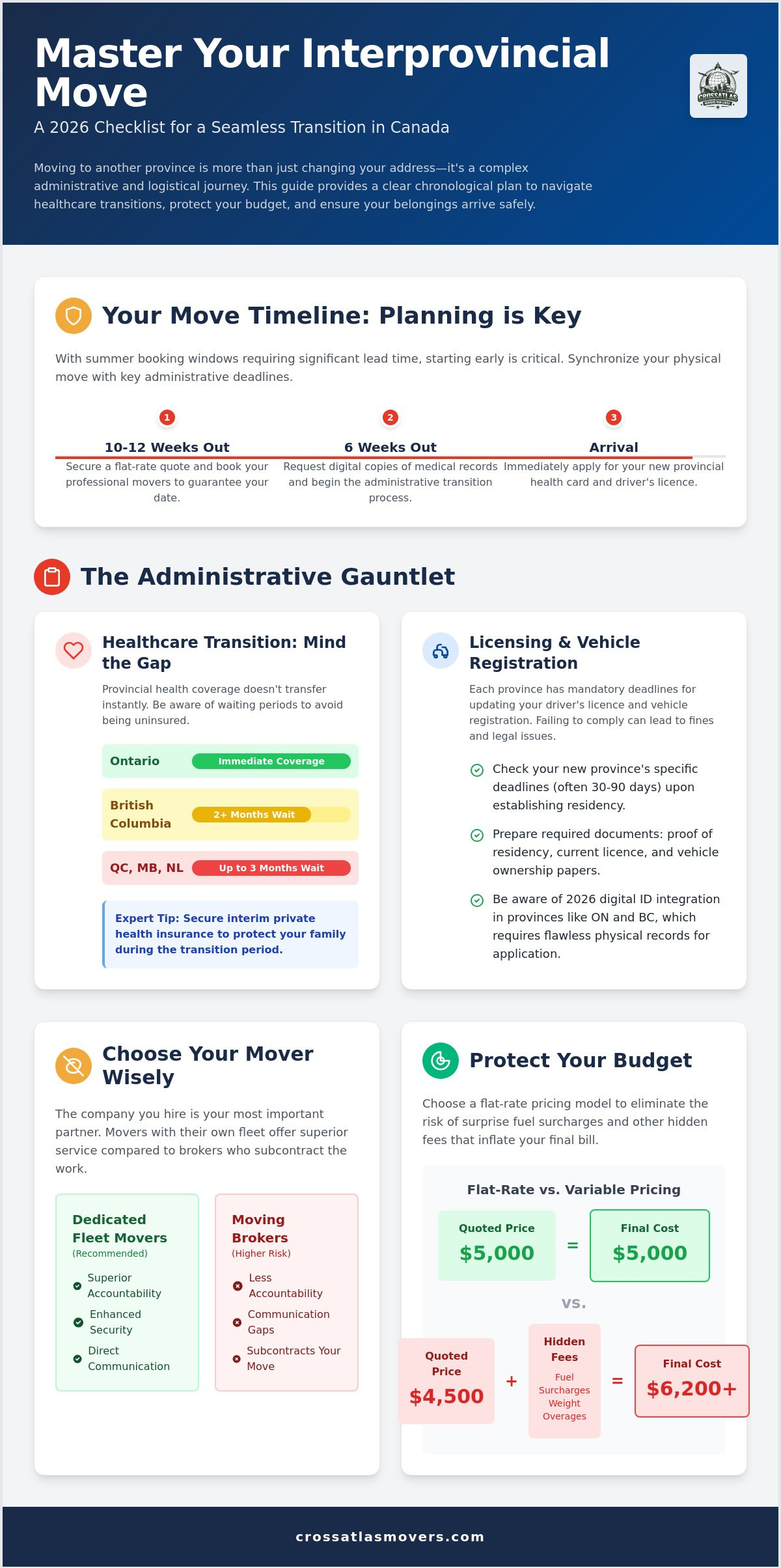
As we move through 2026, administrative transfers require more lead time than in previous years. To secure a reliable partner and a guaranteed delivery date, you should begin your planning at least 10 to 12 weeks in advance. This early start allows you to synchronize your physical move with the administrative deadlines of your new home province. Crossing provincial lines resets your residency clock, which impacts everything from your tax bracket to your child’s school enrolment. Recognizing these differences early allows you to build a checklist that prioritizes administrative deadlines alongside your physical packing schedule.
The Administrative Checklist: Healthcare, Licensing, and Identity
Administrative synchronization is the backbone of any successful relocation. While the physical transport of your goods requires careful planning, your moving to another province checklist canada must prioritize the legal and social framework of your new life. A significant shift in 2026 is the widespread adoption of digital provincial IDs. Provinces like Ontario and British Columbia are increasingly integrating digital credentials into their service models. This means you must ensure your physical records and proof of residency are impeccable before you apply for new electronic versions in your destination province.
Healthcare and Social Services Transition
The transition of your health insurance is governed by specific provincial waiting periods that remain in effect for 2026. If you are moving to British Columbia, your coverage begins after the remainder of the month of your arrival plus two full months. Conversely, Ontario has eliminated its three-month waiting period, providing immediate coverage for eligible applicants. Quebec, Manitoba, and Newfoundland still maintain a waiting period of up to three months. Because of these gaps, securing interim private health insurance is a vital step to protect your family during the transition. You should also request a digital copy of your medical records from your current physician at least six weeks before your departure to assist your new doctor in providing continuous care.
Licensing and Vehicle Registration
Newcomers must also navigate varying provincial deadlines and fee structures for driver’s licences and vehicle registrations. As of 2026, annual passenger vehicle registration fees vary significantly across the country. Quebec remains the highest at approximately $213.00, while Ontario has maintained its $0.00 renewal fee. In Saskatchewan, be prepared for the 3.75% rate increase implemented in June 2026, which raised average annual costs. Most provinces require you to exchange your licence within 30 to 90 days of arrival. Missing these deadlines can lead to insurance complications or fines, so we recommend visiting a provincial registry office within your first week of residency.
Legal and Financial Address Updates
It is essential to update your address with federal agencies, including the Canada Revenue Agency (CRA), to ensure your tax filings and benefit payments remain uninterrupted. Mail forwarding through Canada Post is a reliable safety net, with 12-month domestic services costing between $175 and $250 in 2026. This investment prevents sensitive financial documents or voter registration packages from being lost. As you manage these complex administrative tasks, partnering with professional province to province movers allows you to focus on your family’s paperwork while experts handle the logistical heavy lifting. Remember to update your banking and investment portfolios as well; your new provincial residency may change your provincial income tax brackets, which range from 14% to 33% at the federal level for 2026.
Inventory Management and Professional Packing for Long-Haul Transit
Before the first box is taped, every successful transition begins with a rigorous “purge and organize” phase. Reducing the weight and volume of your shipment is the most effective way to lower your total cost. We recommend sorting your belongings into three clear categories: keep, donate, and discard. This process ensures you aren’t paying to transport items that no longer serve a purpose in your new provincial home. As you finalize your old address, remember to arrange Canada Post Mail Forwarding to bridge the gap between your physical move and your administrative updates. Integrating these steps into your moving to another province checklist canada prevents logistical bottlenecks during the final weeks of your departure. This methodical approach to inventory management simplifies the loading process and ensures your new home remains clutter-free from day one. If you are relocating with animals, reviewing a dedicated guide on how to move with pets across Canada will help you coordinate their transport alongside your household goods without added stress.
Strategic Packing for Long-Distance Durability
Standard packing methods that work for a 10-minute drive across town will inevitably fail during a 3,000-kilometre road journey. Long-haul transit involves constant vibration, shifting loads, and significant temperature fluctuations, especially when crossing mountain passes or the Canadian Shield. We utilize heavy-duty, double-walled boxes and high-quality packing materials to provide the structural integrity required for these conditions. Fragile electronics, fine art, and sensitive musical instruments often require custom crating to survive the journey. Professional packing is not just a convenience; it’s a methodical strategy designed to act as a capable protector for your most valued possessions. Using specialized materials like acid-free paper and industrial-grade stretch wrap prevents surface damage and maintains the condition of your furniture throughout the long transit.
Inventory Tracking and Valuation Protection
Precision is paramount when documenting your household goods for an interprovincial move. Creating a digital inventory ensures that your Bill of Lading accurately reflects every item in the truck. This document serves as the legal contract between you and your mover, making its accuracy vital for insurance and accountability. You must understand the difference between basic carrier liability, which is often based on weight, and full valuation protection, which covers the actual replacement value of your goods. Utilizing a detailed 2026 relocation checklist allows you to track every box from the moment it is sealed until it is placed in your new living room. This level of organization provides the financial transparency and peace of mind necessary for a stress-free transition across Canada.
Budgeting for Your Move: Comparing Moving Models and Costs
A successful interprovincial relocation requires financial precision as much as logistical coordination. In 2026, the economic landscape for transport has shifted significantly, with diesel prices rising by 25% to 30% in the early part of the year. These fluctuations make your moving to another province checklist canada an essential tool for protecting your household budget. While a DIY truck rental might appear cost-effective at $1,000 to $2,000 for a long-distance route, this figure rarely accounts for “soft costs” like fuel, insurance, hotels, and travel meals. When you factor in the physical risk to your belongings and the time required, professional long-distance services often provide superior value and security. This is especially true if you are moving small loads across Canada, where consolidated shipping solutions can deliver significant savings over renting an entire truck for a partial shipment.
The Advantage of Flat-Rate Pricing
The moving industry typically operates on two pricing models: weight-based estimates and flat-rate quotes. Weight-based models are often unpredictable, as the final price is determined at a weigh scale after your life is already loaded onto the truck. This can lead to a “weigh-scale surprise” that forces families to pay hundreds or thousands more than they originally planned. We realize that budget certainty is vital during a high-stress life event. Choosing a transparent flat-rate moving quote eliminates this anxiety by providing a fixed price based on your inventory rather than a fluctuating scale. This model rewards your organization and ensures that you can finalize your financial planning long before the truck arrives at your new driveway.
Avoiding Hidden Costs in Interprovincial Relocation
Transparency in your moving contract is the best defense against unexpected surcharges. Many long-distance movers now add fuel surcharges of 3% to 8% to their base quotes to cover volatile energy costs. Other common hidden fees include stair fees, long-carry charges, or storage-in-transit costs if the mover cannot meet your schedule. Securing a guaranteed delivery date is a critical financial strategy; it prevents the “soft cost” bloat of extended hotel stays or temporary furniture rentals while you wait for your shipment. Furthermore, movers who utilize their own dedicated fleet of trucks provide better accountability than brokers who outsource your move to third-party carriers with varying fee structures.
To truly protect your budget, look for a partner that combines the scale of a national operation with the integrity of a family-owned business. Avoid the temptation of “too good to be true” low-ball estimates, which often signal a weight-based scam or a lack of proper valuation protection. By focusing on total transparency and fixed pricing, you ensure that your transition into a new province is defined by excitement rather than financial strain. If you are ready to secure a predictable budget for your upcoming journey, request a comprehensive flat-rate quote from our methodical team of experts today.
Executing Your Move with Professional Province-to-Province Movers
The final phase of your relocation is where logistical planning meets physical execution. Selecting the right partner from the many province to province movers Canada offers is a decision that impacts the safety of your entire household. We believe a mover should act as a capable protector of your belongings. This means they must possess more than just equipment; they must demonstrate a methodical commitment to punctuality and transparency. Before signing a contract, verify that your chosen company has a physical presence and a history of successful long-haul transits. Avoid brokers who simply sell your contract to the lowest bidder, as this often leads to a lack of accountability and fragmented communication.
The Importance of a Dedicated Fleet
Accountability is significantly higher when a company operates its own dedicated fleet of trucks. Owning the vehicles ensures that maintenance schedules are strictly followed, which reduces the risk of mechanical delays during a 2,000-kilometre journey. It also allows for a consistent chain of custody. When the same professional crew that loads your furniture in one province is responsible for unloading it in the next, the potential for damage or loss is greatly minimized. Family-owned businesses typically prioritize this level of care because their long-term reputation is built on personal integrity rather than quick profits. They treat your transition as a service to another family rather than just another shipment in a queue.
Moving Day and Beyond: Settling In
On the day of your departure, your primary focus should be a final walkthrough of your moving to another province checklist Canada. This ensures that no administrative detail or household item is left behind. We recommend keeping an essential “first-night” box with you in your personal vehicle. This box should contain basic toiletries, chargers, medications, and important documents so you don’t have to search through dozens of boxes the moment you arrive. If you are travelling with cats or dogs, planning their comfort and safety during the journey is equally important; a comprehensive resource on moving with pets across Canada can help you prepare for their specific needs on moving day and beyond. This prevents the stress of unpacking everything at once while you’re exhausted from the journey.
Once the truck reaches your new home, conduct a methodical post-move inspection before the crew departs. Verify that all items on your digital inventory are present and check for any transit-related damage. Finalizing your contract only after you are satisfied with the delivery provides a final layer of security. This structured approach to the final execution ensures that you can begin your new life in a different province with a sense of order and peace of mind. By choosing a partner that values precision and reliability, you transform a complex cross-country move into a predictable and successful transition.
Start Your Next Chapter with Confidence
Mastering a long-distance relocation requires more than just boxes; it demands a synchronization of administrative updates and logistical precision. By following a detailed moving to another province checklist canada, you ensure that your healthcare coverage, driver’s licence, and vehicle registration transition without legal or financial gaps. We realize that the security of your household goods is your top priority. Choosing a partner that utilizes a dedicated, company-owned fleet and professional packing strategies provides the durability needed for the vast Canadian landscape.
Financial transparency is the final pillar of a stress-free move. You shouldn’t have to worry about hidden fees or the uncertainty of weight-based estimates during such a significant transition. As a family-owned and operated specialist, we take pride in acting as a capable protector of your belongings. We offer guaranteed delivery dates and a flat-rate pricing model with no hidden fees guaranteed. This methodical approach allows you to focus on settling into your new community while we manage the heavy lifting. Get Your Free Flat-Rate Moving Quote Today and take the first step toward a seamless provincial transition. Your new home is waiting, and we’re ready to help you get there safely.
Frequently Asked Questions
How soon should I start my moving to another province checklist for Canada?
You should ideally begin your moving to another province checklist canada eight to twelve weeks before your scheduled departure date. This window provides the necessary time to secure a reliable mover and organize your administrative transfers without the pressure of a last-minute rush. Early planning is especially critical during the peak summer season when booking windows for major routes often fill up by April or May.
Can I keep my current health insurance when moving provinces?
No, your current provincial health insurance won’t cover you indefinitely after you relocate. Most provinces require you to apply for new coverage within three months of arrival, and waiting periods vary significantly across the country. Don’t rely solely on your old province’s coverage for specialized care; purchasing private gap insurance is a methodical way to protect your family against unexpected medical costs during the transition.
What is the average cost of province to province movers in Canada?
While the total cost depends on distance and volume, we recommend prioritizing flat-rate pricing models over weight-based estimates. Weight-based quotes are often unpredictable and can lead to unexpected surcharges at a weigh station after your goods are already loaded. It’s safer for your budget to secure a fixed price, especially since diesel prices rose by 25% to 30% in early 2026, leading to increased fuel surcharges across the industry.
How do I change my address with the CRA?
You can update your address with the Canada Revenue Agency (CRA) through their digital “My Account” portal, by telephone, or via traditional mail. It is vital to complete this task as soon as you establish residency to ensure your tax documents reach you and your provincial credits are calculated correctly. This update also ensures that federal benefit payments, such as the Canada Child Benefit, continue without interruption during your move.
What documents do I need for a long-distance interprovincial move?
You must maintain a file containing your signed Bill of Lading, a comprehensive digital inventory list, and documents proving your new provincial residency, such as a utility bill or lease. These records are essential for insurance purposes and for applying for your new driver’s licence. If you’re relocating more than 40 kilometres for a new job, keep all receipts, as many of these moving expenses remain tax-deductible under federal rules.
How long does it take for a cross-country move in Canada?
A typical interprovincial move can take anywhere from 3 to 14 days, depending on the total distance and the logistical schedule of your carrier. Transit times across the Canadian Shield or through mountain passes can vary based on seasonal weather patterns and mandatory driver rest periods. Choosing a mover that offers a guaranteed delivery date is the best way to finalize your moving to another province checklist canada with precision and avoid hotel stays.