
The border doesn’t care how many kilometres you’ve travelled; it only cares about the precision of your paperwork. Understanding how cross border moving services work is the difference between a fresh start in a new country and your life’s possessions sitting in a secondary inspection lot for weeks. It’s completely natural to feel a sense of dread when you imagine customs officers searching your boxes or unexpected fees appearing once the truck crosses the 49th parallel. You deserve to know that your belongings are handled with care and that your moving quote won’t change at the last minute.
In this article, we’ll explain the step-by-step logistics, essential customs requirements like U.S. Form 3299, and the professional secrets behind a seamless Canada-US relocation. You’ll learn how to navigate digital filing systems and why a flat-rate price is your best defence against hidden costs. We’ll begin by outlining a clear timeline of the moving process to give you the confidence you need for a smooth transition.
Key Takeaways
- Master the logistical relay of international relocation to understand exactly how cross border moving services work to protect your belongings during the transition.
- Identify the specific documentation you need, such as Form 3299, to ensure your household effects qualify for duty-free entry into the United States.
- Avoid common border delays by learning why professional packing is preferred over “Packed by Owner” boxes during mandatory customs inspections.
- Protect your moving budget by choosing flat-rate quotes and dedicated fleets over unpredictable weight-based pricing and third-party contractors.
- Prepare for the transit phase with a clear overview of what happens at the Port of Entry during primary and secondary customs inspections.
Understanding the Logistics of Cross-Border Relocation
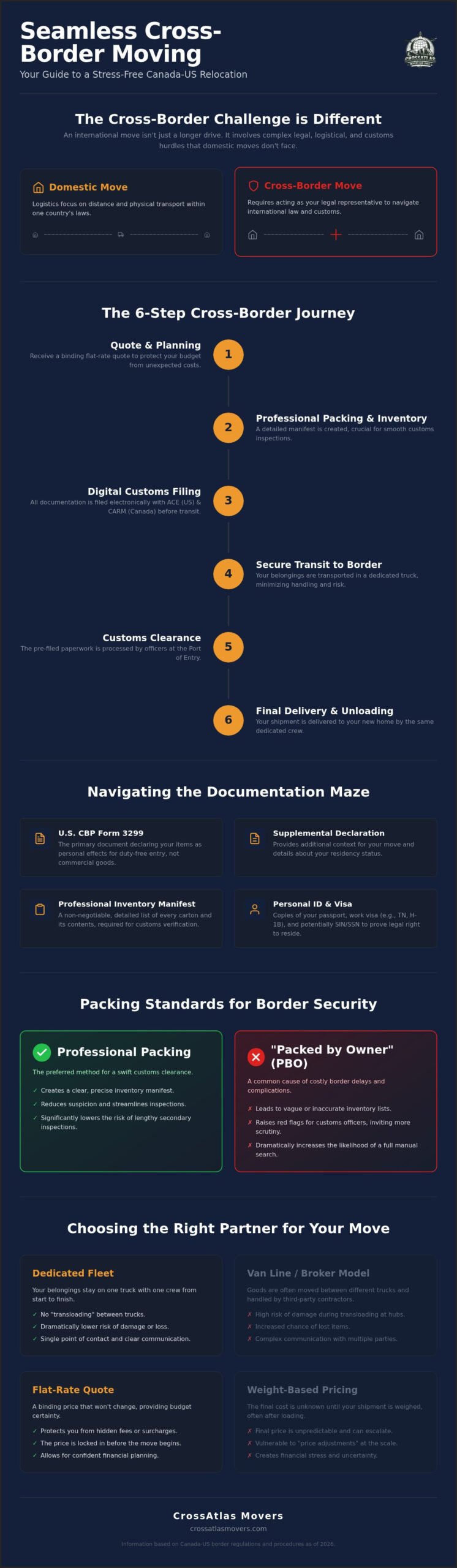
Cross-border moving is the physical transport of your household goods across the Canada-US border. It requires specialized customs clearance that domestic moves simply don’t face. While a domestic move, even across a vast distance within the country, presents its own challenges, crossing into another country introduces a complex layer of international law and administrative oversight. Understanding how cross border moving services work involves recognizing that your mover acts as your legal representative at the border. This isn’t just about driving a truck; it’s about navigating a regulated logistical relay where every box is a declared entry into a foreign country.
The logistics of personal relocation become significantly more demanding when customs agents are involved. As of 2026, the transition to fully digitized systems like the U.S. Automated Commercial Environment (ACE) and Canada’s CARM system has changed the landscape. Every inventory item must be documented with precision before the truck ever leaves your driveway. Professional carriers manage this chain of custody, ensuring that your belongings aren’t just moved, but legally admitted into a new jurisdiction without the risk of seizure or costly delays. For those considering a DIY approach, the absence of a professional customs broker often leads to shipments being turned back at the port of entry.
Why Cross-Border Moving Requires a Specialized Approach
Legal accountability is the primary hurdle in any international move. Carriers must navigate the FMCSA regulations in the U.S. while maintaining strict compliance with Canadian provincial transport laws. This dual-jurisdiction requirement extends to the equipment itself. Trucks must meet specific Department of Transportation (DOT) safety standards to operate south of the border, including specialized emissions controls and electronic logging device (ELD) mandates. Finally, timeline management is more than just calculating driving hours. A professional schedule must account for mandatory border inspections and potential secondary screenings, which can add hours or even days to the transit time if not managed by an expert.
The Advantage of a Dedicated Fleet
Using a dedicated fleet provides a level of accountability that the traditional “van line” model lacks. When you hire a specialist with their own trucks, the same dedicated crew often handles your belongings from the initial packing at your current residence to the final unloading at your new home. This eliminates the risk of “transloading,” where your life’s belongings are moved between different trailers at regional hubs. Reducing these touchpoints significantly lowers the chance of damage or loss. Additionally, it streamlines communication. You receive real-time updates from a single point of contact who knows exactly where the truck is in the customs queue, providing a calm and predictable experience during an otherwise high-stress event.
Navigating the Customs and Documentation Maze
Paperwork is the most daunting aspect of moving to the United States. It’s the primary reason why understanding how cross border moving services work is essential for a stress-free transition. In 2026, the process is almost entirely digital, with the Canada Border Services Agency (CBSA) and U.S. Customs and Border Protection (CBP) requiring pre-arrival electronic manifests. These digital handshakes ensure that your goods are expected and verified before the truck reaches the Port of Entry. Professional long distance moving services manage these filings to prevent your shipment from being flagged or delayed.
Essential Forms for a Successful Entry
The cornerstone of your move is U.S. CBP Form 3299, the “Declaration for Free Entry of Unaccompanied Articles.” This document tells the American government that your belongings are personal effects rather than commercial goods intended for resale. Along with this, you’ll likely need a Treasury Department Form 3299 Supplemental Declaration to provide additional context for your move. A professionally prepared manifest is non-negotiable; it acts as a detailed map of your shipment. It must list every carton with a clear description of its contents, ensuring that customs officers can verify the load quickly during an inspection.
The Residency Requirement
Clearing customs requires proof that you have the legal right to reside in the destination country. You’ll need to provide copies of your passport and your specific work visa, such as a TN or H-1B. For Canadians, the Social Insurance Number (SIN) and the U.S. Social Security Number (SSN) are often required for the ACE digital filing. While you don’t need to be at the border with the truck, your legal entry must precede the shipment. This activation of your residency status is what allows your household goods to clear the border as personal effects.
The Bill of Lading and the Pro-Bill serve as the official contract and tracking number for your shipment. These documents are scrutinized at the border to verify the chain of custody from your Canadian home to your American destination. In 2026, these are transmitted through the Automated Commercial Environment (ACE) to provide a transparent digital trail for customs officers. This level of digital integration means that any discrepancy between your paperwork and your physical inventory can lead to an inspection, making professional inventory management a critical component of your move.
Packing and Inventory Standards for Border Security
Customs officers prioritize security and efficiency at every port of entry. When you understand how cross border moving services work, you realize that the way your goods are packed is a direct communication to the border agent. Boxes marked “PBO” (Packed by Owner) act as an immediate red flag. Because the mover cannot personally verify the contents of a box they didn’t pack, customs officers frequently select these specific cartons for physical inspection. This can lead to delays that ripple through your entire delivery schedule. Professional packing ensures that every item is accounted for on a manifest that the carrier can stand behind with total confidence.
Professional Packing for International Transit
International transit involves crossing multiple climate zones and enduring several days of road vibration. This requires high-quality materials that won’t degrade under humidity or significant temperature shifts. Every box must follow strict labelling protocols. These labels must match the master inventory list exactly to facilitate a quick inspection. If an officer asks to see a specific carton, it should be easily accessible and clearly identified. For more specific techniques, you can explore our guide on professional packing for long-distance moves. Custom crating is also essential for fragile or high-value items, providing the structural integrity needed for a long-haul journey.
Prohibited and Restricted Items
A professional inventory is your best defence against prohibited item delays. Understanding how cross border moving services work means knowing that compliance starts at the packing stage. Certain everyday goods are strictly forbidden or heavily regulated by customs. A methodical expert identifies these items during the initial survey, preventing them from reaching the truck and ensuring your shipment remains compliant with international law.
- Food and Plants: Even sealed dry goods or common houseplants can trigger agricultural holds and lengthy inspections.
- Hazardous Materials: Items like propane tanks, aerosol cans, and certain cleaning fluids are prohibited for safety reasons during transit.
- Alcohol and Tobacco: These items are subject to strict limits and high duties; they usually require separate declarations and can be costly to move.
- Firearms and Ammunition: Transporting weapons across the border involves complex legal requirements and often necessitates specialized transport arrangements.
By removing these items from your shipment early, you eliminate the risk of a simple mistake halting your entire household move at the border. This proactive approach is a hallmark of a seasoned professional who values your time and the security of your belongings.
The Transit Phase: What Happens at the Border?
When the moving truck arrives at the Port of Entry, it enters a high-stakes environment where precision is the only currency. The driver presents the digital manifest and physical paperwork to the Customs and Border Protection (CBP) officer. This is a critical moment in how cross border moving services work; the driver isn’t just a transporter but your legal agent. They answer technical questions about the shipment, clarify inventory details, and ensure the officer has everything needed for a swift clearance. A seasoned driver knows exactly how to navigate these interactions to keep your belongings moving toward their destination.
The Inspection Process
The process typically begins with a primary inspection. This is a document verification phase that often takes less than ten minutes if the paperwork is perfect. However, if any discrepancy appears, the shipment is moved to a secondary inspection. This involves a more thorough visual check where officers may open the trailer or use specialized X-ray technology to verify the load. Having a master inventory list is vital here. It allows the driver to help officers locate specific boxes quickly, preventing the need for a full offload of your possessions. Professional international relocation experts prioritize this organization to minimize the risk of invasive searches.
Timeline and Potential Delays
In 2026, wait times at major crossing points like Windsor-Detroit or the Peace Arch fluctuate based on digital filing volume and officer availability. Most professional carriers account for these mandatory stops when providing guaranteed delivery dates. If a shipment cannot be cleared immediately due to missing information, it may be moved “in bond” to a customs warehouse near your destination. This allows the truck to keep moving while the paperwork is finalized, though it can result in additional handling and storage fees. To stay ahead of these logistics, it’s wise to review a cross country moving checklist well before your departure date.
A seamless border crossing relies on the steady, methodical expertise of a carrier that owns its fleet. When the same company handles the packing, the transport, and the customs interface, the risk of miscommunication at the border vanishes. This level of personal accountability ensures that your transition is handled with the care it deserves. If you are preparing for a relocation, you can secure a flat-rate quote from our cross-border moving services to ensure your budget remains as predictable as your timeline.
Choosing the Right Partner for Your Canada-US Move
Selecting a moving company for an international relocation is a decision that impacts your peace of mind as much as your budget. While many companies offer long-distance transport, the true test of a provider is their ability to manage the intersection of logistics and international law. Understanding how cross border moving services work at an operational level helps you identify which partners possess the “capable protector” persona required for such a high-stress event. You need a partner who takes personal accountability for every box, ensuring that your transition into a new country is steady, predictable, and secure.
Before signing a contract, verify that the carrier holds all necessary credentials for international operation. This includes a valid U.S. Department of Transportation (DOT) number and adequate insurance coverage that remains in effect across the border. Truly professional how cross border moving services work by maintaining high standards for their equipment and staff; they don’t outsource the most critical parts of your journey to third-party contractors. This level of integrity is what separates a methodical expert from a simple transport broker.
The Benefits of Flat-Rate Pricing
Budgeting for a move to the United States shouldn’t involve guesswork or “border surprises.” Traditional weight-based pricing is often unpredictable; you don’t truly know the final cost until the truck hits a certified scale, which can lead to stressful adjustments at the last minute. Flat-rate pricing eliminates this anxiety by providing a fixed quote based on a detailed inventory. This comprehensive price should include customs coordination, professional labour, and transit fees. For a deeper look at financial planning for your relocation, you can review our guide on how to move from Canada to USA to ensure you’re prepared for every expense.
The Family-Owned Difference
The “own fleet” advantage is a critical factor in maintaining a secure chain of custody. When a family-owned company operates its own trucks, there is a direct line of accountability from the owner to the driver. You avoid the “van line” maze of call centres and regional agents who may not have eyes on your shipment. This direct communication ensures that your guaranteed delivery date is a firm promise rather than a vague estimate. Reliability is built on this old-school work ethic; it’s the pride of ownership that ensures your belongings are treated with the same respect as if they were the mover’s own. Choosing a partner who values transparency and punctuality will lower your heart rate and provide the foundation of trust necessary for a successful move.
Secure Your Seamless Canada-US Transition
The border doesn’t have to be a barrier to your new beginning. Moving to a new country is a significant life event that shouldn’t be overshadowed by logistical anxiety or confusing regulations. We’ve explored how meticulous documentation, professional packing, and a dedicated fleet create a predictable path for your household goods. Understanding how cross border moving services work ensures you remain in control of your timeline and your budget from the moment the truck is loaded until it reaches your new driveway.
CrossAtlas Movers brings a family-owned commitment to every relocation, providing personal accountability that large van lines often lack. Because we own and operate our own fleet, we offer guaranteed delivery dates and a flat-rate price that won’t change at the border. You deserve a partner who acts as a capable protector for your possessions while navigating the complexities of customs on your behalf. Request your flat-rate cross-border moving quote from CrossAtlas Movers today to eliminate hidden fees and weight-based surprises. Your new chapter is waiting; let’s ensure you arrive with total peace of mind.
Frequently Asked Questions
Do I need to be present at the border when the moving truck crosses?
You don’t need to be physically at the Port of Entry with the truck, but you must have already crossed and activated your status. The driver acts as your agent at the border. Understanding how cross border moving services work means knowing that customs officers verify your legal entry through digital records before releasing the shipment. If you haven’t entered the country yet, your goods cannot clear customs as personal effects.
What is US Customs Form 3299 and why is it required for my move?
Form 3299 is the “Declaration for Free Entry of Unaccompanied Articles” required by U.S. Customs and Border Protection. It informs the government that your belongings are used personal items rather than commercial goods. This form is essential for duty-free entry. Without it, your movers cannot legally cross the border with your possessions. It must be accompanied by a detailed inventory list and proof of your residency status.
Can I pack my own boxes for a cross-border move to save money?
While you can pack your own boxes, it often leads to delays. Customs officers frequently flag “Packed by Owner” (PBO) cartons for physical inspection because the mover cannot verify the contents. This can result in your belongings being unpacked and searched at the border. Professional packing ensures every box is accounted for on a manifest that officers trust, which streamlines the clearance process and protects your items.
How much does a professional cross-border moving service typically cost?
The cost varies significantly based on the volume of your goods and the total distance between your Canadian and American homes. To avoid the uncertainty of weight-based pricing, many families prefer a flat-rate quote. This approach provides a fixed price that covers all transit and customs coordination. It protects you from unexpected fees if the truck is weighed differently at the border or if there are minor inspection delays.
Can I move my car along with my household goods across the border?
You can move your vehicle, but it requires specialized documentation separate from your household goods. You’ll need to provide the title, a letter of compliance from the manufacturer, and completed DOT and EPA forms. Some carriers can transport your car on the same truck, while others use a separate car carrier. It’s important to declare the vehicle well in advance to ensure all compliance checks are met before transit.
What happens if US or Canadian Customs decides to inspect my entire shipment?
If an officer orders a secondary inspection, the truck is moved to a secure lot for a physical search. This can range from a quick spot check to a full offload of every box. While these inspections are random, having a professionally prepared master inventory helps officers locate items quickly. This minimizes the time the truck spends at the port and helps keep your delivery on schedule without additional handling risks.
Are there items that cross-border movers are not allowed to transport?
Movers are prohibited from carrying hazardous materials like propane tanks, aerosol cans, and flammable liquids. Most carriers also refuse perishable food and live plants because they trigger strict agricultural inspections. Understanding how cross border moving services work involves identifying these restricted items early. Removing them from your shipment prevents the entire truck from being held at the border for a single non-compliant item that could have been left behind.
How long does it usually take for a moving truck to clear customs?
Most trucks clear primary customs in under thirty minutes if all digital filings are completed correctly. However, if the shipment is selected for a secondary inspection, the process can take several hours or even a full day. Major border crossings in 2026 use digitized systems to speed up these checks. A professional carrier accounts for these mandatory stops when providing your final delivery timeline to ensure your expectations remain realistic.