

What if the most expensive part of your international move isn’t the shipping rate itself, but the time your belongings spend sitting in a warehouse or stuck in a port? It’s natural to feel anxious about the safety of your fragile items or the potential for hidden customs fees when you’re moving your life across the globe. You want a transition that’s smooth and predictable, yet the math behind air vs sea freight for international moves can feel intentionally confusing. We understand that you’re looking for more than just a transport method; you’re looking for a strategy that protects your budget and your peace of mind.
This article provides the definitive framework you need to choose the right shipping method for your specific inventory in 2026. You’ll learn exactly how airlines and shipping lines calculate costs differently, allowing you to save money without leaving essential items behind. We’ll explore transit times, security protocols, and the logistical benefits of custom crating so you can move forward with total confidence. From understanding the 200kg break-even point to navigating modern customs documentation, we’ve organized everything you need to manage your relocation like a seasoned professional.
Key Takeaways
- Learn when the superior speed and reduced handling of air freight justify the investment for your most valuable or time-sensitive belongings.
- Discover how to maximize your budget on large-scale household relocations by leveraging the cost-efficiency of sea freight for furniture and vehicles.
- Master the definitive framework for evaluating air vs sea freight for international moves by calculating the critical balance between total volume and actual weight.
- Understand how professional packing and custom crating eliminate the risk of damage while ensuring your shipment meets strict 2026 international standards.
- Identify strategies to secure flat-rate pricing and navigate complex customs regulations to prevent unexpected fees or delays at your destination.
Navigating the Choice Between Air and Sea Freight for International Relocations
Moving your household across an ocean is a monumental task that requires precision and foresight. At its core, the debate over air vs sea freight for international moves centres on how your life’s possessions will traverse the globe. Air freight involves securing space on dedicated cargo planes or within the belly-hold of commercial passenger aircraft; it’s the premium choice for speed. In contrast, sea freight relies on massive ocean liners carrying standardized steel containers. Because shipping costs often represent the largest single expense in a relocation, this decision is the most critical variable in your moving budget.
A professional international moving company acts as your logistical architect during this process. They don’t just move boxes; they analyze your inventory to determine which mode of international freight transport aligns with your specific goals. In 2026, the logistics industry has shifted toward highly integrated solutions where the lines between air and sea are often blurred by multimodal strategies designed to maximize efficiency and maintain a steady flow of goods despite global port fluctuations.
Understanding the Core Logistics
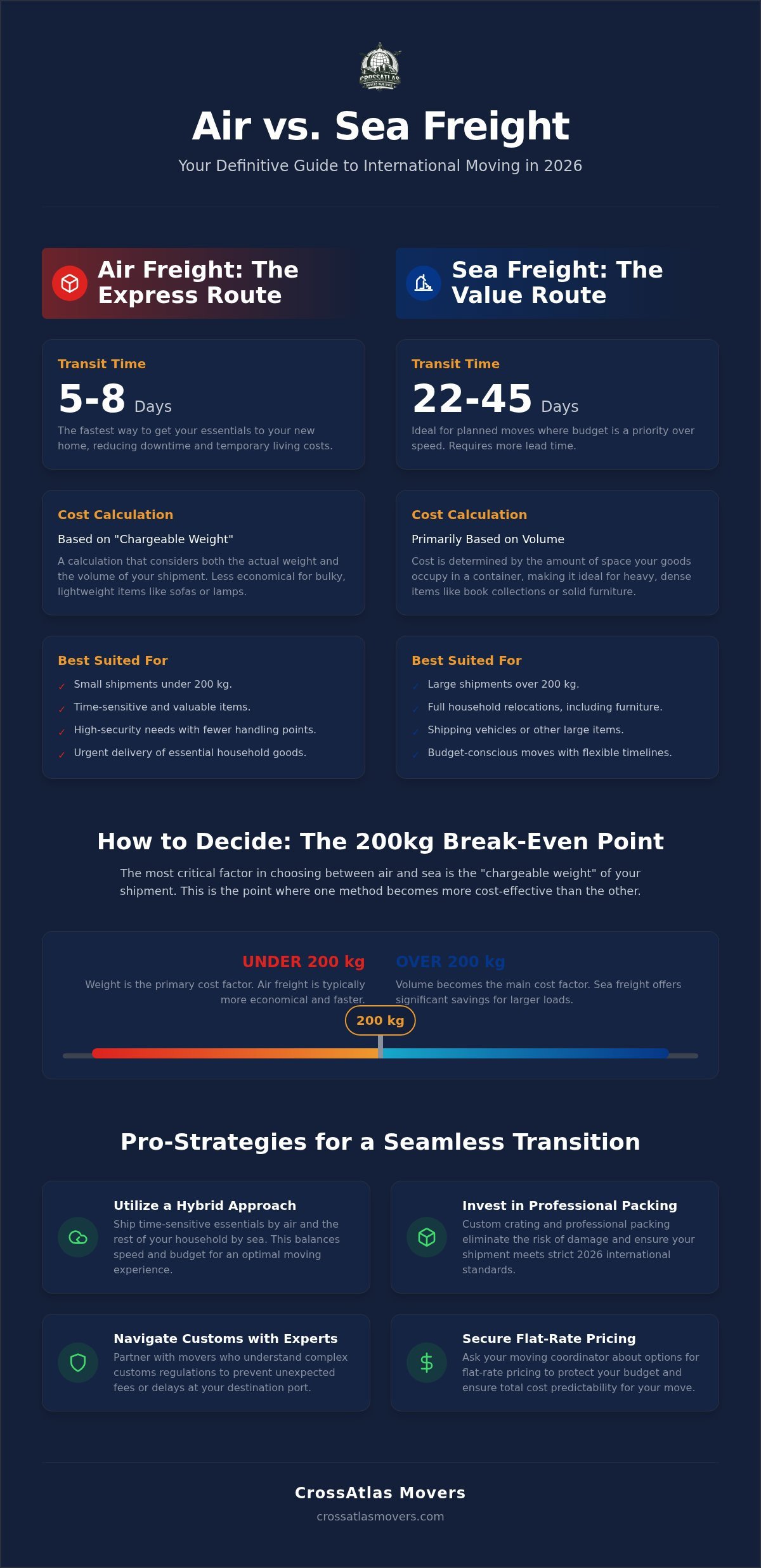
The journey of your goods depends on the physical constraints of the vessel. Air freight is restricted by the dimensions of aircraft doors and the total weight capacity of the fuselage. Sea freight offers more physical freedom, allowing your possessions to travel in 20-foot or 40-foot containers from your current doorstep to a global port. A vital distinction lies in “chargeable weight.” Airlines prioritize volume, often charging more for lightweight but bulky items like a large designer sofa. Shipping lines focus primarily on the volume of space your goods occupy within a container, making it a more forgiving method for heavy, dense items like extensive book collections or solid wood furniture.
Assessing Your Moving Timeline and Budget
Choosing between these methods requires a clear look at your calendar and your bank account. The standard rule of thumb remains consistent: air freight is for those who need their items in days, while sea freight is for those who can wait weeks to save money. During your initial survey, your moving coordinator will help you identify if your move is volume-heavy or weight-heavy. You should ask specific questions during this survey to ensure you realize the full scope of your options:
- How will current 2026 port congestion levels affect my sea freight arrival?
- Is my inventory better suited for a Full Container Load (FCL) or a Less than Container Load (LCL)?
- Can we utilize a hybrid approach to get essentials delivered by air while the rest follows by sea?
By addressing these factors early, you ensure your transition is both cost-effective and perfectly timed. This methodical approach removes the guesswork and builds a foundation of trust for the journey ahead.
When to Prioritize Air Freight: Speed, Safety, and Small Shipments
Air freight is often viewed as a luxury, but it is actually a precision tool for specific relocation needs. When comparing air vs sea freight for international moves, the most immediate benefit is the drastic reduction in transit time. While a sea container might spend 22 to 45 days traversing the ocean, air cargo typically reaches its destination in five to eight days. This speed isn’t just about convenience. It is about security. Every day your belongings are in transit is a day they are subject to environmental factors and external handling. Air shipments involve significantly fewer touchpoints, which reduces the mathematical probability of damage to your most fragile possessions.
There’s also a ‘cost of convenience’ that often pays for itself. If you ship your essentials by air, you can move into your new home almost immediately. This allows you to avoid weeks of expensive hotel stays or furnished short-term rentals while waiting for a ship to dock. In many cases, the premium paid for air freight is less than the cost of a month’s stay in a major international city centre. To see how these costs balance out for your specific destination, you might consult a detailed air and sea freight comparison to weigh the environmental and financial impacts of your choice.
The Mechanics of Air Cargo Weight and Volume
Airlines use a specific calculation called Dimensional (DIM) weight to determine pricing. They realize that a box of pillows takes up as much space as a box of heavy tools, even if it weighs much less. The formula multiplies length, width, and height, then divides by a set factor to find the ‘chargeable weight.’ In 2026, fuel surcharges have become a standard part of these quotes, making it essential to pack with precision. Dense items like large book collections or home gym equipment are better suited for sea freight to avoid these steep volumetric costs.
Ideal Scenarios for Air Freight Shipments
Certain situations make air cargo the only logical choice for your goods. If you’re moving a ‘starter’ apartment or just a single room, the total volume might not justify the port fees associated with a sea container. We often recommend ‘survival shipments’ for larger moves. These small air consignments include professional laptops, seasonal clothing, and basic kitchenware, allowing you to function while your main furniture travels by sea. Additionally, high-value items benefit from the pressurized, climate-controlled environment of an aircraft cargo hold. If you’re unsure which items belong in which shipment, our team can help you plan a custom crating strategy to protect your most sensitive electronics during the journey.
Sea Freight Strategy: Maximizing Value for Large Household Moves
Sea freight remains the most practical choice for established families moving an entire household across the globe. If you’re relocating a three-bedroom home, including a vehicle or heavy heirloom furniture, the cost-efficiency of a shipping container is unmatched. Research shows that air freight is generally four to eight times more expensive than sea freight per kilogram. This makes ocean transport the primary vehicle for maintaining a realistic budget during a major life transition. Beyond the financial savings, sea freight is the responsible choice for the environmentally conscious expatriate. It produces approximately 10 to 40 grams of CO2 per tonne/kilometre, a stark contrast to the 500 grams produced by air transport.
Adopting a sea freight strategy requires a shift in mindset regarding timing. We call this the “Slow Move” reality. In 2026, global logistics are influenced by geopolitical shifts that can add 10 to 14 days to standard routes. While the transit itself might take 22 to 45 days, we recommend planning for a 60-day window from doorstep to doorstep. This buffer ensures you aren’t caught off guard by seasonal spikes or port congestion, allowing you to organize your arrival with a steady, calm approach.
FCL vs LCL: Choosing Your Container Method
Your inventory volume dictates whether you utilize a Full Container Load (FCL) or a Less than Container Load (LCL). If you have enough possessions to fill a 20-foot or 40-foot unit, FCL is the superior choice. You realize the benefit of an exclusive space, which means your goods aren’t handled alongside other shipments. For smaller moves, LCL allows you to share container space and costs with other families. This process, often called groupage, is highly cost-effective but can result in less predictable delivery dates as the container must be fully consolidated before it departs the port.
Managing Long Transit Times and Port Logistics
The journey through major maritime hubs involves complex coordination that extends beyond the ship’s arrival. You must account for Terminal Handling Charges (THC) and various port fees that aren’t always visible in a basic quote. These “hidden” costs can impact your final budget if not managed by an expert. Additionally, understanding the nuances of international shipping by air vs sea freight is essential when selecting insurance. Sea shipments require specific coverage for maritime risks, including moisture protection and the physical shifting of goods during long voyages. Our methodical approach to custom crating ensures your items are secured for the duration of their time at sea, providing a foundation of safety that lasts the entire journey.
How to Decide: A Step-by-Step Framework for Shipping Your Belongings
Choosing between air vs sea freight for international moves doesn’t have to be a guessing game. By following a methodical framework, you can remove the emotional weight of the decision and focus on the logistical reality of your inventory. This structured approach ensures that you prioritize the items that truly matter while maintaining control over your relocation budget.
- Conduct a rigorous inventory audit: Separate your possessions into essentials and non-essentials. This is the time to be decisive.
- Calculate total cubic volume vs total weight: Determine if your shipment is bulky or heavy. Airlines and shipping lines view these metrics differently, which directly impacts your bill.
- Compare shipping costs against replacement costs: Evaluate whether paying for air freight on a specific item is more expensive than purchasing a new version at your destination. Shipping a heavy, used sofa to London might cost more than buying a new one locally.
- Evaluate your Arrival Buffer: Be honest about how long you can comfortably live without your main furniture. Refer back to the 30 to 60 day sea freight window to set realistic expectations.
- Request a detailed quote: Partner with a professional overseas moving company to finalize the math and confirm 2026 port schedules.
Inventory Auditing and Volume Calculation
The “Sell, Donate, or Ship” rule is the gold standard for international relocations. Every cubic foot you eliminate from your sea container or kilogram you remove from your air pallet directly lowers your final invoice. Use a volume calculator to estimate your container space, but remember that certain items are restricted. For instance, lithium batteries often face strict regulations in air cargo, while aerosols and flammable liquids are generally prohibited in sea containers. Identifying these non-shippable items early prevents delays at the port or airport.
The Hybrid Shipping Model: Best of Both Worlds
Many successful relocations utilize a hybrid strategy to balance speed and cost. This typically involves shipping 10% of your most critical items by air and the remaining 90% by sea. Your “Air Essentials” pallet should include professional tools, seasonal clothing, and high-priority kitchenware for immediate comfort. By coordinating two separate delivery dates, you realize a seamless transition into your new home without the stress of waiting months for a single fork. To start building your custom shipping plan, Request a personalized shipping quote today from our expert team.
Partnering with an International Moving Company for a Seamless Transition
Expert coordination is the final piece of the puzzle. While the technical debate over air vs sea freight for international moves provides a logical framework, the actual execution requires a partner who understands the shifting regulatory environment of 2026. CrossAtlas Movers manages the complex interface between land transport, air hubs, and sea ports with a focus on precision and personal accountability. We realize that the technical choice between transport modes is only half the battle. The other half is the trust you place in the people handling your life’s work. Our family-owned structure ensures a level of dedication that larger corporations often struggle to match.
Transparency is the cornerstone of our service. We prioritize flat-rate pricing to ensure you avoid the “bill shock” that can occur at destination ports due to unexpected terminal fees or handling charges. By managing the logistics from our North Vancouver centre to your new doorstep, we remove the burden of coordination from your shoulders. This methodical approach allows you to focus on your family’s transition while we oversee the movement of your goods across borders and oceans.
Professional Packing and Custom Crating for Global Transit
Packing for different transport modes requires distinct technical skills. When shipping by sea, moisture is the primary enemy. We utilize specialized desiccants and multi-layered, moisture-resistant wrapping to protect your furniture from the humid salt air of a long voyage. For air freight, the strategy shifts toward weight-efficient materials and high-precision custom crating to protect fragile electronics without adding unnecessary bulk. Most insurance providers realize that professional packing services are a prerequisite for full-value coverage. Our team ensures that every item, whether it’s a heavy oak table or a delicate laptop, is secured using the specific materials required for its journey.
Navigating Customs Documentation and Global Logistics
The documentation protocols for air and sea shipments involve different legal requirements. Sea freight relies on the Bill of Lading, while air transport utilizes the Air Waybill. Managing these documents alongside duties, taxes, and “Goods to Follow” declarations is a significant hurdle in 2026. A dedicated moving coordinator simplifies this process by preparing your customs dossier well in advance of your departure date. We handle the communication with global customs agents to ensure your clearance is as swift as possible. This proactive management prevents costly delays and ensures that your belongings are ready for delivery the moment they arrive at the port or airport.
Securing Your Global Transition with Confidence
Deciding between air vs sea freight for international moves is a foundational step in your relocation journey. You now realize that while air freight offers unmatched speed and safety for essentials, sea freight provides the volume capacity needed for a full home move. By utilizing a strategic hybrid model and prioritizing professional packing, you can protect your budget without sacrificing the security of your most fragile items. This methodical approach ensures that your belongings arrive exactly when you need them, allowing you to settle into your new life with ease.
As a family-owned business, CrossAtlas Movers takes personal accountability for every shipment we manage. We provide guaranteed delivery dates and a transparent flat-rate structure with no hidden fees. From custom crating to expert customs coordination, we handle the technical complexities so you can focus on your family’s transition. Get a Free, No-Obligation International Moving Quote from CrossAtlas Movers Today and take the first step toward a seamless international relocation. Your new life abroad is waiting, and we are here to ensure you arrive with total peace of mind.
Frequently Asked Questions
Which is cheaper for moving overseas: air or sea freight?
Sea freight is the more economical option for shipments exceeding 200kg. Industry standards indicate that air transport is four to eight times more expensive per kilogram. When evaluating air vs sea freight for international moves, you must weigh the shipping rate against potential hotel costs. For a full-home move, the savings offered by an ocean container far outweigh the extra transit time.
How long does sea freight take for an international move from Canada?
Expect sea freight to take between 30 and 60 days for a door-to-door move from Canada to most global destinations. While the time on the water for routes to Europe or Asia is often 22 to 45 days, you must account for customs clearance and land transport. In 2026, geopolitical factors and port congestion can add up to 14 days to these standard estimates.
Can I ship my car by air freight?
You can ship a vehicle by air, but it’s rarely practical for residential moves due to the extreme cost. Most families choose to ship vehicles in a sea container, either as a Full Container Load (FCL) or via a specialized vehicle carrier. Air transport is typically reserved for high-value collector cars or urgent corporate relocations where the budget allows for premium speed and security.
What is the hybrid shipping method for international moves?
The hybrid method involves splitting your inventory into two separate shipments to balance cost and convenience. You send a small “survival shipment” of essentials like laptops and clothing by air to arrive within a week. The bulk of your furniture and household goods follows by sea, arriving several weeks later. This strategy allows you to settle into your new home immediately without the high cost of shipping everything by air.
Are there items that cannot be shipped by air but can go by sea?
Certain items are prohibited in air cargo because of cabin pressure and safety protocols. This includes lithium batteries, aerosols, and many flammable liquids found in household cleaning kits. While sea freight also has restrictions, it often permits a wider range of items if they’re correctly documented and crated. We help you identify these restricted goods during the survey to prevent delays during your air vs sea freight for international moves coordination.
How is the cost of an international move calculated?
International moving costs are calculated based on either the total volume or the total weight of your goods. Air freight uses a “chargeable weight” formula that considers the dimensions of your boxes, while sea freight is primarily priced by the volume of space you occupy in a container. Additional factors include professional packing, custom crating, and destination port fees, which is why we provide flat-rate pricing to avoid unexpected expenses.
Do I need different insurance for air vs sea freight?
Insurance requirements vary between transport modes to address specific risks. Sea freight insurance focuses on maritime risks like moisture damage and the physical shifting of containers during long voyages. Air freight insurance typically covers shorter transit periods but must account for the high value of items often sent by plane. We recommend professional packing to ensure your insurance remains valid regardless of the shipping method you choose.
How far in advance should I book an international moving company?
You should book your international moving company at least 12 to 16 weeks before your desired departure date. This lead time is essential for securing container space and coordinating the complex logistics of 2026 global shipping schedules. Booking early allows our team to conduct a thorough inventory audit and prepare the necessary customs documentation, ensuring a calm and organized transition for your family.