
Did you know that as of July 2026, the European Union has removed the €150 customs duty exemption for low-value imports? This is just one of many shifting regulations that can make a global relocation feel like an impossible puzzle. It’s understandable if you’re feeling anxious about complex customs documentation or the safety of your items during a long sea voyage. Choosing the right international moving company is about more than just finding a transport service; it’s about finding a methodical partner who can protect your interests and your belongings.
We agree that transparency and accountability are the foundations of a successful move. You deserve to know exactly what you’re paying for and to feel certain that your items are packed to rigorous international standards. This guide will help you understand the moving process from start to finish. We’ll examine the differences between air and sea freight options, show you how to secure a fixed-rate quote that eliminates hidden surprises, and provide a checklist for vetting potential movers. You’ll gain the clarity needed to organize your relocation with total peace of mind.
Key Takeaways
- Understand why a specialized international moving company is essential for navigating complex logistics that go far beyond the scope of a standard local mover.
- Compare the logistical advantages of Full Container Load (FCL) versus Less than Container Load (LCL) to find the most cost-effective shipping method for your household goods.
- Discover how to verify a mover’s credentials and why choosing an asset-based company with its own fleet ensures greater personal accountability and security.
- Learn to prepare critical customs documentation, such as the Valued Inventory, to navigate new 2026 border regulations without unnecessary stress or delays.
- Realize the importance of a flat-rate pricing model as a tool to protect your relocation budget from the unpredictable fees often hidden in international quotes.
What Is an International Moving Company and Why Do You Need One?
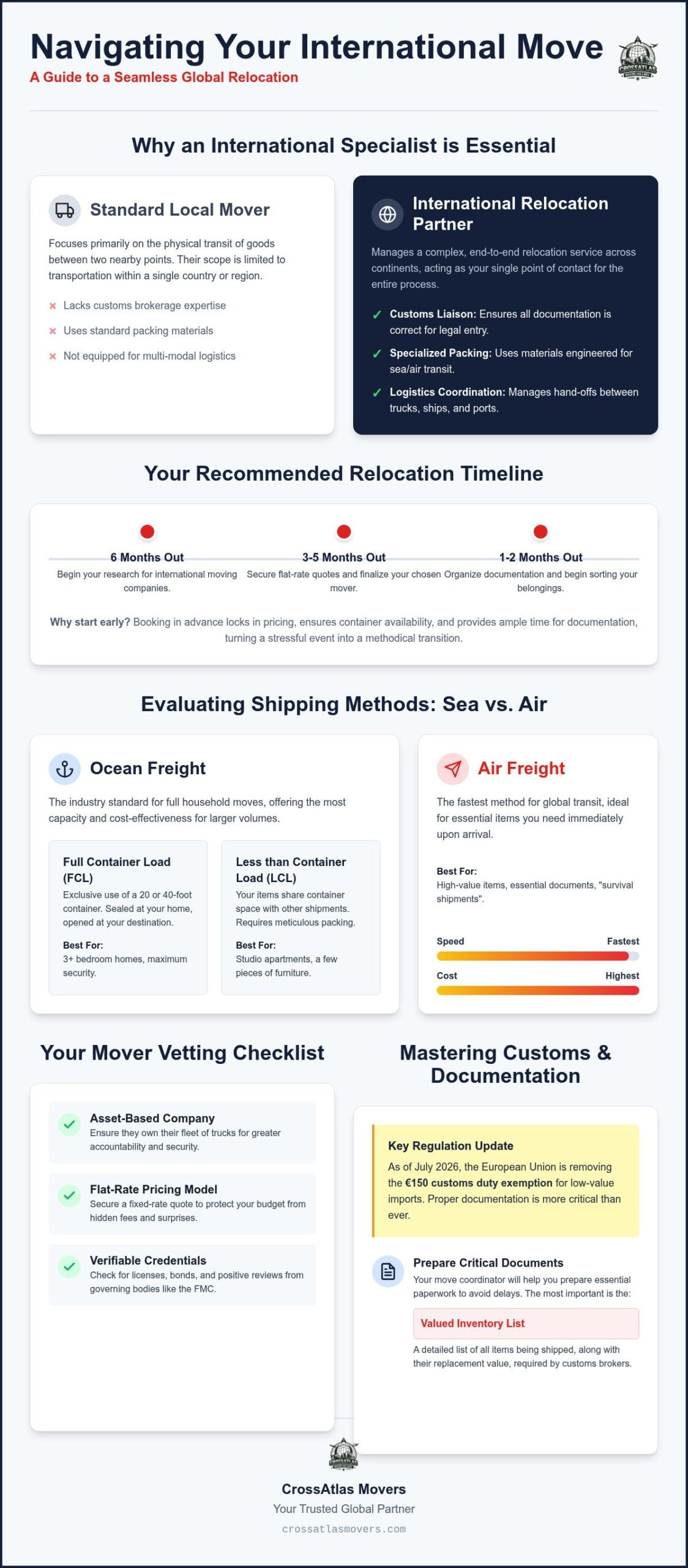
An international moving company acts as the essential architect for your global transition. While a local mover focuses on the physical transit of goods between two nearby points, an international specialist manages a sophisticated relocation service that bridges continents. They don’t just move boxes; they coordinate an intricate web of land, sea, and air logistics. This process requires a deep understanding of maritime law, international freight standards, and the specific customs requirements of your destination country.
Attempting to manage a global relocation on your own is virtually impossible. You cannot simply rent a container and place it on a cargo ship. Maritime regulations require that shipments are managed by licensed entities who can provide the necessary bonds and security clearances. An international relocation specialist serves as your move coordinator, acting as the single point of contact who synchronizes every phase of the journey. They oversee the hand-off from the packing crew to the port authorities, ensuring that your belongings never sit idle or unprotected.
The Core Responsibilities of a Global Relocation Partner
A professional partner takes ownership of your move from the moment they enter your home. Their responsibilities include:
- Specialized Packing: Using materials specifically engineered for long-term sea or air transit to prevent damage from moisture or shifting.
- Logistics Coordination: Managing the multi-modal hand-offs between trucks, ships, and delivery teams in a foreign jurisdiction.
- Customs Liaison: Working directly with customs brokers to ensure your inventory is declared correctly and meets all legal entry requirements.
When to Start Your Search for an International Mover
We suggest you begin your search for an international moving company three to six months before your departure. This lead time is necessary because global shipping cycles are often influenced by seasonal demand and container availability. Starting early allows you to organize your documentation without the pressure of a looming deadline. It also gives you the best opportunity to secure a flat-rate quote. When you book well in advance, you can lock in pricing that helps you budget effectively for the other expenses associated with your international move. Early planning turns a high-stress event into a methodical, predictable transition.
Evaluating International Shipping Methods: Air vs. Sea Freight
Deciding how your belongings will cross the ocean is a pivotal step in your relocation plan. Your choice depends entirely on your timeline, your budget, and the total volume of your shipment. A reputable international moving company will help you weigh these factors to ensure your goods arrive safely and economically. Before you commit to a specific method, we recommend reviewing the Federal Maritime Commission international moving checklist to ensure you have considered all regulatory requirements.
Ocean Freight: Full Container Load (FCL) vs. Less than Container Load (LCL)
Sea freight is the standard for full household moves, offering the most capacity for larger volume shipments. If you are relocating a three-bedroom home, a Full Container Load (FCL) is often the most efficient choice. With FCL, you have exclusive use of a 20-foot or 40-foot steel container. This provides a high level of security since the container is sealed at your residence and remains closed until it reaches its final destination.
For smaller shipments, such as a studio apartment or a few select pieces of furniture, Less than Container Load (LCL) is a practical alternative. In this scenario, your items share container space with other shipments. While this is more cost-effective for low-volume moves, it requires meticulous packing to ensure your items remain protected during the consolidation process. Our team specializes in professional packing to ensure every item in a shared container is secured to international standards.
Air Freight: The Rapid Alternative for Essential Goods
Air freight is the fastest way to move your belongings across the globe, but it comes with a higher price tag. This method is typically reserved for high-value items, essential documents, or the survival shipment you need immediately upon arrival. Unlike sea freight, which is priced by volume, air transport uses a “chargeable weight” model. This calculation considers both the actual weight and the dimensions of the shipment to determine the final cost.
Choosing between these modes requires a clear understanding of your priorities. If speed is your primary concern, air is the clear winner. If you want to maximize your budget for a large-scale move, sea freight is the logical path. For a comprehensive breakdown of how airlines and shipping lines calculate costs differently in 2026, our guide on air vs sea freight for international moves provides the definitive framework you need to protect your budget and choose the right strategy for your specific inventory. You can also find more detailed comparisons in our guide on International Shipping by Air vs Sea Freight: Which Is Right for You? to help you realize the best strategy for your specific needs.
How to Choose the Right International Moving Company
Selecting a partner for your global relocation requires a shift in perspective. You aren’t just hiring a crew to load a truck; you are appointing a steward for your lifetime of possessions. The most critical distinction to understand is the difference between a broker and an asset-based company. A broker acts as a middleman, selling your contract to the lowest bidder. In contrast, an asset-based international moving company owns its fleet and employs its own staff. This ownership creates a direct line of accountability. When the same company manages the land-based leg of your journey in their own trucks, the risk of miscommunication or mishandling drops significantly.
Before signing any agreement, verify that the mover holds recognized industry credentials. Look for membership in the International Association of Movers (IAM) or FIDI. These organizations require members to adhere to strict financial and operational standards. Additionally, a reliable mover will always insist on an in-home or detailed virtual survey before providing a quote. Any company that offers a firm price over the phone without seeing the volume and nature of your goods is a major red flag. You should also be wary of suspiciously low estimates or companies that lack a verifiable physical office address; these are often signs of “rogue” movers who may hold your goods hostage for additional fees at the destination port.
The Advantage of Flat-Rate International Quotes
In the world of global logistics, the word “estimate” is often a precursor to hidden fees. Port charges, terminal handling fees, and fuel surcharges can fluctuate wildly during the weeks your goods are at sea. We believe the only way to provide true peace of mind is through a flat-rate pricing model. A fixed-rate contract protects you from these external market shifts, ensuring that the price you budget for in Canada remains the price you pay at your destination. It eliminates the stress of “unforeseen” costs, allowing you to focus on settling into your new home rather than auditing a complex invoice.
Custom Packing and Crating for Overseas Transit
Standard cardboard boxes are designed for a few hours in a truck, not several weeks in a humid shipping container. To protect your belongings, specialized materials are required. High-value items, such as artwork, electronics, or antique furniture, often require custom timber crating to withstand the vibrations and pressure of maritime transit. Understanding how packing services for long distance moving act as a logistical insurance policy for your belongings can help you make a more informed decision about the level of protection your household goods require. If you are planning a move to a specific destination, such as the United Kingdom, you can find detailed packing and regulatory requirements in our International Relocation Guide. Proper preparation ensures your items are packed to international standards, preventing damage before the journey even begins.
Navigating Customs and Documentation Without the Stress
Customs clearance is often the most daunting phase of a global relocation. It is the point where your personal history meets international law. A methodical international moving company ensures that this meeting is a smooth formality rather than a logistical nightmare. The foundation of a successful entry lies in two primary documents: the Packing List and the Valued Inventory. These aren’t mere lists; they are legal declarations that must align perfectly with the contents of your container. Errors or omissions here can lead to intrusive physical inspections, significant fines, or lengthy delays at the destination port.
Your moving partner should take the lead in this process. They coordinate with customs brokers to ensure every box is accounted for and every regulation is met. For example, many countries require that any wooden crating used for high-value items meets ISPM 15 standards for heat treatment to prevent the spread of pests. We manage these technical details so you can focus on your family’s transition. Proper labelling is your best defence against customs delays. Every box should be clearly numbered and correspond to your inventory list, ensuring that port authorities can verify contents without unnecessary disruption.
Essential Documents for Your International Move
While you focus on your travel arrangements, your household goods require their own “passport.” Depending on your destination, you’ll likely need to provide copies of your passport, valid visas, and work permits to qualify for duty-free importation of used personal effects. The “Declaration of Personal Effects” is a critical document where accuracy is mandatory. CrossAtlas manages the flow of this information, acting as a dedicated liaison between you and the customs broker. We ensure that your paperwork is submitted well before your shipment arrives, allowing for a predictable and efficient clearance process.
Restricted and Prohibited Items: What Not to Pack
It’s easy to overlook items that seem harmless but are restricted by international borders. Plants, seeds, and certain food products are often prohibited due to biosecurity laws. Similarly, liquids and common household chemicals can be flagged as hazardous materials, potentially halting an entire shipping container for inspection. To help you organize your belongings effectively, we recommend reviewing our Cross Country Moving Checklist for general preparation tips that apply to both domestic and international moves. If you’re moving within Canada first before heading abroad, our guide on interprovincial moving in Canada covers the provincial residency requirements and logistical steps you’ll need to address before your international departure. If you’re feeling overwhelmed by the complexities of international documentation, request a consultation with our international relocation specialists to ensure your move is compliant and stress-free.
Conclusion: Why CrossAtlas Is Your Trusted Global Partner
Choosing an international moving company is the most significant logistical decision you’ll make during your global relocation. Throughout this guide, we’ve explored the complexities of maritime law, the nuances of customs documentation, and the critical choice between air and sea freight. The common thread in a successful move is accountability. At CrossAtlas, our family-owned structure ensures that your transition isn’t just another file in a corporate database. We take personal ownership of every shipment, providing the “old-school” work ethic and transparency that modern global moves require.
We’ve designed our services to eliminate the primary pain points of moving abroad. Our flat-rate pricing model serves as a definitive shield against the unpredictable nature of global freight; it protects you from the hidden port fees and fluctuating surcharges that often surprise families at their destination. When combined with our professional packing and custom crating, your belongings receive the highest level of security available for long-haul transit. You deserve a transition that is as predictable as it is secure, allowing you to arrive at your new home with your budget and your peace of mind intact.
The CrossAtlas Commitment to Reliable Delivery
Our dedicated fleet of trucks ensures that the first leg of your journey begins with precision. We don’t rely on third-party contractors for our land-based operations; instead, we use our own equipment and staff to maintain a methodical chain of custody. This approach allows our clients to realize the value of a professional partner early in the process. We believe that a well-planned move is a quiet, efficient operation. By managing every detail with a “capable protector” mindset, we remove the logistical burdens from your shoulders, ensuring your items arrive on time and in perfect condition.
Ready to Plan Your International Relocation?
The path to a stress-free move begins with a clear, honest conversation. Your next step is to request a virtual survey, which allows our specialists to assess your volume and provide an accurate, fixed-rate quote. We’ll discuss your specific destination requirements, from customs nuances in Europe to biosecurity regulations in Australia, ensuring nothing is left to chance. Our team is ready to guide you through every mile of the journey, providing the expert oversight your relocation deserves. Get a Flat-Rate Quote for Your International Move and take the first step toward your new life abroad with confidence.
Secure Your Smooth Transition Abroad
Relocating to a new country is a monumental life event that requires a methodical approach to logistics. You now understand that a successful move relies on more than just transport; it requires a partner who manages everything from maritime regulations to custom crating with precision. By choosing an asset-based international moving company with a dedicated fleet, you ensure that personal accountability remains at the centre of your experience. You also protect your budget from the volatility of global shipping through the security of flat-rate pricing. This structured approach removes the burden of customs documentation and port logistics from your shoulders.
We invite you to Request Your Free Flat-Rate International Moving Quote today. Our family-owned team is ready to provide the professional packing and logistical expertise your belongings deserve. Let’s turn the complexity of global relocation into a predictable and positive journey for your family.
Frequently Asked Questions
What is the average cost of an international moving company in Canada?
The cost of your relocation depends on several variables, including the total volume of your goods, your destination, and the shipping method you select. While we provide flat-rate quotes to ensure transparency, industry pricing is generally influenced by current fuel surcharges and container availability. It’s best to request a virtual survey to receive a fixed-rate quote that reflects your specific household inventory and service needs.
How long does an international move typically take from Canada?
Air freight shipments typically arrive within one to two weeks, while sea freight can take anywhere from four to twelve weeks depending on the destination port. These timelines are influenced by seasonal demand, port congestion, and global supply chain conditions. We provide a projected delivery window and maintain regular communication to ensure you remain informed of your shipment’s progress throughout its journey.
What is the difference between an international mover and a freight forwarder?
An international moving company provides a comprehensive, end-to-end service that includes professional packing, loading, customs coordination, and final delivery to your new residence. A freight forwarder primarily focuses on the port-to-port logistics and may not offer the specialized handling or personal accountability required for household goods. Choosing a full-service specialist ensures you have a single point of contact for the entire process.
Do I need international moving insurance for my belongings?
Securing transit protection is a critical step in protecting your investment during a global relocation. Standard maritime liability is often quite limited, so comprehensive coverage ensures you are protected against unforeseen damage or loss during long-haul transit. We help you prepare a valued inventory to ensure your belongings are covered to their full replacement value, providing essential peace of mind during the move.
Can I pack my own boxes for an international move?
You can pack your own items, but we generally discourage this for international relocations because it can lead to customs delays and insurance restrictions. Port authorities often flag containers with “Packed by Owner” (PBO) boxes for more frequent and intrusive physical inspections. Utilizing our professional packing services for long distance moving ensures that your goods meet international transit standards and remain fully eligible for comprehensive insurance coverage.
How does customs clearance work when moving overseas from Canada?
Customs clearance involves the formal submission of your legal documentation and valued inventory to the authorities at your destination port. Your move coordinator manages this communication, ensuring that all paperwork is accurate and submitted well before your shipment arrives. While most shipments clear without issue, port authorities reserve the right to inspect any container to verify that the contents match the provided declaration.
What happens if my delivery date changes during an international move?
If external factors such as weather or port congestion cause a change in your delivery date, we prioritize immediate communication and logistical adjustments. Our team monitors your shipment in real-time and coordinates with our destination partners to minimize any potential disruptions. Having an accountable partner ensures that these variables are managed professionally, allowing you to focus on settling into your new environment.
Does CrossAtlas Movers handle both sea and air freight relocations?
Yes, we coordinate both sea and air freight options to meet your specific timeline and budgetary requirements. Whether you require an express air shipment for essential items or a full container for a complete household relocation, we apply the same methodical approach to every move. We help you realize the most efficient air vs sea freight strategy for international moves for your destination, ensuring your goods are delivered safely and securely.