
What if the most expensive part of your relocation isn’t the moving truck, but the way you describe a single box of linens? For many families, the stress of inventorying every household item is compounded by the fear of hidden fees or having their life’s possessions held at the border for a secondary inspection. We recognize that the administrative side of a move is often the most daunting, especially when you’re trying to balance conflicting requirements for the CBSA and CBP. Identifying common mistakes on customs forms for Canada-US moves is the first step toward ensuring your belongings cross the border as smoothly as you do.
You deserve a transition defined by progress, not paperwork delays. This guide will show you how to navigate the 2026 regulatory landscape, including the July 2026 CPSC eFiling mandates and the new 10% duty on Canadian-made goods exported to the U.S. We provide a clear checklist of what to avoid and a breakdown of the specific forms, like the BSF186 and updated CBP Form 3299, needed for your direction of travel. You’ll gain the confidence to finalize your documentation with precision, ensuring your move proceeds without the burden of administrative errors or unexpected brokerage fees that can reach C$100 or more.
Key Takeaways
- Precision prevents delays; learn how specific item descriptions stop the “inspection domino effect” that can halt your entire shipment.
- Ensure your valuation is accurate by listing the “Current Market Value” rather than replacement costs for all household goods.
- Correctly identifying common mistakes on customs forms for Canada-US moves, like misusing the BSF186 or CBP Form 3299, is essential for a smooth border crossing.
- Protect your timeline by excluding restricted items like soil or unsealed food, which often trigger high-risk agricultural inspections.
- Understand the benefit of professional oversight and how an expert mover coordinates with brokers to remove the administrative burden from your family.
The High Cost of Vague Customs Documentation
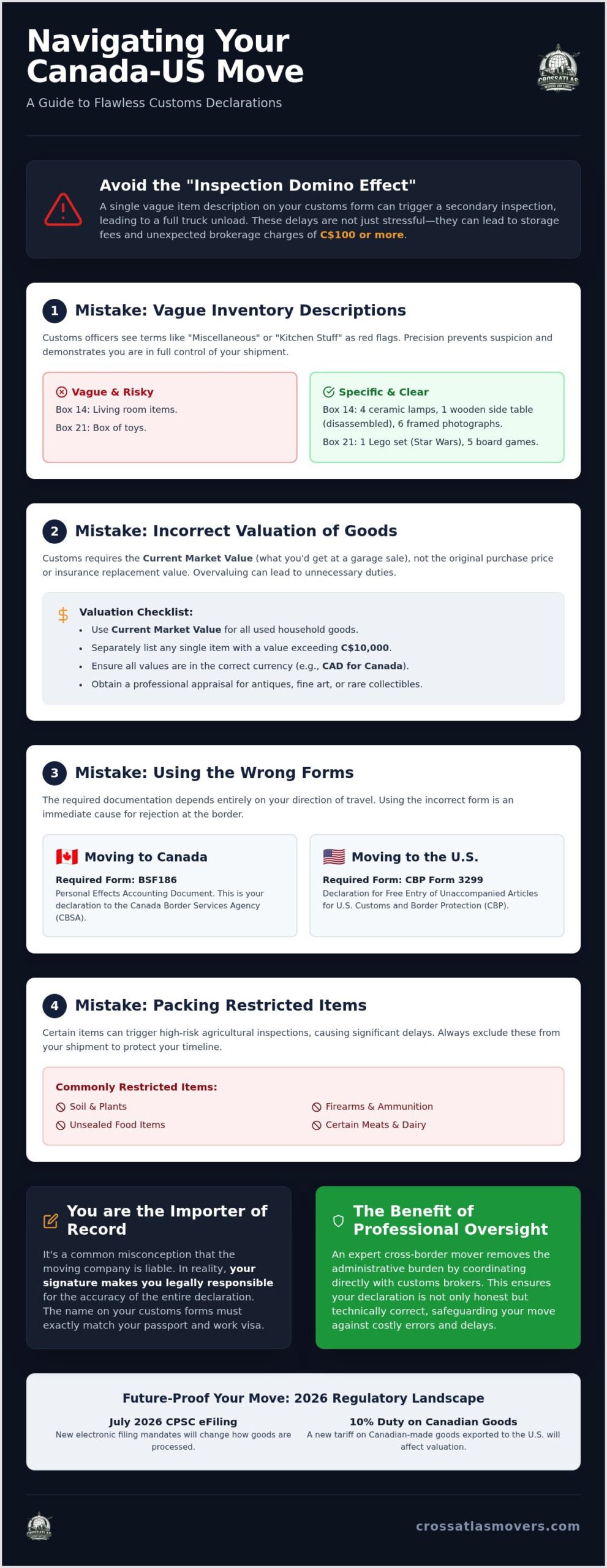
Customs forms are the single most important document in a cross-border move. They serve as the legal bridge between your old life and your new home. Without precise documentation, your shipment is at risk of the “inspection domino effect.” This occurs when a single vague entry triggers a secondary inspection, which often escalates to a full truck unload. These delays are not just stressful; they’re expensive. If a shipment is held, you may face storage-in-transit (SIT) fees while the authorities verify your cargo. The ultimate goal is to achieve “Free Entry,” which is granted when you prove your goods are used personal effects rather than new items meant for resale.
Understanding the rules for entering Canada by land is essential for anyone relocating. Proper preparation ensures that your belongings are treated with the respect they deserve by border officials.
Why “Miscellaneous” is a Red Flag for CBSA and CBP
Customs officers view broad categories like “kitchen stuff” or “box of toys” as a lack of transparency. Vague labels suggest you aren’t fully aware of what you’re transporting, which prompts a closer look. To avoid common mistakes on customs forms for Canada-US moves, you must be specific with every line item.
Consider this comparison for your inventory list:
- Bad: Box 14: Living room items.
- Good: Box 14: 4 ceramic lamps, 1 wooden side table (disassembled), 6 framed photographs.
Numbering your boxes to match the inventory list is a hallmark of a methodical move. It allows an officer to locate a specific item without disturbing the rest of the load. This simple step significantly reduces the chance of a total inspection that could delay your arrival by days.
The Legal Reality of Your Signature on Customs Forms
It’s a common misconception that your moving company is responsible for the accuracy of your declaration. In reality, the owner of the goods is legally liable for every word on the form. You act as the “Importer of Record” for your residential move, meaning the legal weight of the declaration rests on your shoulders.
Precision is mandatory. The name on your customs forms must match your passport and work visa exactly. Any discrepancy in your identity or residency status can lead to the shipment being turned back at the border. By signing these documents, you’re swearing to the accuracy of your inventory. This is why we emphasize the importance of professional oversight to ensure your declaration is both honest and technically correct.
Common Mistakes in Valuation and Itemized Inventories
One of the most persistent common mistakes on customs forms for Canada-US moves involves how you value your life’s possessions. While you might want to protect your items with a high insurance replacement value, customs officials require the “Current Market Value.” This is the price you could reasonably expect to receive if you sold the item today in its current condition. Declaring the original purchase price for a five-year-old television or sofa can lead to unnecessary duties and questions from border agents.
Items with a value exceeding C$10,000 require separate listing. Whether it’s a piece of jewellery or a high-end appliance, failing to highlight these items is a red flag for inspectors. You must also be vigilant about currency consistency. If you are entering Canada, all values should be listed in Canadian Dollars (CAD). Mixing currencies or failing to specify the denomination creates confusion that leads to administrative holds. Adhering to Canada Border Services Agency (CBSA) requirements ensures that your valuation is transparent and compliant from the moment your shipment reaches the primary inspection line.
How to Value Used Household Goods for Customs
The easiest way to approach valuation for standard household items is the “garage sale” method. Ask yourself what a buyer would pay for that specific used item at a local market. This prevents overvaluation, which is a frequent error. This logic does not apply to antiques, fine art, or rare collectibles. For these items, a professional appraisal is often necessary. Having a certified document to support the declared value provides a layer of protection and demonstrates that you have approached the move with methodical precision.
Inventory Organization: The “Box 1 of 50” Rule
A scanable inventory list is your best defence against a full truck unload. Every box should be numbered, such as “Box 1 of 50,” with a corresponding description on your master sheet. This organization allows a customs officer to verify the contents of a single box without needing to disturb the entire load. It’s also vital to keep matching copies of this inventory in the transport truck and in your personal vehicle. If you’re crossing the border ahead of your shipment, you must declare “Goods to Follow” to ensure your items are processed under your personal effects exemption later.
For many families, the task of cataloguing every item is the most stressful part of the journey. Utilizing professional packing services for long distance moving can simplify this process, as expert teams provide the detailed manifests required by border agencies. If you’re feeling overwhelmed by the paperwork, you can request a consultation to learn how we manage these logistics on your behalf.
Form-Specific Pitfalls: BSF186 vs. CBP Form 3299
The direction of your relocation determines which legal framework you must follow. A fundamental error is assuming the same form works for both sides of the border. For those entering Canada, the BSF186, formerly known as the B4, is the mandatory document. Conversely, those moving to the United States must complete the CBP Form 3299. One of the most frequent common mistakes on customs forms for Canada-US moves involves the “unaccompanied articles” section. If your household goods are in a professional moving truck while you cross in a separate vehicle, those items are technically unaccompanied. Failing to mark this correctly leads to a mismatch in documentation that halts your shipment at the border.
Navigating Canada Entry: BSF186 and BSF186A
The BSF186 requires a clear distinction between “Goods Accompanying,” which refers to what is in your personal vehicle, and “Goods to Follow,” which covers what is on the moving truck. A critical mistake is failing to present this form for stamping at the very first point of entry into Canada. If you cross the border and do not get your BSF186 processed by an officer, you lose the ability to claim duty-free entry for the shipment arriving later. For split shipments, where some items arrive months after the initial move, you must use the BSF186A continuation sheet. This ensures every item is accounted for under your original declaration, preventing unexpected taxes on late-arriving furniture or seasonal gear.
Navigating US Entry: CBP Form 3299
When moving south, the CBP Form 3299 is your primary tool for duty-free entry. You must accurately declare whether you are a “Returning Resident” or a “Non-resident.” This distinction is based on your legal status; for example, a Canadian moving on a TN or H1-B visa is typically classified as a non-resident for customs purposes. Leaving the Social Security Number or foreign passport section blank is a guaranteed way to trigger a delay. The “Statement of Importer” section is particularly sensitive. Any inconsistency between your declared residency and your visa type can result in a 48-hour hold while Customs and Border Protection verifies your eligibility. Precision here is the difference between a truck that clears in minutes and one that spends the weekend in a bonded warehouse.
Packing Restricted Items: The Hidden Border Delays
Border delays often stem from items that seem harmless in a domestic context but are strictly regulated internationally. Avoiding common mistakes on customs forms for Canada-US moves often begins with a thorough review of your pantry and garage. The “Pantry Mistake” is a classic example. Packing half-opened bags of flour or unsealed spices might seem practical, but these items can trigger a full agricultural inspection. Such inspections are time-consuming and can lead to your entire shipment being flagged for a secondary search. Similarly, the “Garden Centre Mistake” involves moving live plants or bags of potting soil. Because soil can harbour invasive pests, both the CBSA and CBP have stringent rules that usually result in these items being seized.
Alcohol and tobacco are another area where precision is required. While you can move a personal collection, there are strict duty-free limits that vary by province and state. Exceeding these without proper declaration is a significant error. You should also be aware of the July 2026 CPSC eFiling mandate, which requires electronic filing for certain regulated consumer goods like toys and electronics. Finally, the “Safety Mistake” involves hazardous materials. Items like propane tanks, even if empty, and fire extinguishers are prohibited on moving trucks due to safety regulations. Removing these items before the movers arrive ensures your shipment remains compliant and safe.
Firearms and Weapons: A Zero-Tolerance Zone
The legal gap between Canadian and U.S. firearm laws is vast. You should never include a firearm or any type of weapon in a general household goods shipment. Firearms require specific permits and must often be transported via specialized couriers. A single “forgotten” box of ammunition in a toolbox can lead to criminal charges or permanent seizure of your belongings. We recommend consulting with a specialist if you own regulated items to ensure they are handled through the correct legal channels.
Outdoor Equipment and the “Cleanliness” Standard
Customs officers are vigilant about organic matter. Lawnmowers, garden tools, and bicycles must be scrubbed clean of all soil and grass before they are loaded. If an inspector finds dirt on your equipment, they may order a professional cleaning at your expense, causing significant delays. While your previous experience with interprovincial moving might have been more relaxed, international borders require a higher standard of cleanliness. Motorized vehicles also face scrutiny; they must meet EPA and DOT standards for the U.S. or Transport Canada requirements for entry into Canada.
To avoid these pitfalls and ensure your inventory is fully compliant, contact our cross-border specialists for a comprehensive restricted items list tailored to your specific destination.
How a Cross-Border Moving Company Simplifies the Process
Transitioning from a DIY approach to professional oversight transforms a high-stress relocation into a methodical, managed event. While the paperwork is complex, it is a routine task for experts who navigate these regulations daily. CrossAtlas Movers acts as your primary liaison, coordinating directly with customs brokers to ensure every document is prepared before the truck reaches the border. This proactive management eliminates the guesswork and reduces the likelihood of common mistakes on customs forms for Canada-US moves that often lead to costly delays.
Utilizing a cross country moving checklist specifically designed for international borders provides a clear roadmap for your preparation. This tool ensures that you don’t overlook critical details, such as box numbering or residency declarations, while you focus on the emotional aspects of your transition. We provide the steady, composed voice of an expert who has everything under control, allowing you to breathe easier during this significant life change.
The CrossAtlas Advantage: Flat-Rate and Full-Service
Our flat-rate pricing model provides more than just financial predictability; it offers protection. In an industry where logistical delays can lead to spiralling costs, a fixed rate ensures your budget remains intact even if the border process takes longer than expected. We maintain a dedicated fleet of trucks specifically for cross-border transport, meaning our drivers are intimately familiar with border protocols and port-of-entry requirements. As a family-owned business, we take personal accountability for every shipment. We treat your belongings with the same care we would our own, combining the resources of a large operation with the dedication of a boutique service provider.
Next Steps for Your Canada-US Relocation
Preparation is the key to a seamless move. We recommend starting your itemized inventory at least 30 days before your scheduled loading date. This lead time allows you to identify high-value items that may require professional appraisals or custom crating. It’s also a good time to remember that learning how to move from canada to usa involves more than just filling out forms; it requires a holistic approach to logistics and timing. This includes verifying your residency status and ensuring your personal documentation is in order.
If you’re ready to remove the administrative burden from your relocation, we are here to help. Our team provides the “capable protector” role you need to ensure your life’s possessions cross the border safely and on schedule. Request a free, no-obligation cross-border moving quote today and take the first step toward a confident, stress-free move.
Securing Your Cross-Border Transition
Precision in your documentation is the most effective way to eliminate border stress. By providing specific itemized inventories and selecting the correct forms for your direction of travel, you protect your shipment from unnecessary inspections and secondary holds. Identifying common mistakes on customs forms for Canada-US moves allows you to focus on the excitement of your new home rather than the complexities of administrative protocols. Accurate valuation and the exclusion of restricted items ensure your belongings move through checkpoints with quiet efficiency.
As a family-owned and operated specialist, we take pride in managing these logistical burdens for you. Our dedicated fleet of trucks and guaranteed delivery dates provide the certainty you need during a high-stakes relocation. We invite you to Request a Free Cross-Border Moving Quote to see how our methodical expertise can simplify your journey. Your move represents a significant fresh start, and with the right preparation, your life’s possessions will arrive safely and on schedule. We are ready to act as your capable protector throughout this transition.
Frequently Asked Questions
Do I need to be present at the border when my moving truck crosses?
You don’t always need to be at the physical border when the truck crosses, but you must have already cleared your own entry. For Canada-bound moves, you must meet with a CBSA officer in person to present your BSF186 documentation. For US-bound moves, your signed Form 3299 typically allows the driver to clear the goods on your behalf without you being present at the port.
What happens if I forget to list an item on my BSF186 “Goods to Follow” list?
Items omitted from your BSF186 list will likely attract duties and taxes upon arrival. The CBSA strictly enforces the requirement that all “Goods to Follow” must be declared during your initial entry. If you forget an item, you lose the tax-exempt status for that specific piece of furniture or equipment, as it wasn’t part of your original personal effects accounting.
Can I move my wine collection from Canada to the US without paying duty?
You can move a wine collection, but it’s rarely duty-free beyond the first litre. Both federal and state taxes apply to larger quantities. It’s essential to provide a detailed manifest of the vintage, type, and value to avoid the truck being held. Failing to declare alcohol is one of the common mistakes on customs forms for Canada-US moves that leads to seizures.
Is there a limit to the value of household goods I can bring duty-free?
There is no total value limit for duty-free entry of used household goods, provided you’ve owned them for the required period. However, you must specifically list any single item valued over C$10,000. Failing to highlight these high-value items is a significant oversight that can lead to penalties or secondary inspections while the authorities verify the authenticity and age of the goods.
How do I handle the customs forms for my car when moving cross-border?
Vehicles are processed separately from household goods and require their own specific documentation. You must provide the original title and proof of compliance with safety and emission standards. For entry into Canada, you’ll work through the Registrar of Imported Vehicles (RIV) program. This involves specific fees and inspections that are not covered by your standard residential moving inventory list.
What is the most common reason for a moving truck to be searched at the border?
Vague inventory descriptions are the primary trigger for a search. Using terms like “kitchen items” instead of listing specific appliances is one of the most frequent common mistakes on customs forms for Canada-US moves. Precision in your manifest is the best way to prevent a full truck unload, as it allows officers to verify contents without disturbing the entire shipment.
How far in advance should I complete Form 3299 for a US move?
You should complete CBP Form 3299 at least 30 days before your move. This allows your moving coordinator to review the data for accuracy and ensure it matches your passport details. The mover requires the signed original to accompany the shipment. Don’t leave this until the day the truck arrives, as any errors could delay the departure of your goods.
Do I need a customs broker for a residential household move?
You aren’t legally required to hire a customs broker for personal household goods, but it’s highly recommended for a smooth transition. A broker or an expert moving company manages the technical filings and acts as a liaison with border agencies. This professional oversight ensures you stay compliant with the latest 2026 regulations and avoids the administrative burden of managing the hand-off yourself.